
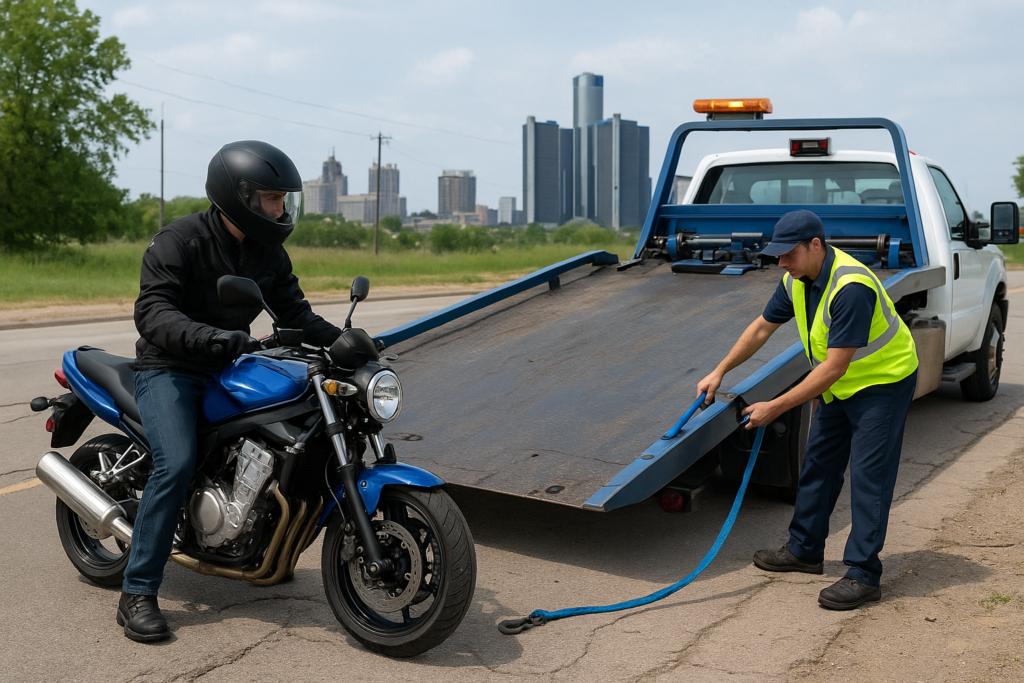
Your bike dies on I-94 near the Ambassador Bridge and suddenly you’re standing next to a machine that’s too heavy to push and too specialized for a regular flatbed driver to handle right. That’s the moment most riders realize they never actually checked what their motorcycle breakdown assistance covers. Some plans handle a dead battery in your driveway but leave you stranded if the transmission locks up on Woodward Avenue during rush hour.
This article breaks down what real coverage looks like: towing distance limits, whether trailer-style equipment is required for your bike, and what a fair price actually runs in the Detroit area versus what national plans quote before hidden fees kick in. We’ll also cover flatbed towing specifics, since dragging a motorcycle on a hook chain can wreck your fairings and exhaust in seconds.
We’ve hauled bikes off Jefferson Avenue after summer thunderstorms and pulled riders out of gravel shoulders on Telegraph Road, so we know what breaks and where. Skyline Towing runs 24/7 out of 6450 E Hancock St in Detroit, and this guide walks through exactly what to expect when your motorcycle quits on you somewhere between Dearborn and Southfield.
Why motorcycle breakdown assistance matters in Detroit
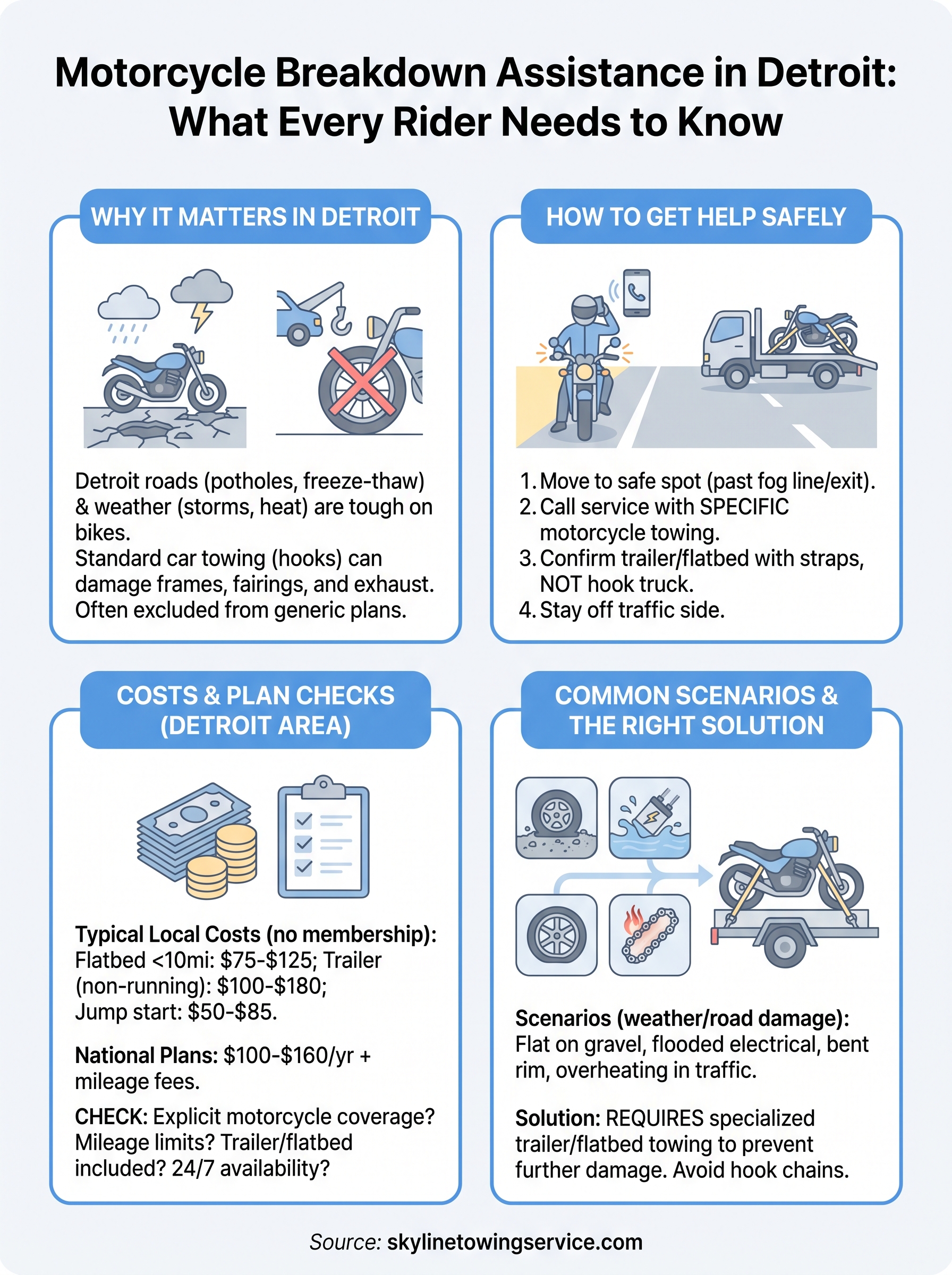
Riding season in Metro Detroit runs roughly April through October, and that stretch brings potholes deep enough to bend a rim on I-75, sudden downpours that soak electrical connections, and pavement that hits 110 degrees and softens tire compounds by August. Motorcycle-specific breakdown coverage exists because bikes fail differently than cars, and a plan built for sedans often can’t handle what happens when a motorcycle goes down on Gratiot or stalls out crossing the Belle Isle bridge.
Detroit’s roads and weather work against motorcycles
Freeze-thaw cycles chew up asphalt every winter, and by spring, riders hit cracks and heaved pavement that a car barely notices but that can snap a motorcycle’s suspension or knock a chain loose. Add lake-effect storms rolling off Lake St. Clair and flash flooding along Jefferson Avenue, and you’ve got conditions that strand riders fast, sometimes with electrical systems shorted out from water intrusion. A dead bike on a wet shoulder during rush hour on the Lodge Freeway isn’t just inconvenient, it’s dangerous, and standard car insurance roadside plans frequently exclude two-wheeled vehicles entirely.
A car breakdown plan that doesn’t mention motorcycles by name almost certainly won’t tow one.
Regular car towing doesn’t cut it for bikes
Most generic roadside plans assume a flatbed or hook setup designed for four wheels, and drivers without motorcycle experience can damage forks, fairings, or exhaust pipes trying to load a bike the wrong way. Roadside assistance for motorcycles needs a driver who knows how to strap down a bike properly, use wheel chocks, and load it without scraping the pipes on the ramp edge. That’s a different skill set than backing a sedan onto a hook chain.
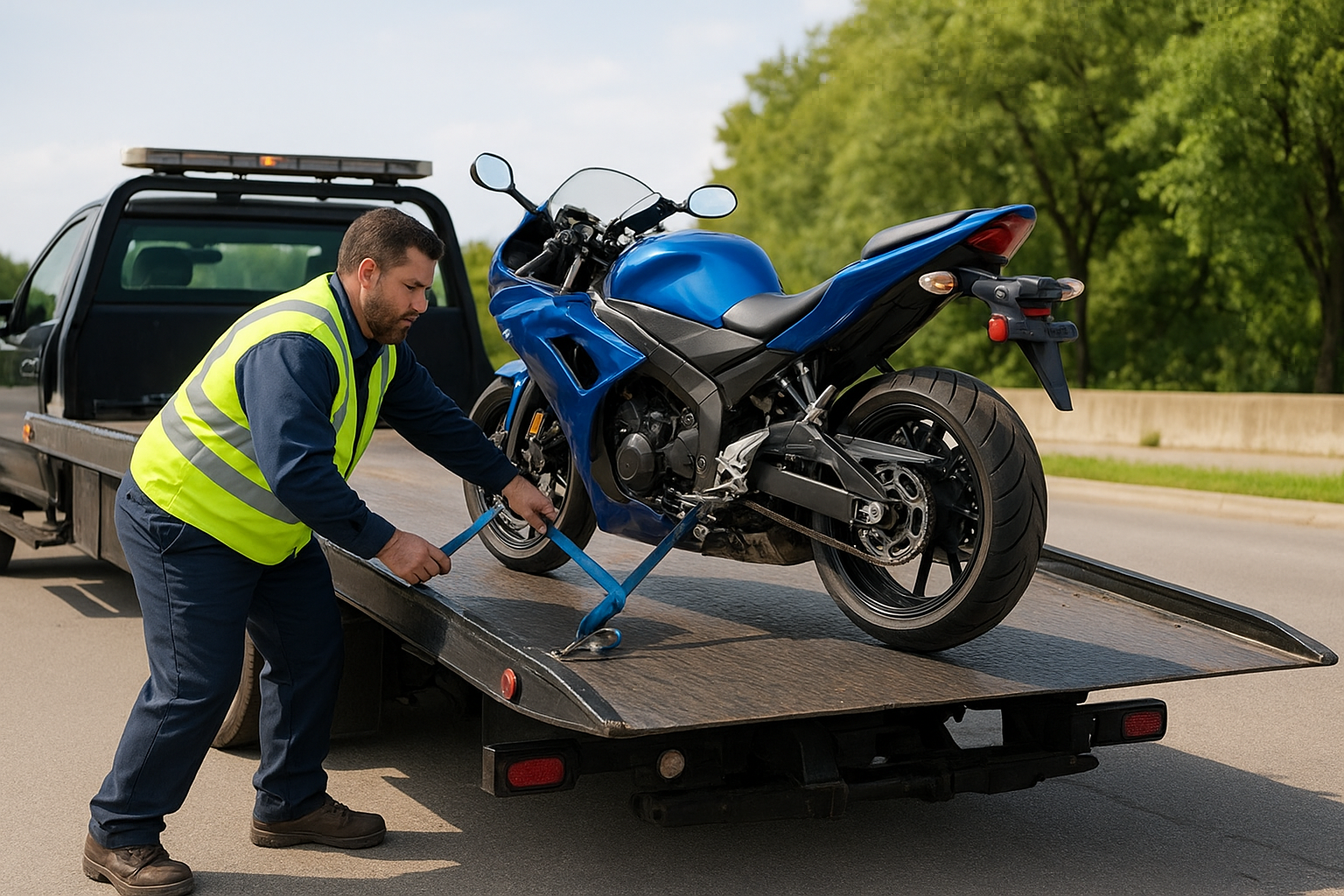
Here’s what typically goes wrong without motorcycle-trained towing:
- Standard tow hooks damage frame components not built for that stress
- Drivers unfamiliar with kickstand angles let bikes tip during loading
- Improper strapping cracks fairings or bends handlebars
- Long tow distances without a trailer risk further mechanical damage
Getting this wrong costs more than the tow itself. It can mean a bent frame, a cracked fairing, or a bike that needs a shop visit it wouldn’t have otherwise required.
How to get help when your motorcycle breaks down
Call for help the moment you know the bike isn’t moving under its own power, don’t wait to see if it "fixes itself" on the shoulder of I-96. Pull as far off the roadway as possible, kill the engine, and put your kickstand on solid ground, not soft gravel that’ll let the bike tip while you wait.
Give the dispatcher specifics that matter for motorcycle towing: your mile marker or nearest exit, the make and model, and whether the bike still rolls or is locked up. This changes what equipment shows up. A seized engine needs a trailer, not a quick hook-and-go.
Telling dispatch it’s a motorcycle, not just a "vehicle," is what gets the right truck sent the first time.
Here’s the sequence that actually works:
- Move to a safe spot, ideally past the fog line or onto an exit ramp
- Turn on hazards and, if you have one, set a reflective triangle behind the bike
- Call a towing company that lists motorcycle towing specifically, not just "all vehicles"
- Confirm they’re sending a trailer or flatbed with tie-down straps, not a hook truck
- Stay visible and off the traffic side while you wait
Detroit traffic on stretches like the Southfield Freeway moves fast even during a breakdown, so standing near the guardrail beats standing near your bike every time.
What coverage costs and what to look for in a plan
Pricing for motorcycle roadside assistance varies more than most riders expect, and the cheapest plan on paper often excludes the exact situation you’ll actually face. National memberships advertise low annual fees, then charge mileage overages once you’re past a set radius, which matters a lot if you break down out past Livonia or Taylor, far from a home base.
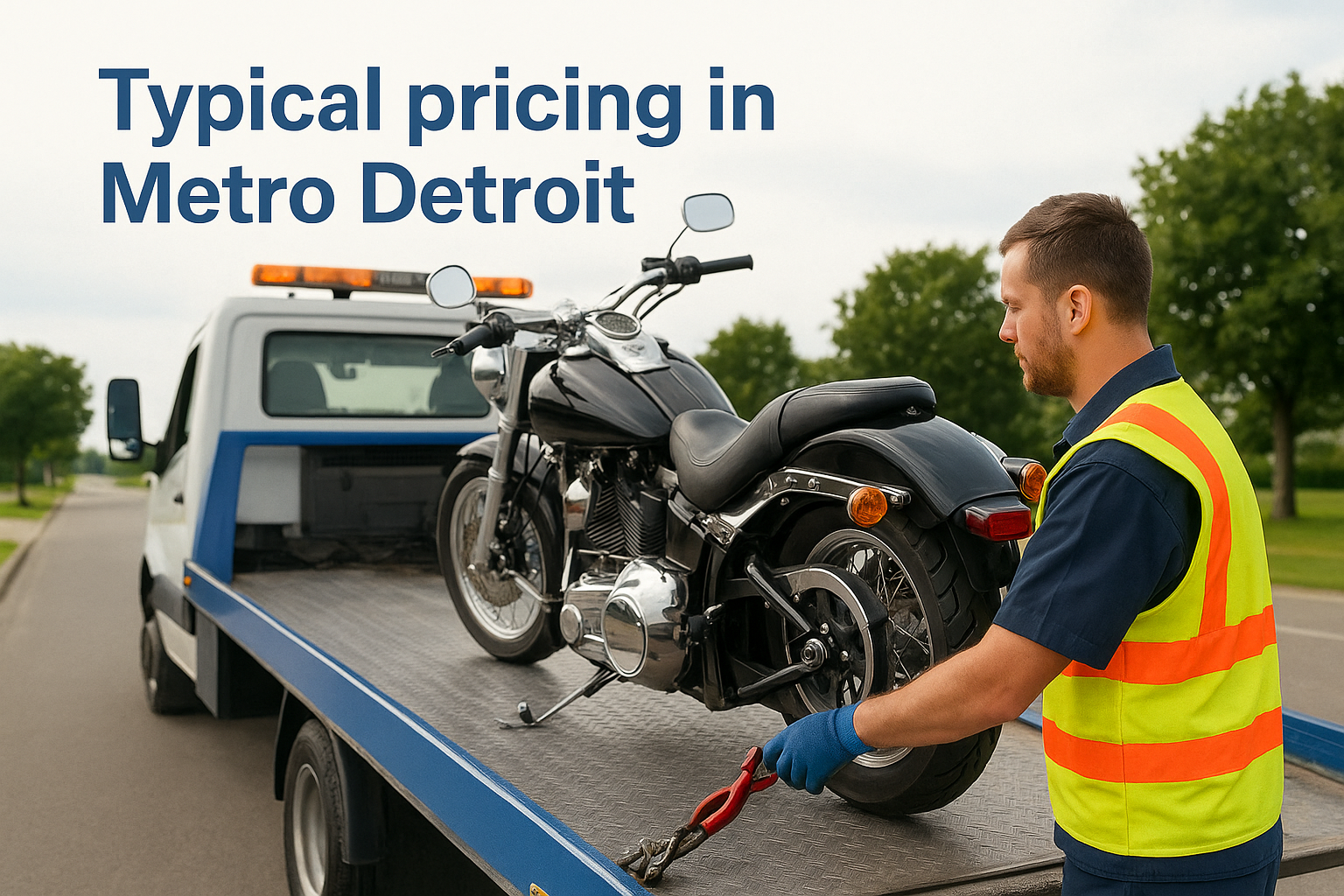
Typical pricing in Metro Detroit
Local, on-demand towing tends to run in predictable ranges without membership fees stacking on top.
| Service type | Typical Detroit-area cost |
|---|---|
| Local flatbed tow (under 10 miles) | $75-$125 |
| Trailer tow for non-running bike | $100-$180 |
| Jump start or battery service | $50-$85 |
| Annual membership plans (national) | $100-$160/year plus mileage fees |
The real cost of a plan shows up in the fine print about mileage caps, not the sticker price.
What to check before you sign up
Questions matter more than the price tag when you’re comparing motorcycle breakdown coverage options. Before committing, confirm these points:
- Does the plan explicitly cover motorcycles, not just "vehicles"?
- Is there a mileage limit before extra charges apply?
- Does it include trailer or flatbed transport, not hook towing?
- Are lockouts, flat tires, and jump starts included or extra?
- Is coverage 24/7, including winter riding season?
Skipping this check is how riders end up paying twice, once for the membership and again for the tow it didn’t actually cover.
Common Detroit breakdown scenarios and how assistance helps
Every rider we’ve pulled off a Detroit road has a story that sounds a little different but ends the same way: stuck, exposed, and needing a truck that actually knows motorcycles. Knowing the common patterns helps you recognize trouble before it strands you somewhere worse.
The scenarios we see most
Gravel shoulders on Telegraph Road catch riders off guard when a tire blows at speed, and without a mobile tire change, that bike isn’t moving until a trailer shows up. Summer storms along Jefferson Avenue flood electrical connections and kill ignitions cold, which means no amount of kickstarting gets you home. Potholes on I-75 near downtown bend rims hard enough that the bike can’t be ridden even a mile further. Heat waves in August soften chains and belts on older bikes, and Woodward Avenue traffic doesn’t leave room to nurse a limping motorcycle to a shop.
Most motorcycle breakdowns in Detroit trace back to weather, road damage, or heat, not mechanical age.
- Flat tire on a gravel shoulder, needs trailer transport
- Flooded electrical system after a downpour, needs diagnostic-aware towing
- Bent rim from a pothole strike, needs flatbed with proper straps
- Overheated chain or belt in stop-and-go traffic, needs safe recovery off the road
Each of these needs a different response, and generic roadside dispatch often can’t tell the difference until a truck that can’t help shows up. Motorcycle-trained dispatch matters as much as the truck itself.
Staying ready for the next ride
Good motorcycle breakdown assistance isn’t something you shop for after you’re already stranded on the shoulder of I-94. It’s something you confirm before riding season starts, when you’ve still got time to check mileage caps, ask about trailer equipment, and make sure whoever answers the phone knows a bike isn’t just "a vehicle." Detroit’s roads and weather don’t give riders much slack, and the difference between a quick recovery and a wrecked fairing usually comes down to who shows up with the truck.
Keep a real plan in your saddlebag: know who you’re calling, know what they cover, and know they’ve got the right equipment for a bike, not just a hook chain built for sedans. Skyline Towing runs 24/7 out of 6450 E Hancock St in Detroit, and we’ve hauled bikes off every stretch mentioned in this guide. If you want motorcycle towing you can count on before your next ride, save our number now, not after you’re stuck.