
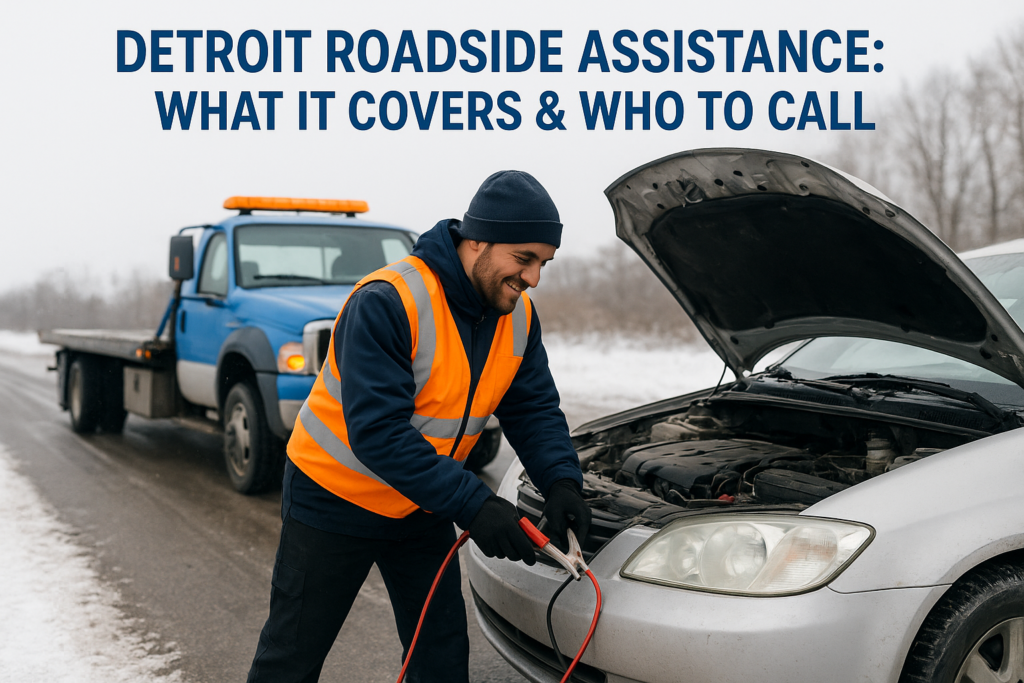
Your battery dies in a Meijer parking lot on Livernois, or you lock your keys in the car outside a shift at the Ford Rouge plant. Either way, you need detroit roadside assistance that shows up fast, not a call center that puts you on hold for twenty minutes while you’re standing on the shoulder of I-94 with semis roaring past. Detroit winters and pothole season put a lot of cars in trouble, and knowing what actually falls under roadside assistance saves you from guessing when you’re already stressed.
Roadside assistance covers more than a lot of people realize: jump starts, flat tire changes, lockouts, fuel delivery when you run dry on the Lodge, and winch outs when you’ve slid into a snowbank near Southfield. It’s different from a full tow, though sometimes one call turns into both. This article breaks down exactly what’s included, what’s not, and how to tell when you need a quick roadside fix versus a flatbed to the shop.
We’re Skyline Towing, based at 6450 E Hancock St in Detroit, and we’ve pulled cars out of snowbanks from Dearborn to Taylor for years. Below, we’ll walk through every service, typical response times, and who to call in metro Detroit when you need help right now.
Why reliable roadside assistance matters in Detroit
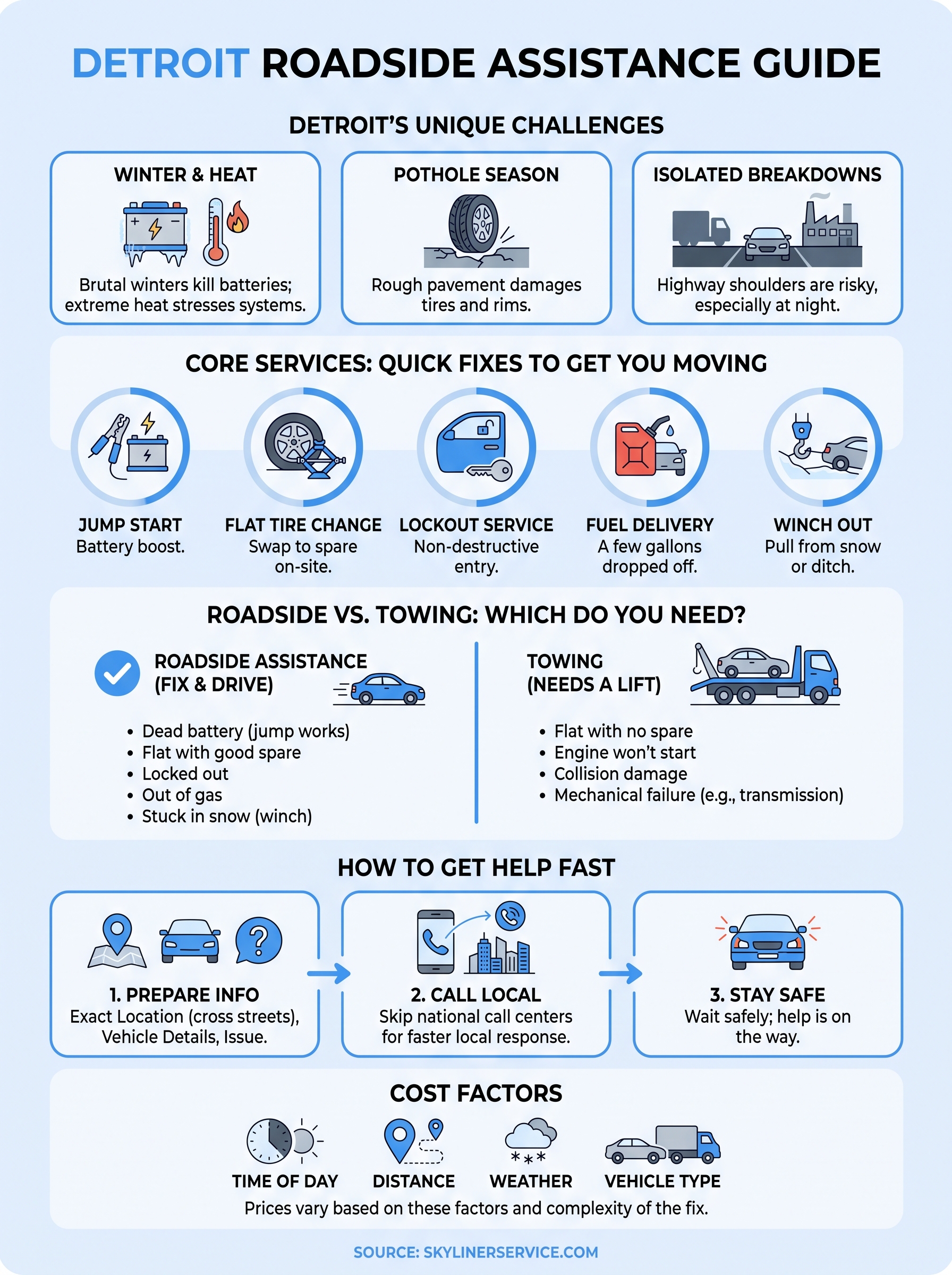
Breaking down in Detroit isn’t the same as breaking down in a mild climate with light traffic. Between brutal winters, aggressive summer heat, and some of the worst pavement in the country, your car takes a beating here that vehicles in other cities never see. Detroit roadside assistance isn’t a luxury add-on, it’s the difference between a fifteen minute delay and a genuinely dangerous situation. When you understand why breakdowns happen so often around here, and why response time matters so much, you start treating a roadside plan like the safety net it actually is.
Detroit’s weather turns small problems into big ones
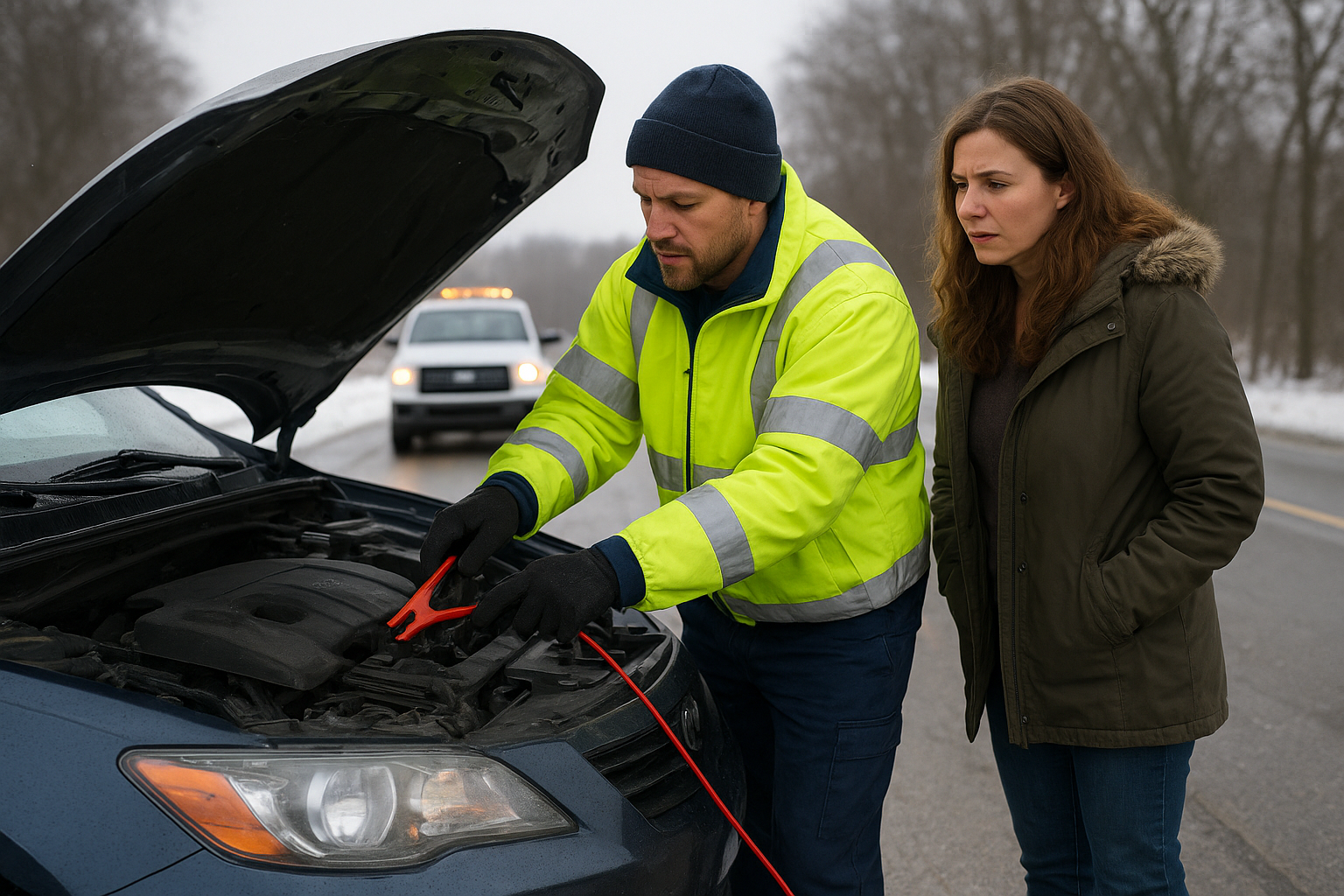
Winter is brutal on batteries, and Detroit winters are longer and colder than most people plan for. A battery that’s been quietly weakening all fall will often die the first morning temperatures drop into single digits, usually right when you’re already running late for a shift or a school drop-off. Summer creates its own version of the same problem: extreme heat stresses alternators, cooks weak belts, and causes tires with low tread to blow out on hot asphalt along stretches of I-75 near Downtown. The National Weather Service tracks how quickly Michigan temperatures can swing from one extreme to another, and that swing is exactly what wears down car batteries and rubber components faster than manufacturers expect (https://www.weather.gov/dtx/).
| Season | Common Cause of Breakdown | Typical Roadside Fix |
|---|---|---|
| Winter | Dead battery from cold | Jump start or battery replacement |
| Winter | Sliding into snowbanks or ditches | Winch out |
| Spring | Pothole damage to tires/rims | Tire change or tow |
| Summer | Overheating engines | Fluid check, tow if needed |
| Summer | Tire blowouts on hot pavement | On-site tire change |
A dead battery on a ten degree morning isn’t an inconvenience, it’s a safety issue if you’re stuck without heat.
Rough roads and potholes take a toll on your car
Metro Detroit’s freeways and side streets go through a punishing freeze-thaw cycle every year, and that cycle is what creates the potholes drivers dodge on the Lodge, the Southfield Freeway, and Gratiot Avenue every spring. Hitting one wrong can bend a rim, blow a tire, or knock your alignment out badly enough that you can’t safely drive another mile. Side streets in neighborhoods like Southwest Detroit or parts of Highland Park often go years between repaving, so cracked pavement and sunken manhole covers add to the wear your suspension and tires take on daily. None of this shows up as a sudden crisis, it builds quietly until the day your tire finally gives out on the shoulder during rush hour.
Being stranded isn’t just inconvenient, it’s risky
Standing on the shoulder of I-94 near the Ambassador Bridge with semis passing at seventy miles an hour is genuinely dangerous, and it only gets worse after dark or during a snowstorm. Isolated stretches of highway and industrial corridors around the Ford Rouge complex or the riverfront don’t get much foot traffic, so a breakdown there can leave you waiting a long time for a passerby to stop, if anyone does. Fast response matters just as much for personal safety as it does for convenience, especially for parents with kids in the car or anyone driving alone at night. That’s why a service that actually answers the phone and dispatches a truck quickly, rather than routing you through a national call center, makes a real difference when you’re standing on the roadside wondering how long you’ll be out there.
How to get roadside assistance fast in Detroit
Getting help quickly starts with who you call, not just how fast a truck can drive. Detroit roadside assistance works best when you skip the national hotline and dial a local dispatcher who already knows the difference between the Southfield Freeway and Southfield the city. National providers often route your call through a queue, then subcontract the job to whichever local company happens to be available, which adds delay right when every minute matters. Calling a Detroit-based company directly, like Skyline Towing at 6450 E Hancock St, means you’re talking to someone who can put a truck in motion immediately instead of waiting for a third party to accept the ticket.
The fastest roadside help usually comes from the company you can call directly, not the one buried behind a call center.
Have your information ready before you dial
Gathering a few details before you pick up the phone shaves real minutes off your wait. Dispatchers move faster when you can answer questions immediately instead of scrambling for information while you’re already stressed. Have this ready:
- Your exact location (cross streets, exit number, or a nearby landmark)
- Your vehicle’s make, model, and color
- What happened (dead battery, flat, lockout, stuck in snow)
- Whether anyone in the vehicle needs immediate medical attention
- A callback number in case the line drops
Having this list ready means the truck gets pointed in the right direction before you’ve even finished describing the problem.
Pin down your location precisely
Landmarks matter more than street addresses on Detroit freeways, since GPS pins can be off by a block or more in areas with dense industrial property or overpasses. If you’re stuck on I-75 near the Ambassador Bridge, mention the nearest exit number and which direction you were heading. If you’re in a neighborhood like Southwest Detroit or Highland Park, cross streets work better than a vague description of
What a Detroit roadside assistance call actually covers
When you call for detroit roadside assistance, you’re not just requesting a tow. Most calls get resolved right where your car sits, without ever needing a flatbed. Understanding the full scope of services helps you know what to expect, what’s reasonable to ask for, and when a dispatcher might tell you the job actually needs a tow truck instead.
The core services included in a standard call
Basic roadside assistance covers a set of common fixes that get you moving again without leaving the spot where you broke down. Here’s what falls under a typical call in metro Detroit:
| Service | What Happens |
|---|---|
| Jump start | Technician arrives and charges your battery enough to start the car |
| Flat tire change | Spare gets installed on-site if one’s available |
| Lockout | Technician opens the vehicle without damaging the lock or door |
| Fuel delivery | A few gallons dropped off when you’ve run dry |
| Winch out | Vehicle pulled from a ditch, snowbank, or soft shoulder |
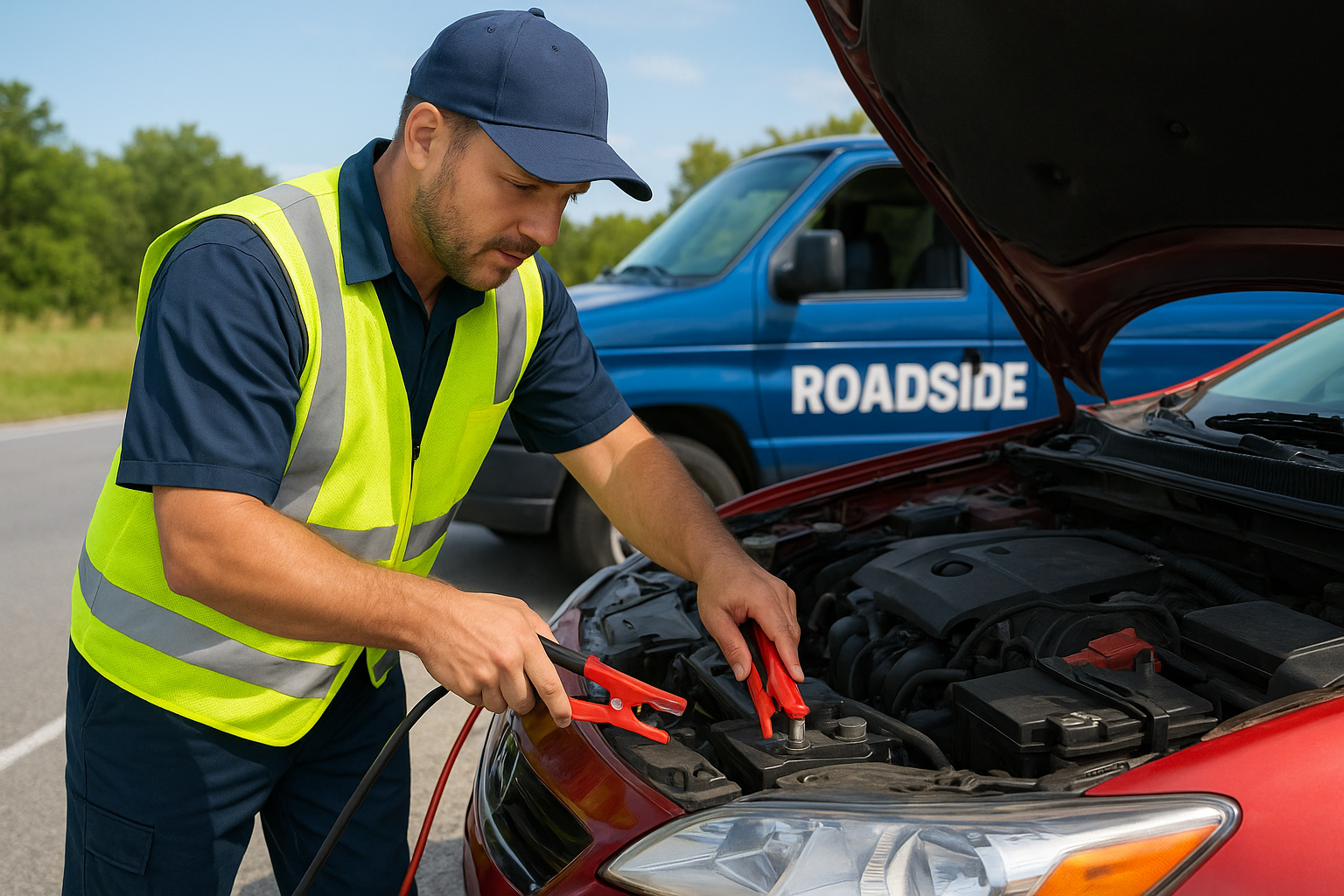
Each of these is a field repair, meaning the technician handles it right there on Gratiot, the Lodge, or wherever you’re parked, and you drive away under your own power.
When one call turns into two services
Sometimes a single breakdown needs more than one fix. A dead battery might get jumped, but if it won’t hold a charge, you’ll need a shop visit anyway, so the same call can lead to both a jump and a tow. A flat tire without a usable spare, which happens more often than you’d think with older vehicles that only carry a compact donut, means the technician calls in a flatbed instead of trying to force a fix that won’t hold on the freeway.
A roadside call isn’t just one fixed service, it’s whatever gets your car safely moving again, even if that means combining two.
What’s typically not included
Roadside assistance isn’t a repair shop on wheels. Mechanical diagnostics, like figuring out why your check engine light came on, aren’t part of a standard call, and neither is replacing parts beyond a battery jump or a spare tire swap. Extensive fixes such as alternator replacement, brake work, or transmission trouble require an actual shop, so the roadside technician’s job is to stabilize the situation and get you there safely.
Dealership transport, salvage auction pickups, and heavy duty towing for larger vehicles usually fall outside a basic roadside plan too, even though companies like ours handle those as separate services. Knowing this ahead of time keeps expectations realistic: a roadside call solves the immediate problem, not every mechanical issue your car might be dealing with that day.
Common roadside emergencies across metro Detroit
Every neighborhood in metro Detroit has its own version of the same problem: cars break down where drivers least expect it. Common emergencies repeat themselves so consistently that our dispatchers can often guess what’s wrong before the caller finishes the first sentence. Knowing the usual suspects helps you recognize trouble early, sometimes before you’re stuck on the shoulder waiting for help.
Dead batteries in parking lots and driveways
Nothing shows up more often than a dead battery, especially between November and March. Cold mornings in Detroit routinely drop below freezing, and a battery that’s been struggling for weeks will finally give out the moment you turn the key outside a Meijer on Livernois or a driveway in Redford. A jump start solves most of these calls in under fifteen minutes.
Flat tires from Detroit’s potholes
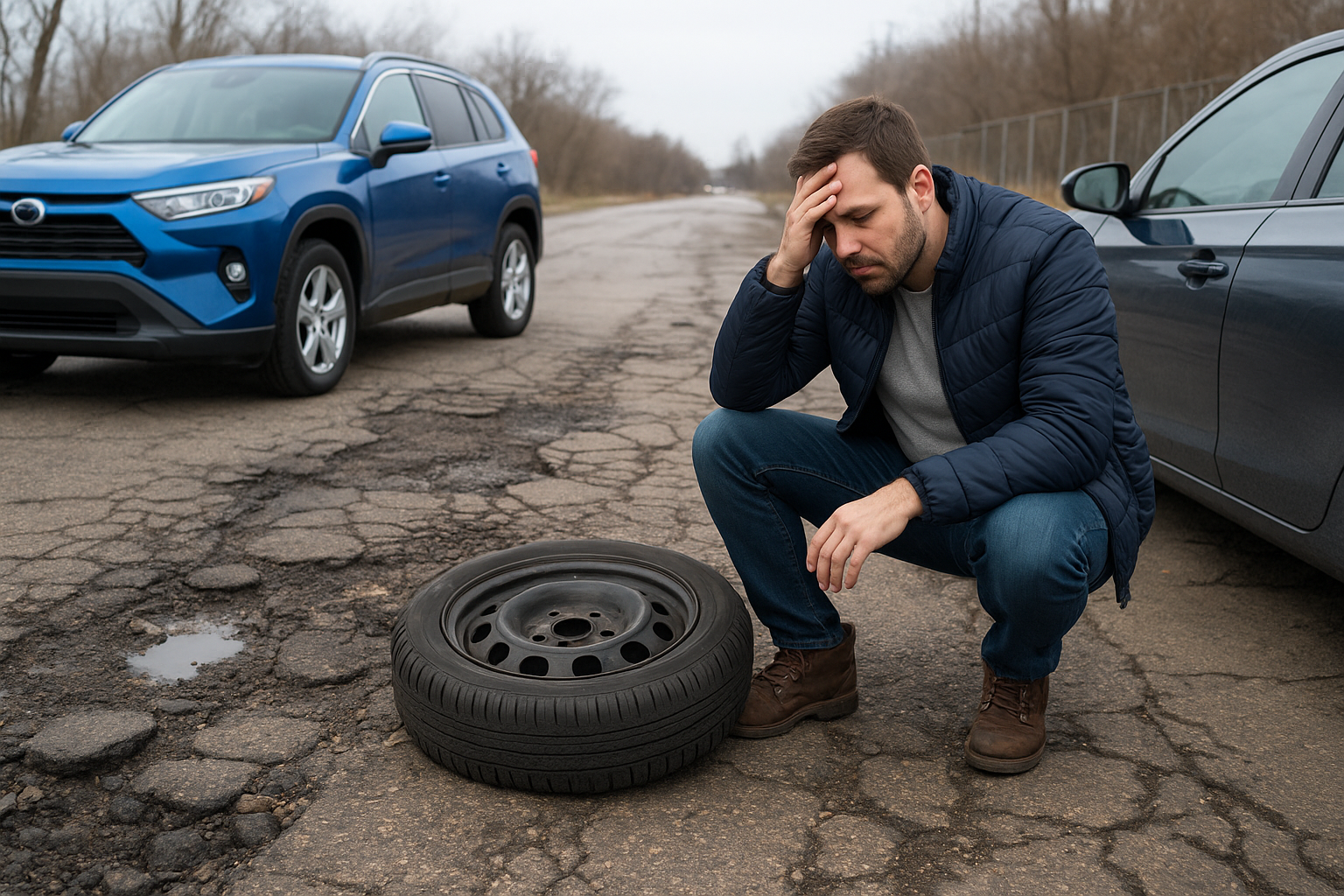
Potholes on the Lodge, the Southfield Freeway, and Gratiot Avenue chew through tires every spring as the freeze-thaw cycle breaks up the asphalt. Sudden blowouts happen fast, often at highway speed, leaving drivers stranded on a narrow shoulder with traffic roaring past. Rim damage is common too, which sometimes turns a simple tire change into a call for a flatbed instead.
Lockouts outside work and events
Lockouts happen constantly outside places like the Ford Rouge plant, Ford Field after a game, or a grocery store on a rushed afternoon. Keys locked inside the car is one of the most common calls we get, and it’s rarely about carelessness so much as distraction during a busy day. A trained technician gets the door open without damaging the lock or the weatherstripping.
| Emergency Type | Where It Happens Most | Typical Response |
|---|---|---|
| Dead battery | Parking lots, driveways | Jump start |
| Flat tire | I-75, the Lodge, Gratiot Ave | On-site change or tow |
| Lockout | Workplaces, event venues | Non-destructive entry |
| Stuck in snow | Southfield, side streets | Winch out |
| Collision | I-94, Ambassador Bridge corridor | Accident recovery |
Getting stuck in snow or a ditch
Winter storms push plenty of drivers off the road entirely, sliding into a snowbank near Southfield or sinking into a soft shoulder after a slushy commute. Winch outs require the right equipment and enough know-how to avoid damaging the frame or undercarriage while pulling a vehicle free.
The most dangerous emergencies aren’t always the loudest ones, a quiet dead battery at night can be just as risky as a collision.
Accidents needing recovery
Collisions along I-94 or near the Ambassador Bridge corridor call for accident recovery rather than standard roadside help. Vehicle recovery after a crash involves clearing the scene safely, often working alongside police, which is a different job entirely from a jump start or a tire change.
What roadside assistance costs in Detroit
Price is usually the first question people ask, and the honest answer is that detroit roadside assistance costs vary based on what you need and where you’re stuck. A jump start in your own driveway costs less than a winch out from a snowbank on I-696 at 2 a.m., simply because of the equipment and time involved. Straightforward calls near your home base tend to run cheaper than one from a remote industrial stretch near the Rouge complex, where a truck has farther to travel and less room to work safely.
Typical price ranges for common services
Rates shift depending on distance, time of day, and how complicated the fix turns out to be once a technician actually looks at the car. Here’s a general breakdown of what Detroit drivers usually pay:
| Service | Typical Cost Range |
|---|---|
| Jump start | $50 – $90 |
| Lockout | $60 – $100 |
| Flat tire change | $60 – $100 |
| Fuel delivery | $50 – $80 plus fuel cost |
| Winch out | $100 – $200+ |
| Local tow (under 10 miles) | $75 – $150 |
These numbers move around depending on the company, the neighborhood, and whether it’s a Tuesday afternoon or a Saturday night during a snowstorm.
What actually drives the price up or down
Several factors push a bill higher or keep it low, and knowing them ahead of time helps you avoid surprises when the invoice shows up. Consider these before you assume a quote is out of line:
- Time of day: late night and holiday calls often carry a higher rate
- Distance: a call from Downtown costs less to service than one from a rural stretch near the county line
- Weather: ice storms and heavy snow increase demand, which can raise wait times and pricing
- Vehicle type: heavy duty trucks and vans typically cost more than a standard sedan
- Complexity: a straightforward jump start costs less than a winch out that needs extra equipment
Ask for a price range before the truck rolls, a reputable company will give you a straight answer, not a vague estimate that changes on arrival.
Membership plans versus pay-per-call
Membership plans through your insurance or a national provider can make sense if you break down often, but the flat annual fee doesn’t always beat a single pay-per-call rate for someone who rarely needs help. Paying per call gives you flexibility and control over which company shows up, rather than waiting on a subcontractor assigned by a call center. Skyline Towing quotes real, upfront pricing before dispatching a truck, so you know the cost before you commit, whether you’re calling from a driveway in Livonia or a shoulder on the Southfield Freeway.
Roadside assistance vs. towing: which do you need
Figuring out which service to ask for saves you time on the phone and gets the right truck moving toward you. Detroit roadside assistance handles quick fixes that let you drive away under your own power, while towing means your car can’t safely move at all and needs a flatbed to a shop, home, or impound lot. Most drivers don’t know the difference until they’re standing outside a stalled car trying to describe the problem, so knowing the line between the two ahead of time makes that call a lot faster.
When roadside assistance solves the problem
Grab roadside help when your car has a fixable issue that gets you back on the road immediately. A dead battery that takes a jump, a flat with a good spare, a lockout, or running out of gas near the Southfield Freeway all fall into this category. Quick fixes like these rarely require more than fifteen or twenty minutes on scene, and you drive off the same way you arrived, just running again.
When you actually need a tow
Towing becomes the answer once your car physically can’t be driven safely, no matter how good the technician is. A blown transmission, a wreck that’s crumpled the frame, or an engine that won’t turn over at all means a flatbed is the only real option. Accident recovery calls almost always end in a tow, since a damaged vehicle from a collision on I-94 or near the Ambassador Bridge corridor usually isn’t drivable even after the immediate danger is cleared.
If your car can limp to a shop under its own power, it’s roadside assistance. If it can’t move safely at all, it’s a tow.
Quick reference for common scenarios
Use this as a rough guide next time you’re deciding which to request:
| Situation | Roadside Assistance | Towing |
|---|---|---|
| Dead battery, jump works | Yes | No |
| Flat tire, spare available | Yes | No |
| Flat tire, no usable spare | No | Yes |
| Locked out of the car | Yes | No |
| Ran out of gas | Yes | No |
| Stuck in a snowbank | Yes (winch) | Sometimes |
| Collision or crash damage | No | Yes |
| Engine won’t start at all | No | Yes |
When you’re not sure, let the dispatcher decide
Sometimes you genuinely can’t tell which one you need, and that’s fine. Trained dispatchers ask the right questions over the phone, like whether the car started before it died or whether you heard grinding before it stopped moving, and they’ll send the right equipment based on your answers. Yelling out every symptom you noticed helps more than trying to diagnose it yourself, since a dispatcher who’s fielded thousands of these calls can usually narrow it down faster than you’d expect.
Staying safe on Detroit’s roads
Breakdowns happen to everyone eventually, whether it’s a dead battery on a January morning or a flat tire from a pothole on the Lodge. Knowing the difference between a quick roadside fix and a full tow means you’ll spend less time confused on the phone and more time actually getting help. Keep your location details, vehicle info, and a callback number ready before you dial, and you’ll cut your wait time down considerably.
Detroit’s weather and roads aren’t forgiving, but a fast local response turns a dangerous situation into a minor delay. That’s the whole point of having a company you trust on speed dial instead of gambling on a national call center. When you’re stuck on I-94 with your hazards on, you want someone who already knows the area, not a dispatcher three states away. Save the number now and call Skyline Towing before you actually need it.