
Your car battery doesn’t send a warning text before it dies. One morning it cranks fine on Livernois, the next morning it’s dead in the lot at Eastern Market. If you’re wondering how long a battery should actually last, car battery life expectancy is shorter than most drivers assume, and Detroit’s climate makes it even shorter.
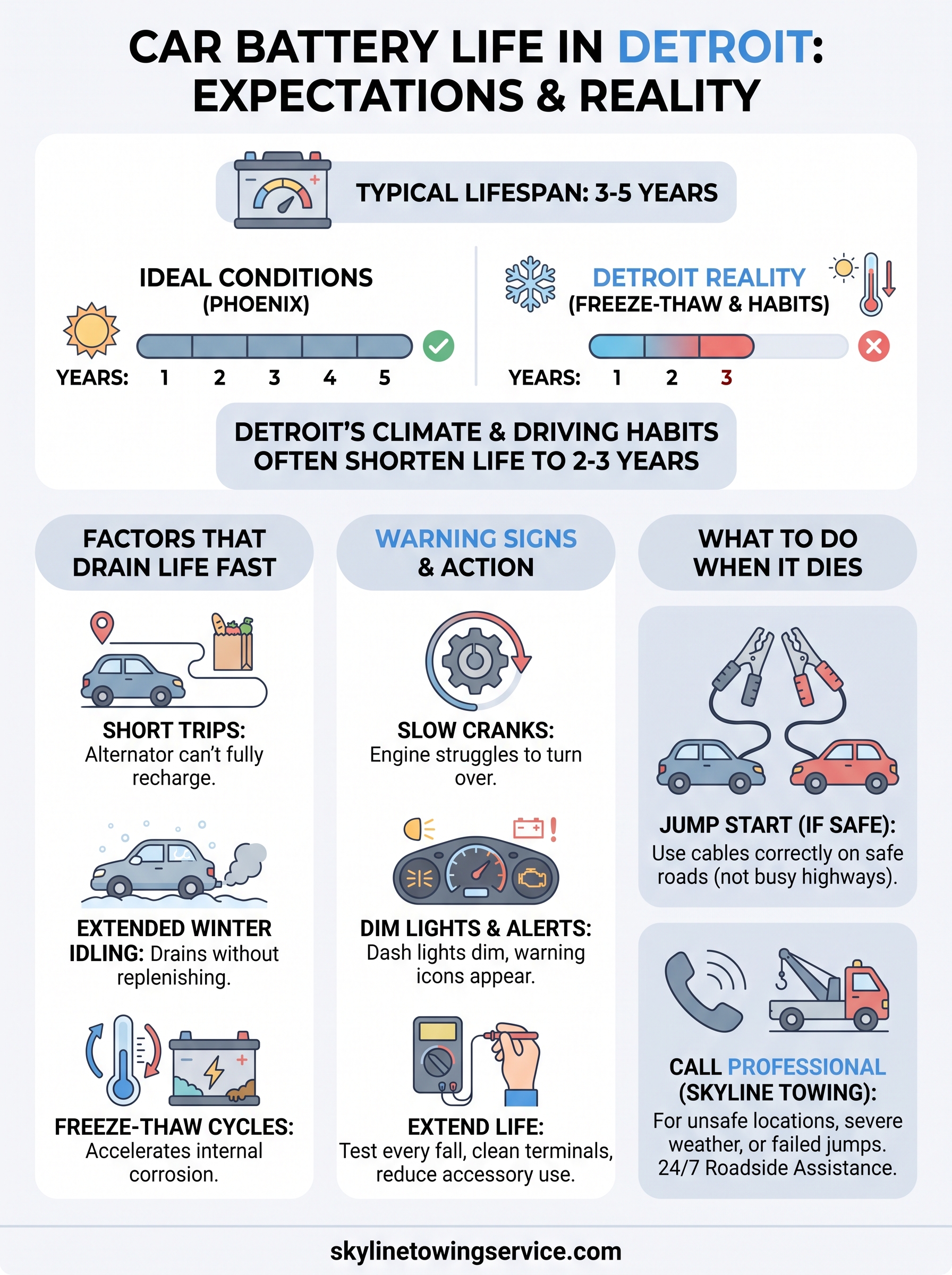
Most car batteries last three to five years, but that range depends heavily on how you drive, how you park, and what winter does to your engine bay. A battery that would coast to year five in Phoenix might tap out by year three after a couple of brutal Michigan winters, especially if it’s already weak going into a cold snap on I-94 or the Lodge Freeway.
We’ve jumped, tested, and replaced batteries all over Detroit, Dearborn, and Southfield, so we know what actually wears them down here versus what the owner’s manual claims. Below, we break down realistic battery lifespan numbers, the local factors that shorten it, and the warning signs to catch before you’re stuck calling us from a cold parking lot instead of planning ahead.
Why battery life expectancy matters for Detroit drivers
A weak battery doesn’t just leave you stranded, it can strand you in the worst possible spot: a dark stretch of Gratiot Avenue at 6 a.m., or the Meijer lot in Southfield during a lake-effect snow squall. Battery lifespan isn’t an abstract number for Detroit drivers. It’s the difference between a routine oil-change reminder and a 2 a.m. call to a towing service because your car won’t turn over on the Lodge Freeway shoulder.
Michigan’s freeze-thaw cycle drains batteries faster
Cold weather is brutal on battery chemistry, and it’s the main reason a car won’t start on a freezing Michigan morning. Every drop in temperature slows the chemical reaction that produces cranking power, and at 0 degrees Fahrenheit, a battery can lose more than half its rated capacity. Detroit doesn’t just get cold once, it swings from freezing mornings to 40-degree afternoons and back again, sometimes within the same week. That constant freeze-thaw cycle stresses the internal plates and accelerates corrosion at the terminals faster than a steady, mild climate ever would.
A battery rated for five years in Florida often taps out by year three after two hard Michigan winters.
Summer doesn’t give your battery a break either. Heat evaporates the internal fluid and speeds up corrosion just as much as cold weakens the charge, so a battery here takes a beating from both directions every single year.
Local driving patterns shorten battery lifespan
How you actually drive matters as much as the weather. Short hops to the grocery store on Woodward, sitting in stop-and-go traffic on I-96, or letting the car idle in a Dearborn driveway while you scrape the windshield all keep the alternator from fully recharging the battery. Add in heated seats, defrosters, and phone chargers running at once, and you’re asking a lot from a battery that never gets a full recharge cycle.
Driving habits and Detroit’s climate combine in ways that catch a lot of people off guard, so here’s how they stack up:
| Factor | Effect on Battery Life |
|---|---|
| Short trips under 10 minutes | Alternator never fully recharges battery |
| Extended winter idling | Drains charge without replenishing it |
| Repeated freeze-thaw cycles | Speeds up internal plate corrosion |
| Summer heat over 90°F | Evaporates internal fluid, weakens capacity |
| Heavy accessory use (heat, defrost, chargers) | Adds ongoing draw during weak charging conditions |
Owners who ignore these patterns often assume their battery failed randomly, when really there are common reasons a battery keeps dying in the Detroit area, and most of them come down to daily habits. We’ve pulled batteries out of cars in Taylor and Livonia that were barely two years old but tested weak because of nothing but short commutes and constant winter accessory use. Knowing this upfront lets you plan a replacement before it becomes an emergency, rather than finding out the hard way when your car won’t start outside your own garage on a January morning.
How to extend your car battery’s life in Michigan weather
Protecting a battery in Detroit isn’t about buying a premium brand and hoping for the best. It’s about a handful of habits that counter exactly what Michigan weather does to it. Extending battery lifespan here means fighting cold-weakened chemistry and heat-driven corrosion at the same time, not just one or the other.
Test your battery before winter hits
Getting a load test done every fall, before temperatures drop below freezing, catches a weakening battery while you still have time to replace it on your schedule instead of the roadside’s schedule. Most auto parts stores and towing companies, including us, can run this test in minutes. A battery that tests at 80% capacity in October can easily drop below the threshold needed to start your engine once a hard freeze hits I-75 or the Southfield Freeway in January.
Test in October, not January, and you’ll never learn about a weak battery the hard way.
Keep terminals clean and connections tight
Corrosion buildup on terminals restricts the current your battery can deliver, especially when it’s already struggling in the cold. A baking soda and water mixture, an old toothbrush, and five minutes under the hood once a season keeps corrosion from choking off your battery’s cranking power right when you need it most.
Cut back on parasitic drains
Short trips and heavy accessory use are the two biggest local culprits, so build habits that counter them:
- Combine short errands into one longer trip so the alternator gets time to fully recharge the battery
- Turn off heated seats and rear defrosters once they’ve done their job instead of running them the whole drive
- Avoid charging phones or running dash cams during long idle periods, like scraping ice in a Dearborn driveway
- Park in a garage or use a block heater on brutal single-digit nights whenever you can
If you’re near our shop at 6450 E Hancock St in Detroit, stop by for a free battery test before the next cold snap rolls in. Catching a weak battery early beats getting stranded on Gratiot Avenue at 6 a.m.
Warning signs your battery is about to fail
Most batteries don’t die instantly, they fade over a week or two of small clues that Detroit drivers often brush off as "just the cold." Recognizing these signs early is the whole point of understanding car battery life expectancy, because a dying battery gives you a window to act before it strands you on I-75 or in a dark corner of a Southfield parking garage.
Slow cranks and dim lights
Sluggish starts are the clearest tell, and one of the 5 signs Detroit drivers notice when a battery is dead. If your engine cranks noticeably slower than it did last week, especially on a cold morning near Eastern Market or Corktown, the battery is losing its charge capacity. Dashboard lights or headlights that dim when you start the car, or that flicker at idle, point to the same weakening cells struggling to keep up with demand.
A slow crank on a cold morning is your battery’s last warning before it quits completely.
Dashboard warnings and electrical quirks
Modern vehicles often flag battery trouble before you notice it yourself. A battery warning light, a check engine light tied to voltage issues, or power windows that move slower than usual all signal declining output. Don’t ignore these just because the car still starts, they’re an early version of the same failure that eventually leaves you calling for a jump on the Lodge Freeway shoulder.
Watch for these signs together, since the 12 symptoms of a failing or flat battery usually show up in combination rather than alone:
- Engine cranks slower than normal, especially in cold weather
- Headlights or interior lights dim when starting
- Dashboard battery or voltage warning light appears
- Clicking sound instead of a full engine turnover
- Corrosion visible on battery terminals
- Battery case looks swollen or bulging
Age and smell as final clues
Age alone matters too. A battery past the three-year mark deserves closer attention every fall, even without obvious symptoms yet. A rotten-egg smell near the engine bay is a red flag on its own, since it usually means the battery is overheating internally and could fail within days, not weeks.
What to do when your battery dies on a Detroit road
Even with every precaution, batteries sometimes quit without warning, and knowing what to do with a dead car battery matters more than knowing why it happened. Pull over safely first, whether that means the shoulder of the Lodge Freeway or a side street off Michigan Avenue in Dearborn, and turn on your hazards before you do anything else.
Try a jump start only if it’s safe
If you’ve got cables and another vehicle nearby, and you know the right order for hooking up jumper cables, a jump start can get you moving again in minutes. But doing this on a busy stretch of I-94 or in an icy Southfield parking lot isn’t worth the risk to save fifteen minutes. Roadside safety always comes before troubleshooting, especially at night or during a snow squall when visibility drops fast.
A dead battery isn’t an emergency worth risking your safety over, it’s worth calling for help.
Call for professional help when conditions aren’t safe
Some situations call for a professional jump instead of a DIY fix:
- You’re stopped in a traffic lane or narrow shoulder with no safe place to stand
- It’s dark, icy, or actively snowing
- You don’t have jumper cables or another vehicle to help
- The jump doesn’t hold and the battery dies again within minutes
- You suspect the alternator, not the battery, is the real problem
That’s exactly when a call to Skyline Towing makes sense, and it helps to know where to find jump start service in Metro Detroit before you need it. We run 24/7 roadside assistance across Detroit, Dearborn, Dearborn Heights, Southfield, Taylor, and Livonia, and jump starts are one of the most common calls we get during a Michigan cold snap. Our techs show up with commercial-grade equipment, not a set of cables from someone’s trunk, so we can diagnose whether it’s the battery or something deeper in the electrical system.
Know when it’s time for a tow instead of a jump
Sometimes a jump won’t hold, and that’s a sign the battery itself has failed rather than just discharged. In that case, towing to a shop beats a second dead stop twenty minutes later on Woodward Avenue. Our team based at 6450 E Hancock St in Detroit is one of the fast 24 hour towing options in Detroit that can get a flatbed or wheel-lift truck to you day or night, whenever a jump isn’t enough.
Staying ready for whatever Detroit roads bring
Knowing your car battery life expectancy isn’t just trivia, it’s how you avoid getting stuck outside a Southfield parking garage or stranded on the Lodge Freeway shoulder at 6 a.m. Three to five years is the general rule, but Detroit’s freeze-thaw swings and short-trip driving patterns push plenty of batteries toward the low end of that range. Testing before winter, keeping terminals clean, and watching for slow cranks or dim lights buys you time to replace a battery on your own schedule instead of the roadside’s.
Even with good habits, batteries fail without warning sometimes. When that happens on Gratiot Avenue, I-94, or a side street in Dearborn, you want a crew that shows up fast with real equipment, not guesswork. Save Skyline Towing in your phone now, so when your battery finally taps out, Detroit roadside assistance for a dead battery is already one call away.