
Your battery dies in a Meijer parking lot on Gratiot, or you slide into a snowbank on I-96 during a February whiteout, and suddenly you’re scrolling through roadside assistance plans trying to figure out which one actually covers what you need. Detroit winters and pothole season on Woodward and Telegraph make breakdowns a matter of when, not if, so picking the wrong plan means paying out of pocket exactly when you can least afford it.
This guide gives you a straight compare roadside assistance plans breakdown covering AAA, Allstate, Good Sam, insurance-based add-ons, and local options like ours, looking at real costs, tow mileage limits, wait times, and what’s actually included versus what gets billed extra. Whether you’re weighing family roadside assistance plans that cover multiple drivers under one membership, or looking at roadside assistance plans for seniors with simpler pricing and dispatch, you’ll see how each stacks up for Metro Detroit driving conditions specifically.
We’ve towed vehicles from Dearborn to Southfield to Livonia long enough to know which plans hold up when it’s ten degrees outside and your car won’t start. Skyline Towing, based at 6450 E Hancock St in Detroit, runs 24/7 calls across the metro area, so we’ll also show you where local, on-demand service beats a nationwide membership.
1. Skyline Towing’s local roadside assistance plans
Skyline Towing runs its own membership-style plans built specifically for Metro Detroit driving, not a national call center that dispatches whoever’s closest. Local dispatch means when you call from a stalled car on I-75 near the Ambassador Bridge or a driveway in Dearborn Heights, you’re talking to someone who knows the roads, the weather patterns, and which neighborhoods need extra time in a snowstorm.

What’s covered
Our plans bundle the services Detroit drivers actually use: towing, jump starts, lockouts, flat tire changes, mobile tire installation, winch outs, and fuel delivery. Accident recovery and heavy-duty towing are available too, which most national memberships either exclude or charge extra for once you go beyond a standard passenger vehicle.
Cost
Pricing runs simpler than most competitors because you’re not paying for a national network you’ll rarely use outside Michigan.
| Plan feature | Skyline Towing |
|---|---|
| Annual membership | Starts around $60-$90/year |
| Tow distance included | Typically 15-25 miles |
| Response time (metro area) | Usually 20-45 minutes |
| Extra family drivers | Add-on option available |
A local plan only pays off if the company answers fast and shows up before your battery drains further in the cold.
Best for
This setup suits Detroit-area drivers who rarely travel outside the metro region and want fast dispatch without navigating a national call tree. Families splitting one membership across a couple of drivers, and folks who’ve had a bad experience waiting an hour for a national provider during a January cold snap, tend to switch to us and stay.
Watch out for
Because we focus on Metro Detroit, our plans aren’t built for someone who drives to Florida every winter and needs coast-to-coast coverage. If you’re mostly local, that’s not a downside, but if you split time between states, you’ll want to weigh that against the national roadside assistance plans covered further down. Also confirm your specific plan’s mileage cap before a long trip out to a cabin up north, since standard towing distance is calibrated for city and suburban driving, not a three-hour haul.
2. AAA membership plans
AAA has been the default answer for roadside assistance plans for decades, and plenty of Metro Detroit drivers still carry a card in the glovebox out of habit. It’s a national membership network, so the tradeoff for that broad reach is a call center dispatch system rather than a local tow company who already knows your neighborhood.
What’s covered
Basic AAA membership includes towing, jump starts, lockout service, flat tire changes, and fuel delivery. Higher tiers like Plus and Premier extend your tow distance and add extras like trip interruption coverage and RV towing, which matters if you’re hauling a camper up to Higgins Lake.
Cost
| Tier | Approx. annual cost | Tow distance |
|---|---|---|
| Basic | $65-$75 | Up to 5 miles |
| Plus | $100-$120 | Up to 100 miles |
| Premier | $130-$160 | Up to 200 miles |
Paying for Plus or Premier only makes sense if you actually drive long distances outside Metro Detroit on a regular basis.
Best for
Drivers who travel frequently between states, or who want one membership that works whether they’re stuck on I-94 near Ann Arbor or visiting family in Chicago, get the most value here. It also suits people who prefer a well-known brand name over a smaller local operator.
Watch out for
During major winter storms, AAA’s call volume spikes across the whole region, and their contracted tow trucks aren’t always Detroit-based, which can stretch wait times past an hour on a bad night. Confirm your tow mileage and how many calls per year you’re allowed before you commit, since overage fees add up fast.
3. Roadside assistance through your car insurance
Many Detroit drivers already pay for roadside assistance plans without realizing it, tucked into their auto policy through Progressive, State Farm, or Farm Bureau. It’s usually a small add-on line item, easy to overlook until you’re stuck on Telegraph Road wondering if you even have coverage.
What’s covered
Insurance-based roadside assistance typically bundles towing, jump starts, lockout service, flat tire changes, and fuel delivery, similar to a basic membership. Coverage often applies per incident rather than unlimited calls, so check your policy declarations page for the exact number of tows allowed per year before you assume you’re fully protected.
Cost
| Add-on detail | Typical range |
|---|---|
| Annual cost | $15-$45/year |
| Tow distance | Often capped around 15 miles |
| Calls per year | Usually 2-4 |
Cheap coverage only helps if you know the call limit before your third breakdown of the winter.
Best for
Drivers who want a bare-bones safety net without paying for a standalone membership find this option appealing. Budget-conscious households who already juggle multiple family roadside assistance plans through work or insurance sometimes stack this as a backup rather than a primary plan.
Watch out for
Occasionally, a claim tied to your insurance can flag your account even for a simple tow, which some drivers worry affects future premiums. Verify that directly with your carrier. Response times also depend on whichever tow company your insurer contracts locally, so you lose the ability to request a provider you already trust, like one based in your own neighborhood.
4. Good Sam motor club plans
Good Sam built its reputation serving RV owners and campers, so if you tow a trailer up to the Upper Peninsula or take the camper out to Waterloo Recreation Area most summers, this name probably already sounds familiar. It’s less common among everyday Metro Detroit commuters, but for RV and trailer owners, it fills a gap that AAA and most local plans don’t fully cover.

What’s covered
Standard Good Sam plans include towing, jump starts, lockout service, and fuel delivery, but the real draw is RV-specific coverage like winching a trailer out of mud or sand, mobile mechanical repairs at your campsite, and towing for vehicles too large for a typical flatbed. Passenger car coverage is included too, just secondary to the RV focus.
Cost
| Plan tier | Approx. annual cost | Tow distance |
|---|---|---|
| Standard | $60-$80 | Up to 100 miles |
| Platinum | $100-$130 | Up to 200 miles |
A trailer-specific plan only earns its cost if you actually haul something heavy on a regular basis.
Best for
Owners who tow boats, campers, or trailers around Michigan lakes benefit most here. Weekend campers heading to Sterling State Park or up toward Traverse City get coverage that a standard car-only membership skips entirely.
Watch out for
Daily commuters without a trailer are paying for RV-focused perks they’ll never use. Dispatch networks also thin out in dense city areas like downtown Detroit, since Good Sam’s contracted providers lean toward highway and campground coverage rather than urban breakdowns.
5. AARP roadside assistance for seniors
AARP offers roadside assistance through a partnership with Allstate, and it’s become one of the more popular roadside assistance plans for seniors among Metro Detroit retirees who want simple pricing without a lot of tiers to compare. Membership doubles as access to travel discounts and pharmacy savings, so a lot of members already have the card in their wallet before they even think about towing coverage.
What’s covered
Coverage includes towing, jump starts, lockout service, flat tire changes, and fuel delivery, matching most basic motor club plans. Some tiers add trip interruption benefits, which help if a breakdown happens while visiting grandkids out near Rochester Hills or driving down to Toledo for a doctor’s appointment.
Cost
| Detail | Typical range |
|---|---|
| Annual membership (AARP + roadside add-on) | $40-$70 |
| Tow distance | Up to 100 miles on higher tiers |
| Calls per year | Usually 4 |
A senior-focused plan earns its keep when the phone line is easy to use and the person answering doesn’t rush you through the call.
Best for
Older drivers who want straightforward phone support and don’t need heavy-duty or commercial towing benefit most. It also suits retirees already carrying an AARP membership for other perks, since the roadside add-on stacks cheaply on top.
Watch out for
Dispatch still runs through Allstate’s national network, so response times in Detroit depend on whichever contracted tow company is available that night, not a dedicated local crew. Confirm the mileage cap and yearly call limit before assuming it covers a longer trip up north.
6. Credit card roadside assistance perks
Some Visa Signature, Mastercard World Elite, and Amex cards toss in roadside assistance as a cardholder perk, and plenty of Detroit drivers already qualify without realizing it. Unlike a membership plan, there’s no annual roadside fee since it rides along with a card you’re already paying an annual fee for anyway, or sometimes no fee at all.
What’s covered
Coverage typically includes towing, jump starts, lockout service, and fuel delivery, but here’s the catch: most card issuers charge you per service call rather than bundling it into your card benefits. Chase, Amex, and Capital One generally dispatch through a third-party network and bill you directly, then you submit for reimbursement up to a set cap.
Cost
| Detail | Typical range |
|---|---|
| Membership cost | $0 (included with card) |
| Cost per service call | $50-$100, billed to you first |
| Reimbursement cap | Often $50-$80 per incident |
Free roadside assistance from a credit card usually means you pay upfront and hope the reimbursement covers most of it.
Best for
Occasional drivers who rarely break down and don’t want to pay for a standalone membership find this useful as a backup. It also suits people already carrying a premium card for travel points who don’t mind fronting cash on the rare call from a stalled car on Michigan Avenue.
Watch out for
Wait times run longer since dispatch isn’t dedicated to your card, and coverage often excludes flatbed towing for larger vehicles. Read your cardholder agreement closely, since benefits change yearly and some issuers have quietly dropped roadside perks altogether.
7. Automaker warranty roadside assistance
New car buyers often get roadside assistance bundled into the factory warranty without ever signing up for it, which surprises a lot of drivers who bought a Ford or GM from a dealer in Dearborn or Southfield. This coverage rides along with the vehicle itself rather than a person, so it transfers if you sell the car within the warranty window, but it disappears the moment the warranty period ends.
What’s covered
Most automaker plans include towing to the nearest dealership, jump starts, lockout service, flat tire changes, and fuel delivery. Dealership-only towing is the catch here since some brands only tow you to their own service center, not wherever you’d prefer, which matters if your regular mechanic isn’t a dealer.
Cost
| Detail | Typical range |
|---|---|
| Membership cost | $0, bundled with new car purchase |
| Coverage window | Usually 3-5 years or 36,000-60,000 miles |
| Tow distance | Often to nearest dealer only |
Free coverage from your automaker only helps while the warranty clock is still running.
Best for
Owners of newer vehicles still under factory warranty get solid value here since there’s no extra cost involved. It suits drivers who mostly stick close to Metro Detroit dealerships anyway and don’t mind a tow landing at a specific service bay instead of their own garage.
Watch out for
Coverage vanishes once your warranty expires, often catching owners of five- or six-year-old vehicles off guard on a cold night near Telegraph Road. Confirm your exact mileage and year cutoff, since some brands cut roadside benefits earlier than the full mechanical warranty term.
8. Cell phone carrier roadside assistance add-ons
Verizon, AT&T, and T-Mobile all sell roadside assistance as a monthly add-on tucked into your phone bill, usually bundled with device protection plans. It’s an easy option to overlook since you’re already paying the carrier every month anyway, and a lot of Metro Detroit drivers sign up during a store visit without comparing it against other roadside assistance plans first.
What’s covered
Coverage generally includes towing, jump starts, lockout service, flat tire changes, and fuel delivery, mirroring most basic motor club benefits. Mileage caps run tighter than a standalone membership, often limited to a handful of miles per tow before you’re billed extra out of pocket.
Cost
| Detail | Typical range |
|---|---|
| Monthly add-on cost | $3-$8/month |
| Tow distance | Often 5-15 miles |
| Calls per year | Usually 1-3 |
A phone bill add-on is only worth it if you actually remember you have it when your car won’t start.
Best for
This suits drivers who want a low-cost backup without committing to a separate annual membership, especially younger drivers or renters without a car payment tying them to dealer coverage. It also works for occasional drivers who mostly use public transit or rideshare around Detroit and just need something in place for the rare breakdown.
Watch out for
Dispatch runs through a third-party network, not a dedicated local towing company, so response times during a snowstorm can stretch long past what you’d expect from your carrier’s ads. Canceling or switching phone plans can also quietly drop the roadside add-on without much warning, so check your account settings before you assume you’re still covered.
9. Choosing the right plan for Detroit’s roads and winters
Winter is where every one of these roadside assistance plans gets tested for real. Ice storms on I-696, whiteouts on the Lodge Freeway, and single-digit mornings in Livonia all push response times and dispatch networks past their limits at the same time, so the plan that looks fine on paper in July can leave you waiting an hour when it’s ten degrees outside. Potholes on Woodward and Telegraph add a second stress test every spring, blowing tires and bending rims in ways that make tow distance and per-call limits matter more than most drivers expect.
Start by matching the plan to how you actually drive, not how you imagine you might drive someday. Use this quick checklist before you sign up for anything:
- Do you mostly stay in Metro Detroit, or cross state lines often?
- Would you split coverage across multiple family roadside assistance plans, or is one membership enough?
- Does the plan dispatch a local tow company, or route through a national call center?
- What’s the real tow mileage cap, not just the advertised number?
- How many calls per year are actually included?
The best plan isn’t the cheapest one, it’s the one that shows up fast when your street is covered in ice.
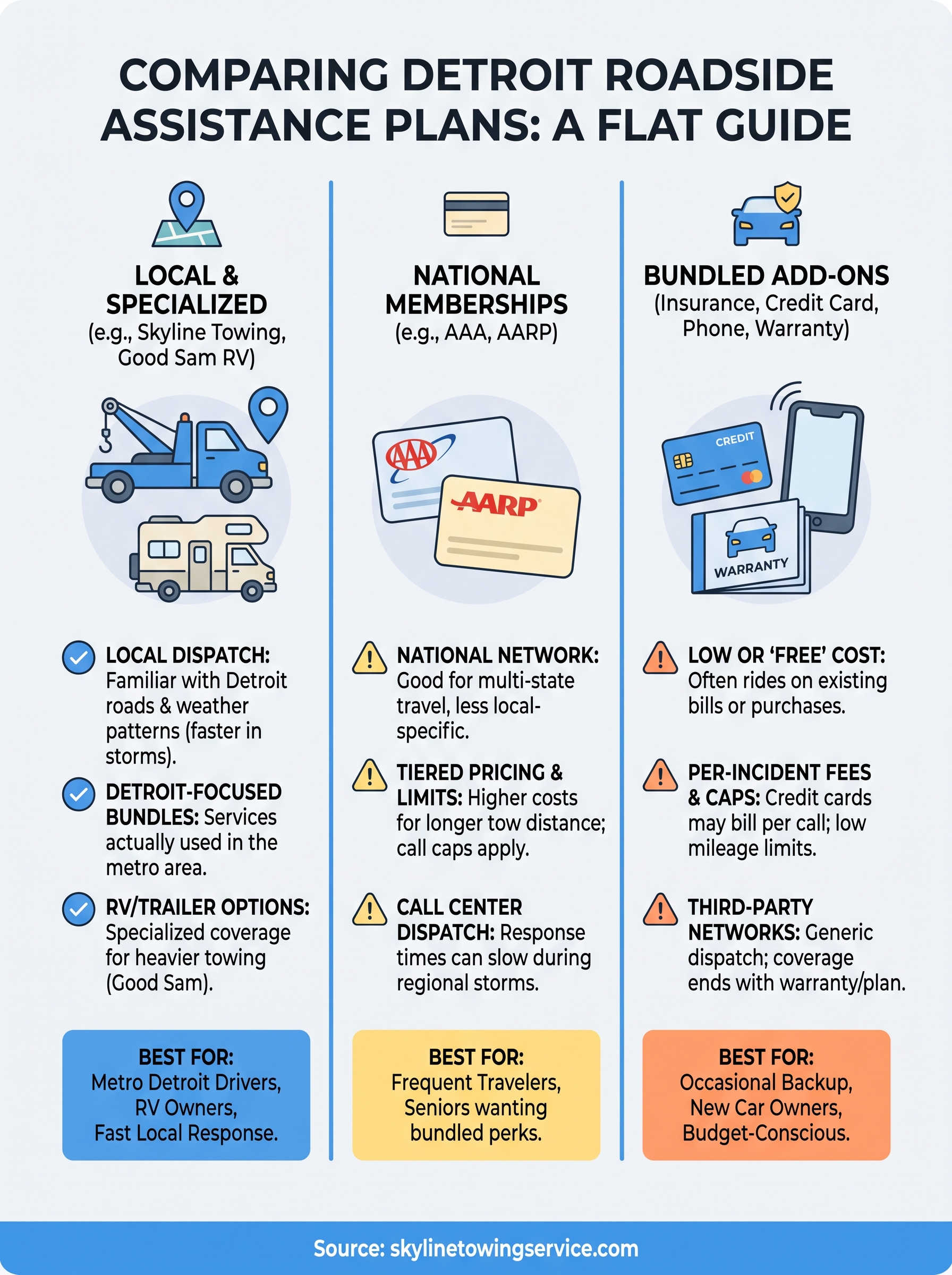
Once you compare roadside assistance plans side by side using those five questions, the choice usually narrows fast. Seniors tend to value simple phone support over extra tiers, while families splitting coverage often save more by bundling one solid membership than paying for several overlapping perks.
The bottom line for Detroit drivers
Every plan in this guide covers the basics somewhere. What separates them is what happens on the night it’s ten degrees outside and your battery finally gives up on a side street in Southfield or a dark stretch of Telegraph Road. National networks and card perks work fine most of the time, but local dispatch cuts the wait when weather and call volume spike together, which happens every single Detroit winter without fail.
If you drive mostly around Metro Detroit and want a plan built for these roads instead of a national average, that’s exactly why we built ours the way we did. Compare the mileage caps, call limits, and response times against your own driving habits, then pick the plan that actually shows up. When you’re ready for coverage designed around Detroit weather and Detroit roads, check out Skyline Towing’s roadside assistance plans and get set up before the next storm hits.