
You’re on I-94 heading through Dearborn at 11 PM when your engine sputters and dies. Or maybe you walk out to your car on a freezing January morning in Southfield and the battery’s completely dead. These situations happen to Metro Detroit drivers all the time, and what is roadside assistance comes down to one thing: getting help sent to your exact location when your vehicle won’t cooperate.
Roadside assistance covers a range of services designed to get you back on the road, or safely off of it. We’re talking towing, jump starts, lockout help, tire changes, fuel delivery, and more. At Skyline Towing, we provide 24/7 roadside assistance across Detroit and the surrounding metro area, so we know firsthand what drivers actually need when they’re stuck and what questions they have about how this all works.
This article breaks down exactly what roadside assistance includes, what it typically costs, how to request it, and how to decide which option makes the most sense for your situation.
Why Roadside Assistance Matters in Metro Detroit
Detroit drivers deal with conditions that make breakdowns more likely and more serious than in many other parts of the country. Michigan winters regularly push temperatures well below zero, and roads like I-75, I-96, and M-39 carry heavy traffic year-round. A dead battery or a blown tire on any of those routes during rush hour is not just an inconvenience; it is a real safety issue.
Detroit’s Weather Puts Extra Stress on Your Vehicle
Michigan’s freeze-thaw cycle does serious damage to both roads and cars. Potholes on surface streets like Telegraph Road and Eight Mile can flatten a tire in seconds, and the cold snaps that hit every January and February drain batteries fast. If your car sits outside overnight in Southfield or Dearborn Heights during a deep freeze, you risk starting your morning completely stranded.
Understanding what is roadside assistance becomes a lot more urgent when you are standing next to a dead car at 6 AM in 15-degree weather with nowhere to go.
The salt and moisture from Michigan winters also accelerate mechanical wear on older vehicles. That increases the chance of an unexpected breakdown during your daily commute or on a run out to Livonia or Taylor on a weekend.
Metro Detroit’s Size Makes Response Time Critical
Metro Detroit spreads across a large geographic area, and not every breakdown happens close to home or near a convenient highway exit. If you end up stuck on a side street in a less-traveled part of the city, or on a stretch of I-94 between exits, getting help to you requires a driver who actually knows the area.
Skyline Towing serves Detroit and the surrounding suburbs specifically because local knowledge shapes how quickly and safely a driver can reach you. Knowing which roads flood, which on-ramps back up, and where to safely position a tow truck on a busy shoulder makes a measurable difference in how your situation gets resolved.
What Roadside Assistance Typically Covers
When you break down and call for help, what roadside assistance covers determines what actually happens next. Most services include a core set of situations that account for the most common reasons drivers get stranded. Understanding your coverage ahead of time keeps you from discovering a gap in your plan while you’re standing on the cold shoulder of I-75.
The difference between a minor inconvenience and a two-hour ordeal often comes down to knowing exactly what services are available to you before you need them.
The Core Services Most Plans Include
Roadside providers generally handle the most frequent vehicle emergencies drivers face. Skyline Towing covers all of these across Metro Detroit:
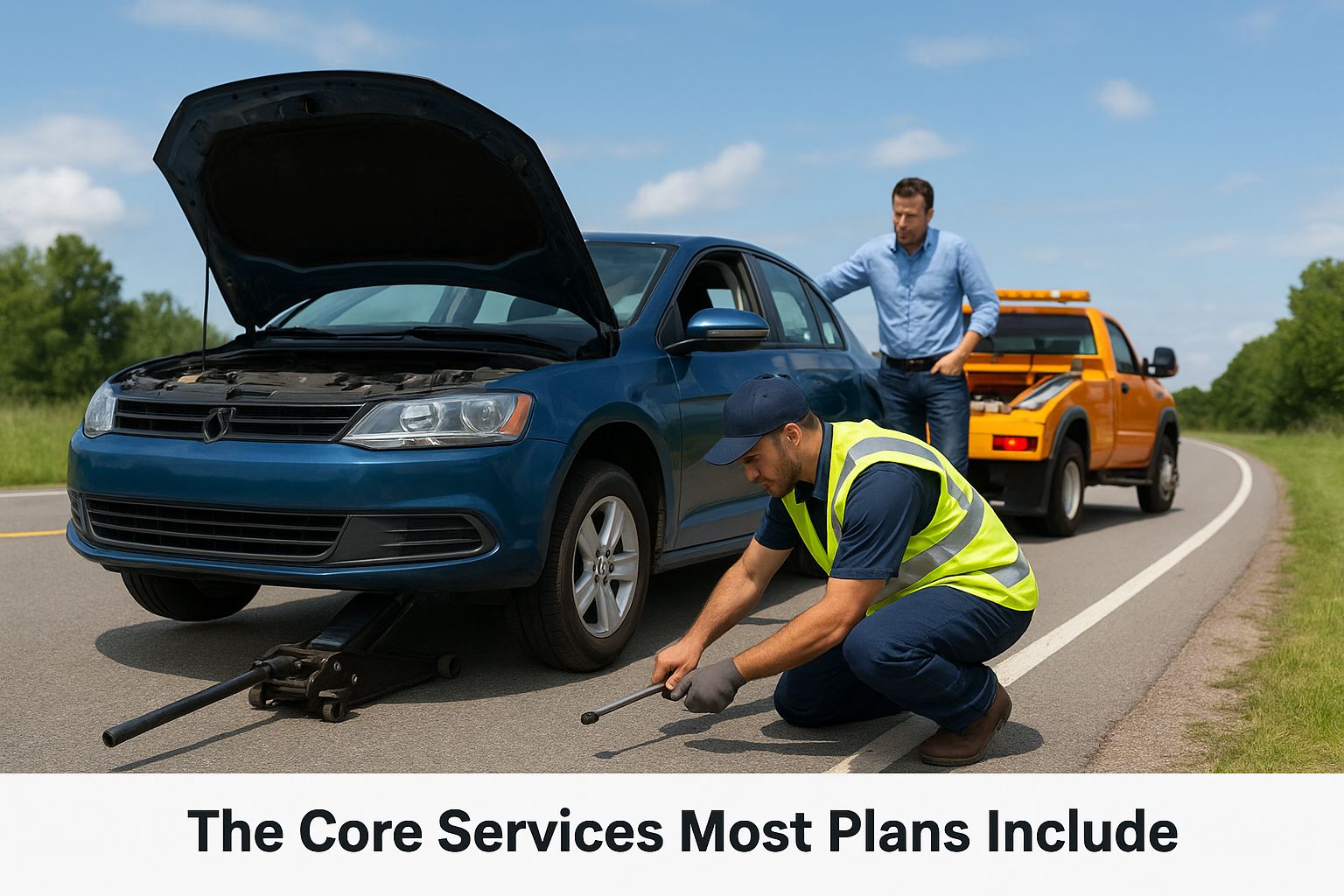
- Towing: Moving your vehicle to a shop or safe location when it won’t run
- Jump starts: Getting a dead battery going so you can drive again
- Lockout service: Opening your car when keys are locked inside
- Flat tire changes: Putting on your spare when you have a blowout
- Fuel delivery: Bringing enough gas to reach the nearest station
- Winch-outs: Recovering your vehicle from mud, snow, or a ditch
Not every provider covers all six of these, and some cap how many miles they’ll tow or limit how many service calls you can make per year. Reading the fine print on your plan protects you from unexpected costs when you’re already in a stressful situation.
How Roadside Assistance Works When You Need Help
Part of understanding what is roadside assistance is knowing what to expect the moment you call. You contact a provider, share your exact location and situation, and a driver gets dispatched to you. Most providers ask for your name, phone number, vehicle details, and location. On a highway like I-96, a mile marker or nearby exit helps the driver reach you faster.
The faster you describe where you are, the faster help arrives.
What Happens After You Call
Your call gets routed to a dispatcher who assigns the nearest available driver. At Skyline Towing, response times across Metro Detroit vary based on traffic and location, but we give you an honest ETA upfront. Once the driver arrives, they assess your vehicle and handle whatever the situation requires, whether that is a jump start, a tire change, or a tow to a local shop.
What to Do While You Wait
Staying safe and visible matters as much as making the call. Keep your phone accessible so the driver can reach you if they have trouble locating your exact spot. If you stalled in an active lane, tell the dispatcher right away.
While you wait:
- Turn on your hazard lights immediately
- Move off the roadway if you can do so safely
- Stay inside on high-speed roads like I-75 or the Lodge Freeway
How Much Roadside Assistance Costs
Cost is one of the first things people ask about once they understand what is roadside assistance and what it covers. Pricing varies based on how you access the service, whether through your auto insurance, a motor club membership, or by calling a local provider directly without any prior plan.
Knowing the cost structure before you’re stranded gives you real options instead of sticker shock at the worst possible moment.
Breaking Down the Common Pricing Models
Most drivers in Metro Detroit access roadside assistance through one of three main channels, each with its own cost structure. Your auto insurance policy may already include roadside coverage as an optional add-on for roughly $10 to $30 per year, making it one of the most affordable ways to stay covered.

Motor club memberships typically run $60 to $180 per year depending on the tier you select. Calling a local provider directly without a plan costs more per incident, with towing fees starting around $75 to $125 for a basic hookup, plus additional mileage charges. For drivers who rarely break down, paying per incident can make financial sense. For anyone running an older vehicle or regularly dealing with Michigan winters, a plan almost always pays for itself faster than you would expect.
How to Choose the Right Option in Detroit
Once you understand what is roadside assistance and how costs break down, the right choice comes down to your driving habits, your vehicle’s condition, and how often you realistically expect to need help. Metro Detroit drivers face a different risk profile than drivers in warmer, less congested states, so generic nationwide advice rarely applies here.
Match Your Coverage to How You Actually Drive
Your vehicle’s age and reliability are the clearest indicators of what level of coverage makes sense for you. If you drive an older car through Southfield winters or commute daily on I-94 or the Lodge Freeway, a full membership or an insurance add-on gives you predictable costs and real peace of mind without surprises.
Paying out of pocket twice in one Michigan winter can easily cost more than an entire year of membership coverage.
Drivers with newer vehicles under manufacturer warranty may already have roadside coverage built in, so check your documentation before paying for something you already have. If you want local service with no annual commitment, calling Skyline Towing directly gives you honest pricing upfront and a driver who knows Metro Detroit roads, suburbs, and traffic patterns inside and out.
Quick Recap and Next Steps
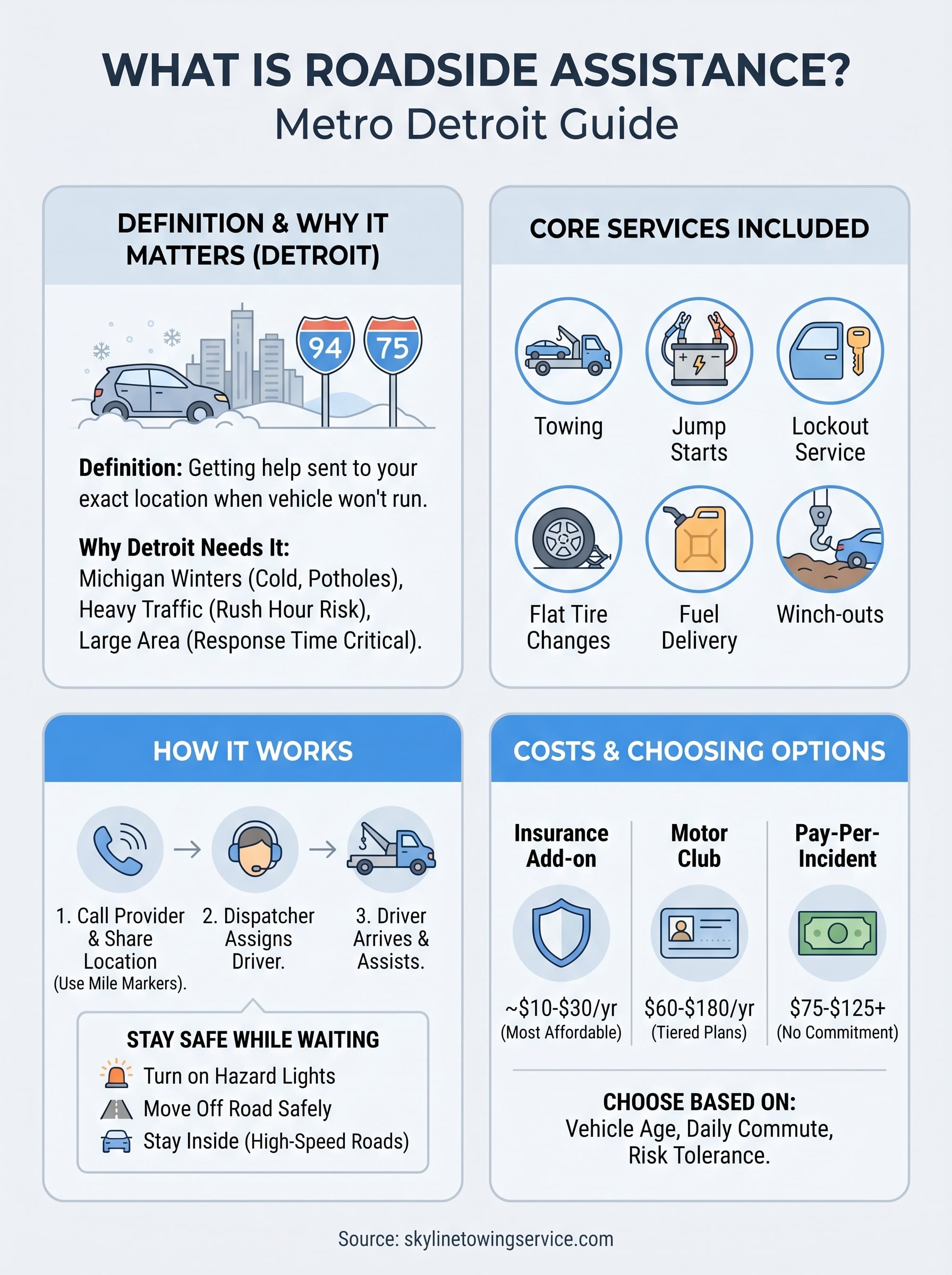
Roadside assistance is a set of on-demand services that come to you when your vehicle breaks down, covering towing, jump starts, lockouts, tire changes, fuel delivery, and winch-outs. What is roadside assistance at its core is a safety net for when your car stops cooperating. In Metro Detroit, where Michigan winters, heavy highway traffic, and aggressive potholes add real risk to every commute, having a plan before something goes wrong is a practical decision, not an optional one.
Your three main options are your auto insurance add-on, a motor club membership, or paying per incident through a local provider. Match your choice to your vehicle’s age, daily commute, and how often you realistically expect to need help. If you drive an older car or log serious miles on I-94 or I-75, coverage almost always saves you money and stress.
When you need fast, reliable help anywhere in Metro Detroit, contact Skyline Towing for 24/7 roadside assistance from a team that knows these roads.