
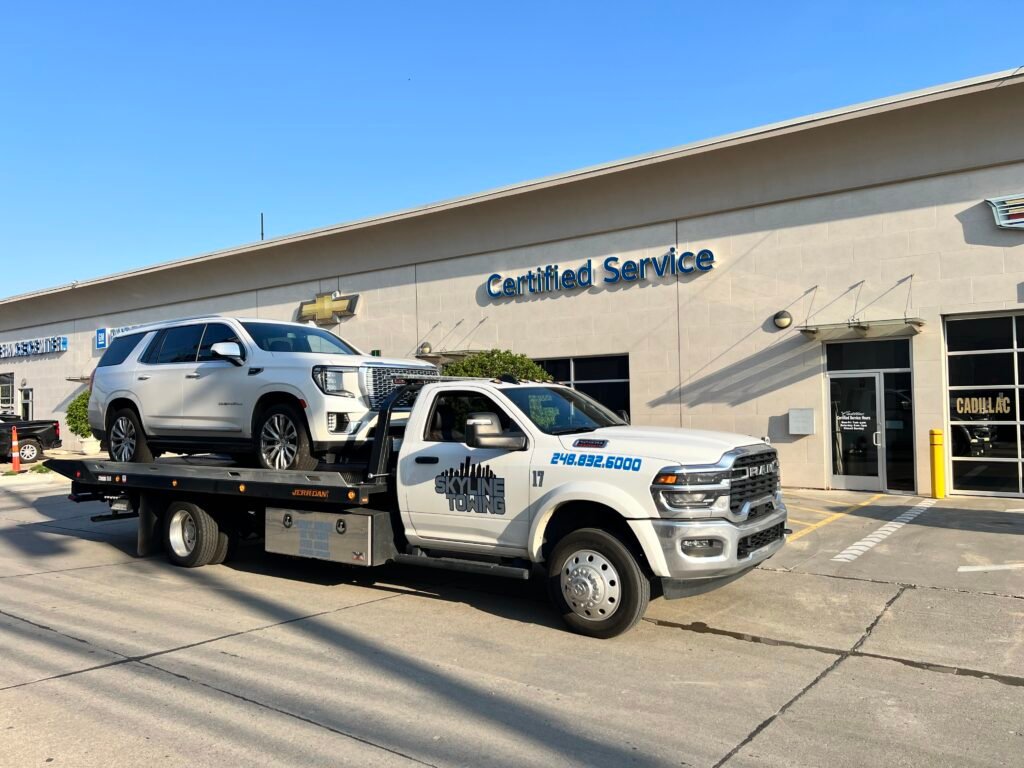
IMG 9812 1024x550

What Is Flatbed Towing? How It Works Vs Wheel-Lift In Detroit

If you’ve ever had your car break down on I-94 or gotten into a fender bender on Michigan Avenue, you’ve probably wondered what is flatbed towing, and whether it’s the method you actually need. It’s one of the most common questions we hear at Skyline Towing, and the answer matters more than most people realize, especially when your vehicle’s safety is on the line. Not every tow job calls for the same equipment, and choosing the wrong method can cause real damage.

At our headquarters on 6450 E Hancock St in Detroit, we run both flatbed and wheel-lift trucks across Metro Detroit every single day, Dearborn, Southfield, Taylor, Livonia, and everywhere in between. That daily experience gives us a clear picture of when each method makes sense and when it doesn’t.

This article breaks down exactly how flatbed towing works, how it compares to wheel-lift towing, and which option fits different vehicles and situations you’re likely to run into on Detroit-area roads. By the end, you’ll know enough to make a confident call the next time you need a tow.

Why flatbed towing matters for vehicle safety

Understanding what is flatbed towing starts with understanding what happens when it isn’t used. With a wheel-lift truck, two of your vehicle’s wheels stay on the road the entire time it’s being moved. That might sound fine for a quick trip, but those two wheels are still connected to your drivetrain, which means they’re spinning and putting stress on your transmission, axle, and differential with every mile the truck travels.

Towing a car improperly, even for a short distance, can cause thousands of dollars in drivetrain damage that won’t show up until days later.

Drivetrain damage you won’t see coming

Drivetrain damage from incorrect towing is sneaky. Your transmission fluid doesn’t circulate properly when the engine is off, so the components inside get no lubrication while they’re spinning. On a run from Dearborn back to our shop at 6450 E Hancock St in Detroit, that’s enough distance to overheat bearings or score transmission components in certain vehicles.

All-wheel-drive and four-wheel-drive vehicles are especially vulnerable here. Manufacturers like Subaru, Audi, and Ford explicitly warn against flat towing their AWD models because the transfer case and differentials can’t handle the load without the engine running.

Low-clearance and damaged vehicles

If your car has a lowered suspension, a body kit, or front-end damage, getting it onto a wheel-lift truck often means dragging parts that shouldn’t be dragged. Flatbed towing solves this completely because the entire vehicle rides on the platform, never touching the road from pickup to drop-off.

Vehicles with locked-up brakes or collision damage also load onto a flatbed without issue, since the truck’s hydraulic bed tilts down to meet the car. That eliminates scraping, dragging, and secondary damage that a wheel-lift simply can’t avoid in those situations.

How flatbed towing works step by step

When you understand what is flatbed towing at the mechanical level, it becomes clear why it’s the safer choice for most situations. The whole process is built around one core goal: getting your vehicle from pickup to drop-off without anything rolling, dragging, or straining along the way.

Getting the truck in position

The driver backs the flatbed up to your vehicle and activates the hydraulic system that tilts the bed down toward the road surface. That angle creates a smooth, gradual ramp your car can roll or get winched onto without any force applied to the bumpers or body panels.

The bed tilts gradually, which means even vehicles with front-end damage or low ground clearance load cleanly every time.

Loading and securing your vehicle

Your car either drives up under its own power or gets pulled up with a winch cable attached to the frame, not the bumper. Once the vehicle sits fully on the platform, the bed levels out completely before the truck moves an inch.

IMG 9812 Rotated

From there, the driver runs heavy-duty wheel straps and safety chains across all four corners of the deck. Your vehicle stays locked in place the entire ride, which is the exact protection flatbed towing is designed to deliver.

Flatbed vs wheel-lift towing in Detroit

Both methods move your car from point A to point B, but the experience and risk level are different enough that knowing the distinction matters. Understanding what is flatbed towing versus wheel-lift towing helps you make a faster, smarter decision when you’re stranded on the Lodge Freeway at rush hour.

Where wheel-lift towing still makes sense

Wheel-lift trucks aren’t the wrong tool in every situation. For short-distance moves involving a standard front-wheel-drive sedan with no mechanical or body damage, they get the job done quickly and at a lower cost. If your car breaks down in Livonia and needs to reach a shop two miles away, wheel-lift is often a reasonable option.

Cost and availability also factor in. Wheel-lift trucks are more common, which means faster response times in high-demand situations, though the tradeoff is real if your vehicle doesn’t fit the safe towing profile.

Detroit roads and conditions change the math

Michigan winters add a layer of complexity. Potholes, ice, and uneven road surfaces on roads like Van Dyke or Gratiot put more stress on a suspended vehicle than towing conditions in smoother cities. A flatbed keeps your car completely isolated from road vibration and impact, which matters a lot more in Metro Detroit than people expect.

When conditions are rough, flatbed towing removes a whole category of risk that wheel-lift simply can’t.

When to request a flatbed in metro Detroit

If you’re still unsure whether what is flatbed towing applies to your situation, a few specific scenarios make the call straightforward. Metro Detroit’s road conditions and weather create situations where flatbed towing is clearly the safer choice, and knowing the triggers ahead of time helps you avoid a bad decision when you’re stressed and stranded on the side of the road.

Knowing which situations call for a flatbed before you need one keeps you from making the wrong call under pressure.

Vehicles and situations that require a flatbed

AWD, four-wheel-drive, and rear-wheel-drive vehicles should always go on a flatbed for any tow longer than a parking lot. If your car has collision damage, a locked wheel, or suspension failure, a flatbed is the only method that won’t cause additional damage during transport. The same goes for luxury cars, sports cars, and lowered vehicles where ground clearance makes wheel-lift loading a real scraping risk.

IMG 8088 2

Winter conditions on roads like I-75 or M-39 add another layer of risk that makes flatbed the smarter default. When your vehicle breaks down in ice or heavy snow, keeping all four wheels completely off the road protects both your car and the tow driver working around it.

Our Detroit HQ at 6450 E Hancock St

Skyline Towing operates out of 6450 E Hancock St in Detroit, MI 48207, which puts us in a strong position to reach you fast across the metro area. Whether you’re stuck on the eastside near Jefferson Avenue or broken down further out in Dearborn Heights or Taylor, our dispatch sends the right truck for your situation based on what you tell us when you call.

What You Get When You Call Us

Our drivers know Metro Detroit roads the way you know your own neighborhood. That local knowledge matters when conditions on I-94 or the Davison Freeway are making a bad situation worse. Understanding what is flatbed towing and how it compares to wheel-lift is something our team walks you through on the call, so you’re never left guessing which truck is heading your way.

Calling from the road is faster than searching, and our team gives you a straight answer on which method fits your vehicle and situation.

Your vehicle gets careful, damage-free handling from the moment we load it to the moment it reaches your chosen destination, and our central HQ location keeps response times short across the entire service area.

what is flatbed towing infographic

Next steps if you need a tow

Now that you understand what is flatbed towing and how it compares to wheel-lift, you’re in a much better position to make the right call when something goes wrong on Detroit’s roads. The next step is simple: call Skyline Towing, tell us your location and vehicle type, and our team will confirm which truck fits your situation before we dispatch.

You don’t need to figure it out alone. Our drivers handle everything from accident recovery on I-94 to lockouts in Dearborn, and they bring the same local knowledge and careful handling to every job. Whether you need a flatbed for an AWD vehicle or a quick wheel-lift move across town, we operate 24 hours a day, seven days a week from our headquarters at 6450 E Hancock St in Detroit, MI 48207. Get fast, professional towing help in Metro Detroit whenever you need it.

Leave a Comment

Your email address will not be published. Required fields are marked *