
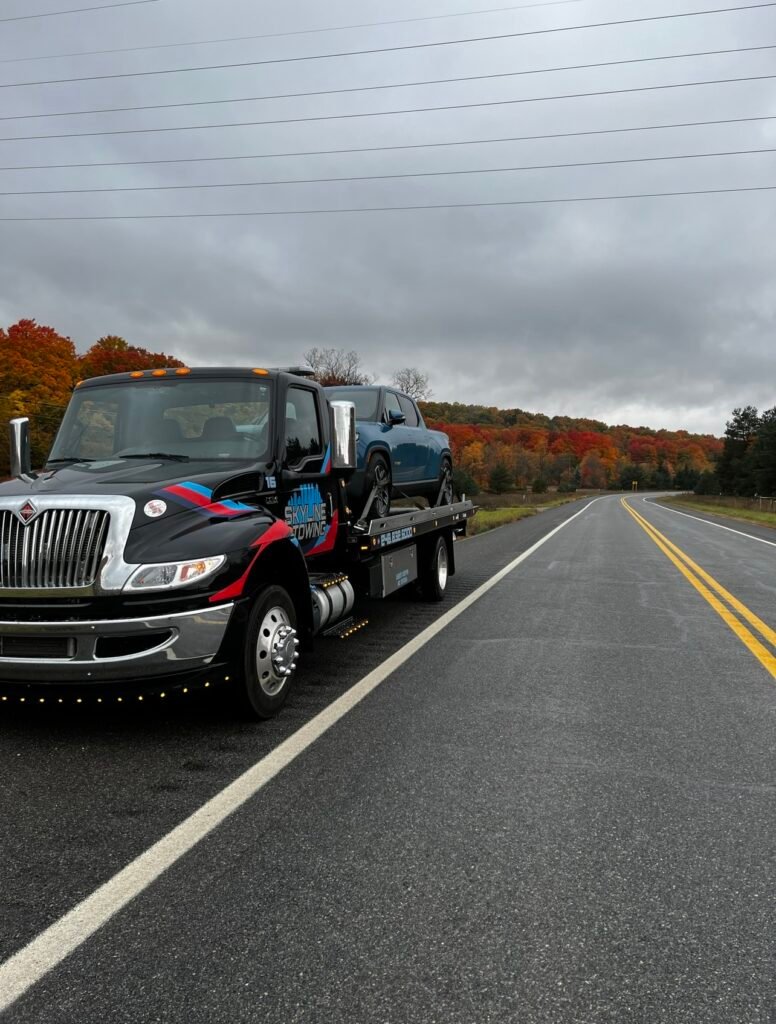
5 Long Distance Towing Tips From Detroit's Roadside Pros

5 Long Distance Towing Tips From Detroit’s Roadside Pros

If you’re planning a haul from Detroit down to Toledo or out to Chicago on I-94, a few missed checks can turn a routine trip into a breakdown on the shoulder of I-75. Our dispatchers at Skyline Towing field these calls every week, and most of them trace back to the same avoidable mistakes. These long distance towing tips come straight from crews who’ve hooked up trailers in January snow squalls and August heat waves across Metro Detroit, so you’re getting field-tested advice, not guesswork.

This article walks through exactly what you need before pulling onto the freeway with a load behind you, from hitch and brake checks to tire pressure and weight distribution. We’ll also cover driving habits that keep you safe when your rig handles differently than your daily driver, plus how often to stop and inspect things once you’re rolling.

We put this list together after years of pulling stranded trailers off Woodward, I-96, and the Southfield Freeway, so it reflects real problems we see on Detroit roads. If you’re gearing up for a long haul, our team at 6450 E Hancock St in Detroit is also available 24/7 if something goes wrong along the way.

1. Start with a pre-trip inspection near Detroit

A thorough pre-trip inspection catches the problems that turn into roadside calls once you’re 50 miles past the Ohio border with no shoulder in sight. We’ve hooked up plenty of trailers on Warren Avenue and Gratiot that never should have left the driveway, whether it was a bald tire, a taillight that hadn’t worked in months, or a hitch pin that was one pothole away from letting go. Detroit’s freeway system doesn’t leave much room for error, and I-75 through downtown gives you narrow shoulders and heavy truck traffic if you need to pull over and troubleshoot.

Fifteen minutes with a checklist in your driveway beats an hour waiting for a tow truck on the shoulder of I-94.

Why it matters

Most long distance towing breakdowns aren’t caused by bad luck. They’re caused by small mechanical issues that were visible before the trip even started. Tire blowouts, wiring failures, and loose safety chains almost always show warning signs if you know where to look, and catching them in your own driveway costs you nothing compared to a tow bill and a ruined weekend.

How to do it

Run through this list before every haul, not just the first one of the season:

  • Check tire tread and pressure on both the tow vehicle and trailer, including the spare
  • Test all trailer lights: brake lights, turn signals, and running lights
  • Inspect the hitch ball, coupler, and safety chains for wear or looseness
  • Look under the trailer for rust, cracked welds, or leaking wheel bearings
  • Confirm your brake controller is wired correctly and responding when you press the pedal
  • Check fluid levels in your tow vehicle, especially transmission fluid if you have an automatic

Detroit-area tip

Winter road salt is brutal on trailer frames and wiring harnesses across Metro Detroit, so if your trailer sits outside near Dearborn or Southfield through the winter, spend extra time checking for corrosion on light connectors and brake lines before a spring or summer trip. We see more electrical failures from corroded grounds than almost any other single issue, and it’s an easy fix if you catch it in your own driveway instead of on the shoulder of I-96.

2. Confirm your tow vehicle and hitch weight limits

Guessing at your towing capacity is one of the fastest ways to end up calling for a winch out on I-75. We’ve pulled overloaded rigs off the shoulder near the Ambassador Bridge where the driver had no idea their truck was rated hundreds of pounds under what they were hauling, and by then the damage to the transmission or axle was already done.

If you don’t know your exact tow rating and tongue weight, you’re driving blind, no matter how confident your truck looks.

Why it matters

Exceeding your gross combined weight rating (GCWR) stresses your brakes, transmission, and suspension in ways that don’t show up right away. It might feel fine crossing the Southfield Freeway, but 100 miles down I-94 near Jackson, that overworked transmission can overheat or your brakes can start fading on a grade, and that’s a dangerous spot to discover you’re overloaded.

How to do it

Check these numbers before you hook up anything:

  • Look up your vehicle’s GCWR in the owner’s manual or on the door-jamb sticker
  • Weigh your loaded trailer at a public scale, not just an estimate
  • Confirm your hitch class matches or exceeds your trailer’s gross weight
  • Verify tongue weight sits between 10-15% of total trailer weight

Detroit-area tip

Several truck stops along I-75 near Monroe and I-94 toward Ypsilanti have public scales, so weigh your rig on your way out of town rather than assuming factory numbers apply to your specific setup with cargo and passengers loaded.

3. Balance and secure your trailer load correctly

A poorly loaded trailer is the reason so many drivers call us about trailer sway somewhere along I-96 or the curve where I-94 splits near the Michigan Central corridor. We’ve arrived on scene plenty of times where the trailer looked fine sitting still in a driveway, but once it hit highway speed, uneven weight distribution turned it into a fishtailing mess.

3. Balance and secure your trailer load correctly

Load it wrong at home, and you’ll feel it at 65 miles per hour on the freeway.

Why it matters

Weight sitting too far back on a trailer lifts the tow vehicle’s rear end and kills steering control, while weight loaded too far forward overloads your hitch and front axle. Either mistake makes trailer sway worse the moment a semi passes you or a gust hits you crossing an overpass near the Rouge River.

How to do it

Follow this loading order every time:

  • Put roughly 60% of cargo weight ahead of the trailer’s axle
  • Keep heavy items low and centered, not stacked up top
  • Use rated tie-down straps or chains, not rope or bungee cords
  • Recheck tongue weight after loading, not just before
  • Walk around and shake the load by hand before you pull out

Detroit-area tip

Potholes on Gratiot, Van Dyke, and stretches of I-75 through Detroit will find any loose strap or shifted item within the first ten miles, so retest your load’s tightness after that initial stretch before committing to the highway.

4. Plan rest stops and manage driver fatigue

Towing a trailer wears you out faster than normal driving, even on a familiar stretch like I-94 between Detroit and Ann Arbor. Constant mirror checks, extra steering input, and the mental load of managing a longer rig add up over hours behind the wheel. We’ve responded to more than one call where a driver drifted onto the shoulder near Ypsilanti simply because they pushed too far past their limit without stopping.

Fatigue behind the wheel of a loaded rig shows up as slower reactions long before you feel tired.

Why it matters

A tired driver towing a trailer has less margin for error than a tired driver in a regular car. Reaction time drops, and a loaded trailer needs more distance to stop or correct than most people expect. Combine that with Michigan’s unpredictable weather and you’ve got a recipe for a preventable accident instead of a routine trip.

How to do it

Build breaks into your route instead of waiting until you feel worn down:

  • Stop every two hours or 100 miles, whichever comes first
  • Walk around the trailer at every stop and check tire temperature and strap tension
  • Switch drivers if you’re hauling with someone else
  • Avoid driving between midnight and 6 a.m. when fatigue hits hardest

Detroit-area tip

Rest areas along I-75 south of Monroe and truck stops near the Michigan-Ohio line give you enough room to pull a trailer in and out safely, which matters more than it sounds once you’re hauling something wide.

5. Know how to handle sway, weather, and breakdowns

Even a well-loaded trailer can start swaying when a crosswind hits you on the Zilwaukee Bridge or a semi blasts past on I-75 near Flint. Knowing how to react in that first second matters more than any gadget on your rig. We’ve talked drivers through sway incidents over the phone while they were still moving, and the ones who stayed calm and followed the right steps avoided a jackknife or a ditch.

5. Know how to handle sway, weather, and breakdowns

Fighting the wheel makes sway worse. Easing off the gas is what actually saves you.

Why it matters

Trailer sway feeds on speed and panic. Slamming the brakes or yanking the steering wheel almost always makes the swinging worse, and Michigan’s mix of lake-effect snow, sudden downpours, and gusty overpasses gives you plenty of chances to test that theory the hard way.

How to do it

When you feel the trailer start to move on its own, work through this:

  • Take your foot off the gas gently, don’t brake hard
  • Keep the steering wheel steady and avoid overcorrecting
  • Apply the trailer brake controller manually if you have one
  • Slow down gradually until the sway settles, then find a safe spot to check your load
  • Pull off at the next exit and inspect tires, hitch, and straps before continuing

Detroit-area tip

Winter squalls off Lake St. Clair can drop visibility fast along I-94 near Grosse Pointe, so if sway starts during weather like that, get off at the nearest exit rather than pushing on. If something’s damaged and you can’t safely continue, our crew at Skyline Towing handles long distance recoveries throughout Metro Detroit and beyond.

long distance towing tips infographic

Hitting the road with confidence

Long distance towing rewards drivers who prepare instead of hoping for the best. A solid pre-trip inspection, honest weight numbers, a properly balanced load, planned rest stops, and a calm response to sway or bad weather will get you through most of what I-75, I-94, and I-96 can throw at you between Detroit and wherever you’re headed. None of this requires special equipment, just the discipline to check things before you need them checked for you.

Stuff still happens even when you do everything right. A blown bearing outside Monroe or a jackknifed trailer near the Zilwaukee Bridge doesn’t care how careful you were. That’s where having a real number saved matters. Keep Skyline Towing in your phone before you leave Detroit, and if your long haul turns into a breakdown, call the team at Skyline Towing and we’ll get you moving again.

Leave a Comment

Your email address will not be published. Required fields are marked *