
Your car dies on I-94 near the Ambassador Bridge, and the dispatcher asks where you want it towed. Home in Southfield? A shop in Livonia? Suddenly you’re wondering: how far can a tow truck tow a car before it costs a fortune or breaks some rule you’ve never heard of. It’s a fair question, and one we get almost daily at Skyline Towing.
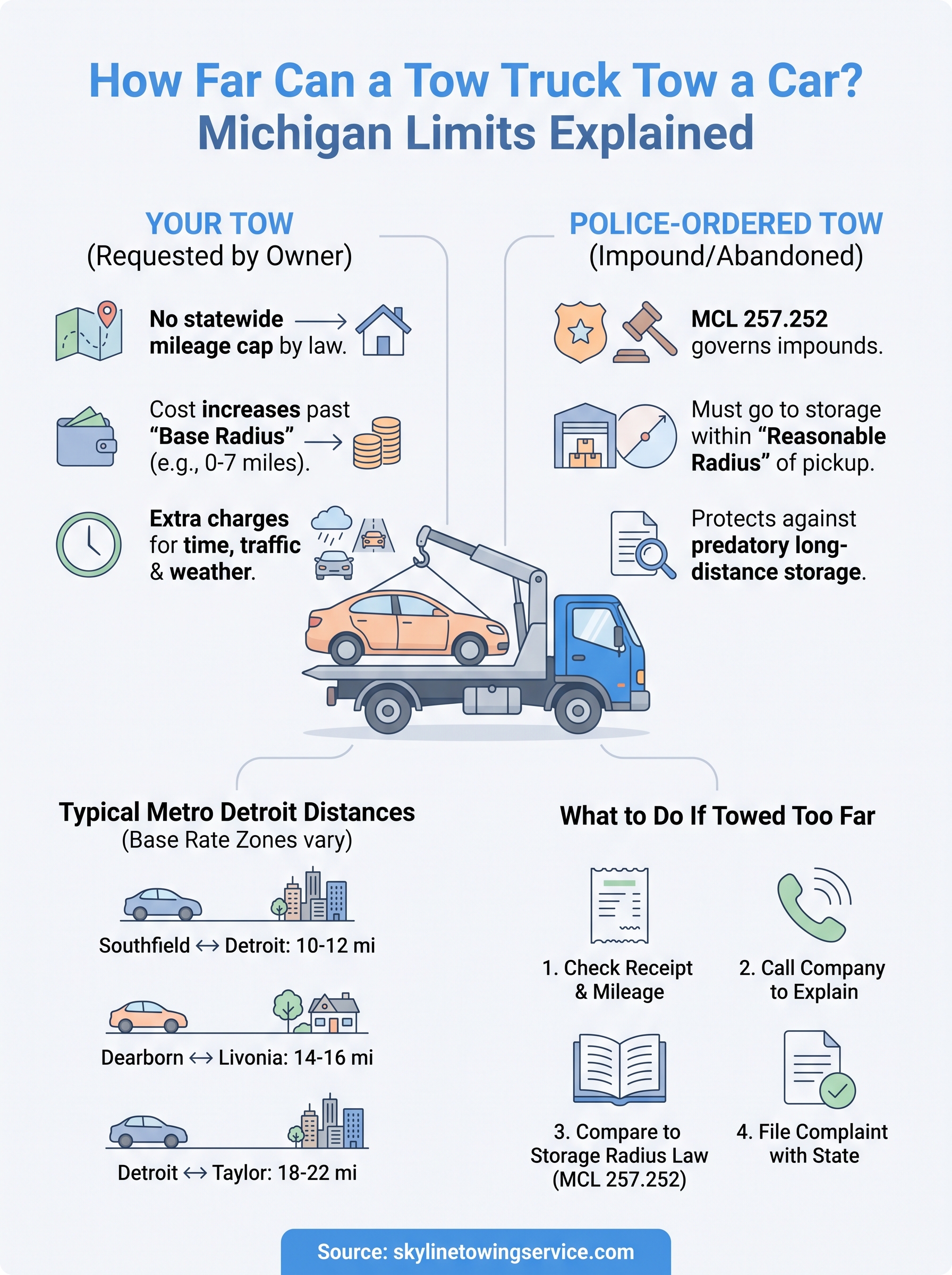
Here’s the short answer: there’s no single statewide mileage cap on towing distance in Michigan. What matters more is the storage radius rule tied to abandoned and impounded vehicles, plus how far you’re willing to pay for mileage beyond a base tow. Private property tows, police-ordered tows, and the tow you call yourself all follow slightly different logic.
We’ve hauled vehicles from Dearborn to Detroit, from Taylor out to Southfield, and everywhere between, so we know how these distance questions actually play out on real Metro Detroit roads. Below, we break down Michigan’s towing regulations, what
Why the towing distance limit actually matters to you
Most drivers never think about towing distance until they’re standing on the shoulder of I-75 near the Fisher Freeway interchange, watching their car get hooked up. Then the questions pile up fast. Will the shop near your house even be an option, or are you stuck with whatever yard the tow company prefers? Will you get hit with a per-mile fee that doubles your bill? These aren’t small details. They decide whether your roadside emergency costs $75 or $300.
The cost of every extra mile
Here’s the part most people miss: distance is one of the biggest hidden cost drivers in towing. A base tow rate usually covers a set number of miles, often somewhere around 5 to 10, and everything beyond that gets billed per mile. If your car breaks down in Dearborn Heights and you want it towed to a specialty shop in Livonia, that extra distance adds up quickly, especially during rush hour when the truck is crawling down I-94 instead of moving freely.
| Scenario | Typical Distance | Cost Impact |
|---|---|---|
| Local tow within base radius | 0-7 miles | Flat base rate, no surprises |
| Cross-suburb tow (e.g., Southfield to Taylor) | 15-20 miles | Base rate plus per-mile charge |
| Long-distance tow to a specific shop or dealer | 25+ miles | Higher per-mile rate, possible wait time fee |
Every mile past the base radius is a mile you’re paying for, so knowing the distance before the truck arrives saves you from an ugly bill later.
Storage radius and impound headaches
Michigan’s abandoned vehicle rules also tie directly into distance. When police order a tow, the vehicle usually has to go to a storage facility within a legally defined radius of where it was picked up. This protects you from a company hauling your car 40 miles away and then charging you storage fees you can’t reasonably reach to pay. If you’ve ever had a car towed from a Detroit side street after an accident, you know how stressful it already is without also having to drive across three suburbs just to retrieve it.
Peace of mind when you’re stranded
Understanding these limits isn’t just about money, it’s about knowing what to expect when you’re already having a bad day. Whether you’re broken down near the Southfield Freeway during a January snowstorm or dealing with a fender bender on Telegraph Road, knowing roughly how far your car can go, and what that will cost, lets you make a clear decision instead of a panicked one. That clarity is exactly what separates a manageable tow from an expensive mess.
How Michigan’s towing distance rules actually work
Michigan doesn’t set a hard mileage cap on towing distance in state law. Instead, the rules focus on consent, rates, and where a vehicle can legally be stored. The Michigan Vehicle Code (MCL 257.252) governs abandoned and impound tows, and it requires towing companies to keep vehicles within a reasonable distance of where they were picked up, not haul them across the metro area to a yard nobody can find.
Police-ordered tows versus tows you request
When an officer orders your car towed after an accident on I-96 or a breakdown blocking traffic on Woodward Avenue, the tow company usually has to take it to an approved storage facility nearby. You don’t get to pick the destination in that moment. Compare that to calling Skyline Towing yourself: you choose the shop, the dealer, or your driveway in Livonia, and distance simply becomes a pricing conversation instead of a legal restriction.
The law limits how far a towed car can sit in storage, not how far you can choose to have your own car taken.
What the state actually regulates
Here’s what Michigan law and local ordinances typically cover when it comes to distance and towing:
- Where impounded vehicles must be stored relative to the tow location
- Notification requirements telling owners where their car went
- Rate disclosure rules so companies can’t hide mileage charges
- Licensing requirements for tow operators working police-ordered calls
None of these set a flat "20 miles and that’s it" rule. They protect you from predatory storage practices, not from choosing a longer tow on your own terms. For the exact statutory language, the Michigan Legislature’s vehicle code is the authoritative source, and it’s worth a look if you ever end up disputing an impound.
What determines how far a tow truck will actually go
Several practical factors decide how far a tow truck will actually go, and none of them are arbitrary. Dispatchers at Skyline Towing weigh truck type, road conditions, fuel cost, and driver hours before quoting a distance, especially on longer hauls out past the I-275 corridor.

Truck type and equipment
Generally, a flatbed hauling a sedan from Dearborn to a Livonia repair shop faces fewer restrictions than a heavy duty tow truck moving a box truck from a warehouse near the Detroit riverfront to a salvage yard in Taylor. Bigger rigs burn more fuel per mile and need more clearance, so companies often cap heavy-duty runs tighter than light-duty passenger tows.
Weather, traffic, and time of day
Metro Detroit weather changes the math fast. A trip that’s a 20-minute pull down Telegraph Road on a clear afternoon turns into an hour-long crawl during a lake-effect snow squall or a jackknifed semi on I-94. Longer time on the road means higher labor cost, and that gets reflected in how willing a company is to quote a long-distance tow without a wait-time fee attached.
Driver availability and destination access
Surprisingly, one of the biggest limits isn’t distance at all, it’s whether the destination is reachable. A locked gate at a dealership after hours, a salvage auction lot with restricted drop-off windows, or a shop tucked behind a residential street with no truck access can matter more than raw mileage.
Distance rarely stops a tow truck. Access, weather, and equipment do.
Here’s a quick rundown of what typically shapes a company’s decision on distance:
- Vehicle weight and truck class required for the job
- Current weather and traffic conditions along the route
- Time of day, since night calls often carry different rates
- Destination accessibility, including gate hours and lot restrictions
- Fuel and driver time, which scale with every extra mile
Understanding these factors helps you set realistic expectations before you ever pick up the phone.
Typical tow distances around metro Detroit
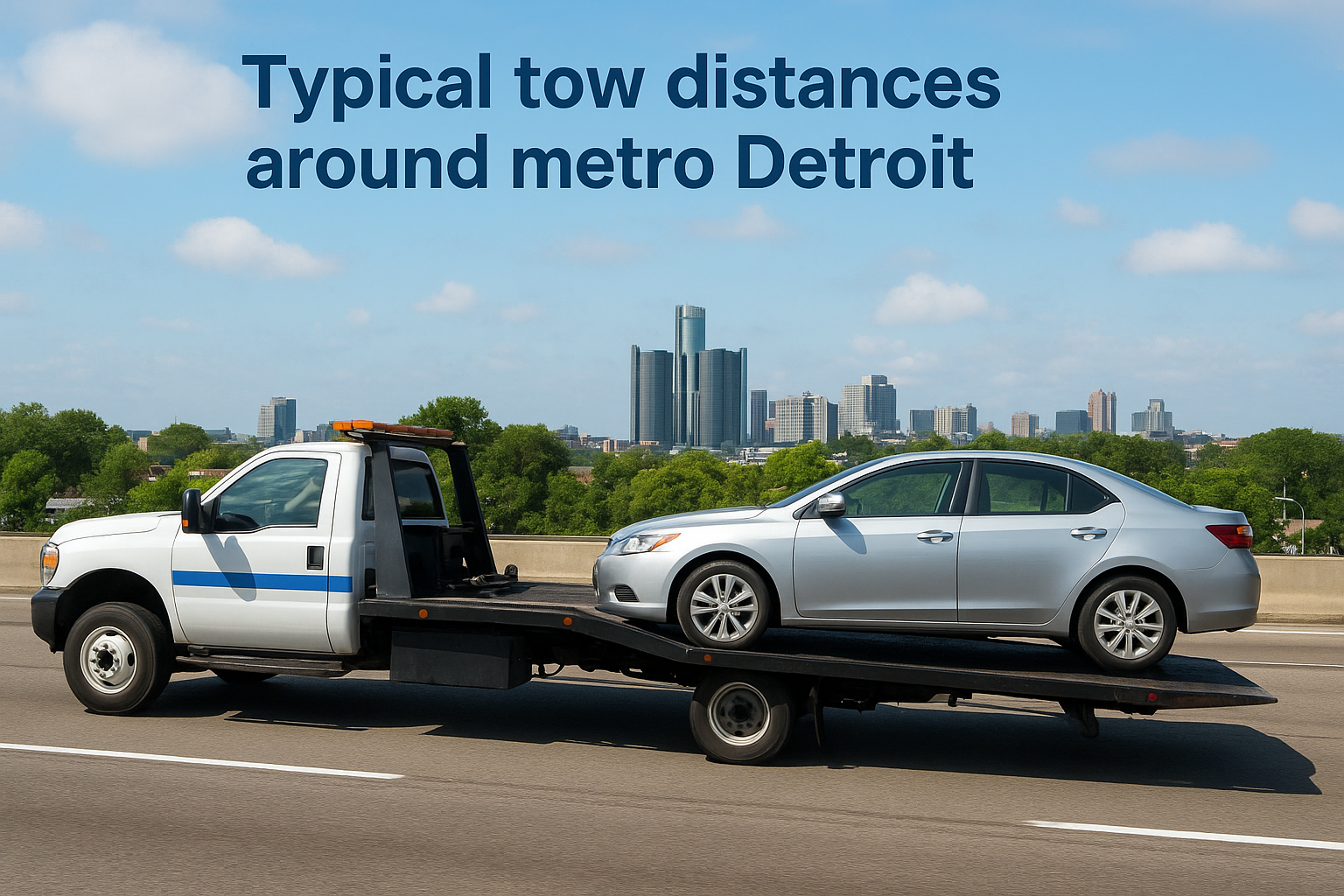
Real numbers help more than theory when you’re trying to picture how far can a tow truck tow a car on an actual Metro Detroit route. Skyline Towing runs jobs from Southfield to Taylor, Dearborn to Livonia, and plenty of short hops within Detroit proper, and the distances rarely surprise us anymore. Knowing typical mileage on these common routes gives you a realistic benchmark before you call anyone.
Common routes we run every week
Some runs happen so often we could drive them blind. A breakdown on I-96 near Southfield usually ends up at a shop within 10 miles. A tow from Dearborn Heights to a dealership in Livonia runs closer to 15 miles. Longer hauls, like moving a vehicle from a Detroit side street out to Taylor, stretch past 20 miles depending on the exact drop-off point.
| Route | Approximate Distance | Typical Time |
|---|---|---|
| Southfield to Detroit | 10-12 miles | 20-30 minutes |
| Dearborn to Livonia | 14-16 miles | 25-35 minutes |
| Detroit to Taylor | 18-22 miles | 30-45 minutes |
| Taylor to Southfield | 20-25 miles | 35-50 minutes |
Most Metro Detroit tows fall between 5 and 20 miles, which is exactly why per-mile pricing rarely spirals out of control here.
When distance changes the price
Traffic on I-94 during rush hour turns a 15-mile tow into a 40-minute job instead of 20, and that extra time shows up on the invoice. Weather adds another layer. Winter storms along Telegraph Road or the Lodge Freeway slow every truck down, so dispatchers sometimes quote wait-time separately from mileage.
Longer hauls: dealer transport and salvage runs
Occasionally a job runs well past 20 miles, usually for dealer transport or salvage auction drop-offs outside the immediate metro core. Those trips get quoted individually since they involve different equipment scheduling and sometimes cross into neighboring counties.
What to do if your car was towed too far
Finding your car parked 35 miles from where it broke down feels like a punch to the gut, but you have real options if a towed vehicle ended up farther than it should have. Start by checking the tow receipt or impound notice for the pickup address and storage location. If the gap doesn’t match a reasonable storage radius, you likely have grounds to push back.
Steps to take right away
- Photograph the tow receipt, impound slip, and any mileage listed before you leave the lot
- Call the towing company directly and ask for the exact mileage calculation used for billing
- Compare that mileage against MCL 257.252 storage radius language if it was a police-ordered tow
- File a written complaint with the Michigan Department of State if the company can’t explain the distance
- Keep every receipt, since disputed charges often get resolved through a refund, not an argument on the phone
A tow you didn’t authorize should never cost you a wasted afternoon chasing down your own car.
When it’s worth disputing the bill
Generally, disputing makes sense when the distance jumps well past what local routes normally require, say a tow from Livonia landing 30 miles away in a county you’ve never heard of. That’s not typical for Metro Detroit, and it’s usually not something Skyline Towing would ever quote without your direct approval first. Reasonable companies explain mileage before the hook goes on your bumper, not after.
Calling a company you can actually reach
Honestly, the easiest fix is avoiding the problem entirely by calling a local towing company with a real address and a dispatcher who answers the phone. Skyline Towing operates out of 6450 E Hancock St, Detroit MI 48207, and every tow we run gets quoted with distance and pricing upfront, so you’re never left guessing where your car went or why the bill looks the way it does.
Getting towed the right way, close to home
So, how far can a tow truck tow a car in Michigan? Far enough to get you where you actually need to go, without breaking any law, as long as you know the pricing upfront and the company you call operates in good faith. There’s no statewide mileage cap, but there is a storage radius rule for police-ordered tows, and there’s always a per-mile cost once you leave the base zone. Knowing both keeps you from getting stuck with a bad surprise on a stressful day.
Metro Detroit drivers don’t need to guess at any of this. Dispatchers who quote distance before the hook goes on your bumper make the whole experience predictable instead of nerve-wracking. Next time you’re stranded on I-94 or dealing with a tow gone sideways, call Skyline Towing and get a straight answer about where your car is headed and what it’ll cost to get there.