
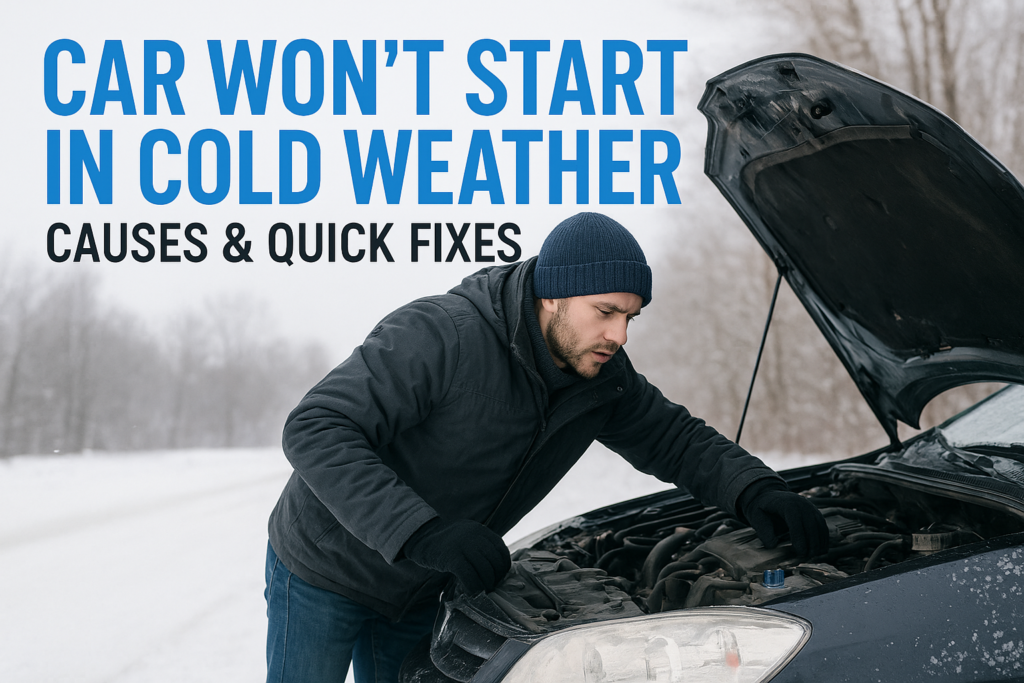
A Detroit winter morning at negative ten degrees hits different when you turn the key and nothing happens. Your car won’t start in cold weather, and you’re sitting in the driveway watching your breath fog up a windshield that’s already coated in ice. It’s one of the most common calls we get at Skyline Towing, especially between December and March when Metro Detroit temperatures drop well below freezing for days at a stretch.
From our headquarters at 6450 E Hancock St, Detroit, MI 48207, we respond to dead batteries, frozen fuel lines, and no-start situations across Dearborn, Southfield, Livonia, Taylor, and every neighborhood in between. After years of handling these calls on roads like I-94, Telegraph, and Michigan Avenue, we’ve seen the same handful of causes come up again and again, most of which you can actually troubleshoot yourself before calling for a tow.
This guide breaks down the most common reasons your vehicle refuses to start when temperatures plummet, along with practical fixes you can try right there in your driveway or parking lot. We’ll cover everything from weak batteries to thickened oil, so you can figure out what’s going on and decide whether it’s a quick fix or time to call for roadside assistance.
Why cold weather causes no-start problems
When temperatures drop below freezing in Metro Detroit, several systems in your vehicle struggle at the same time. The problem is rarely just one thing. Cold weather creates a chain reaction where a slightly weak battery meets thickened engine oil and suddenly your car won’t start in cold weather, even if it was running fine the day before at a normal temperature. Understanding each factor helps you narrow down the cause quickly instead of guessing.
Your battery loses cranking power fast
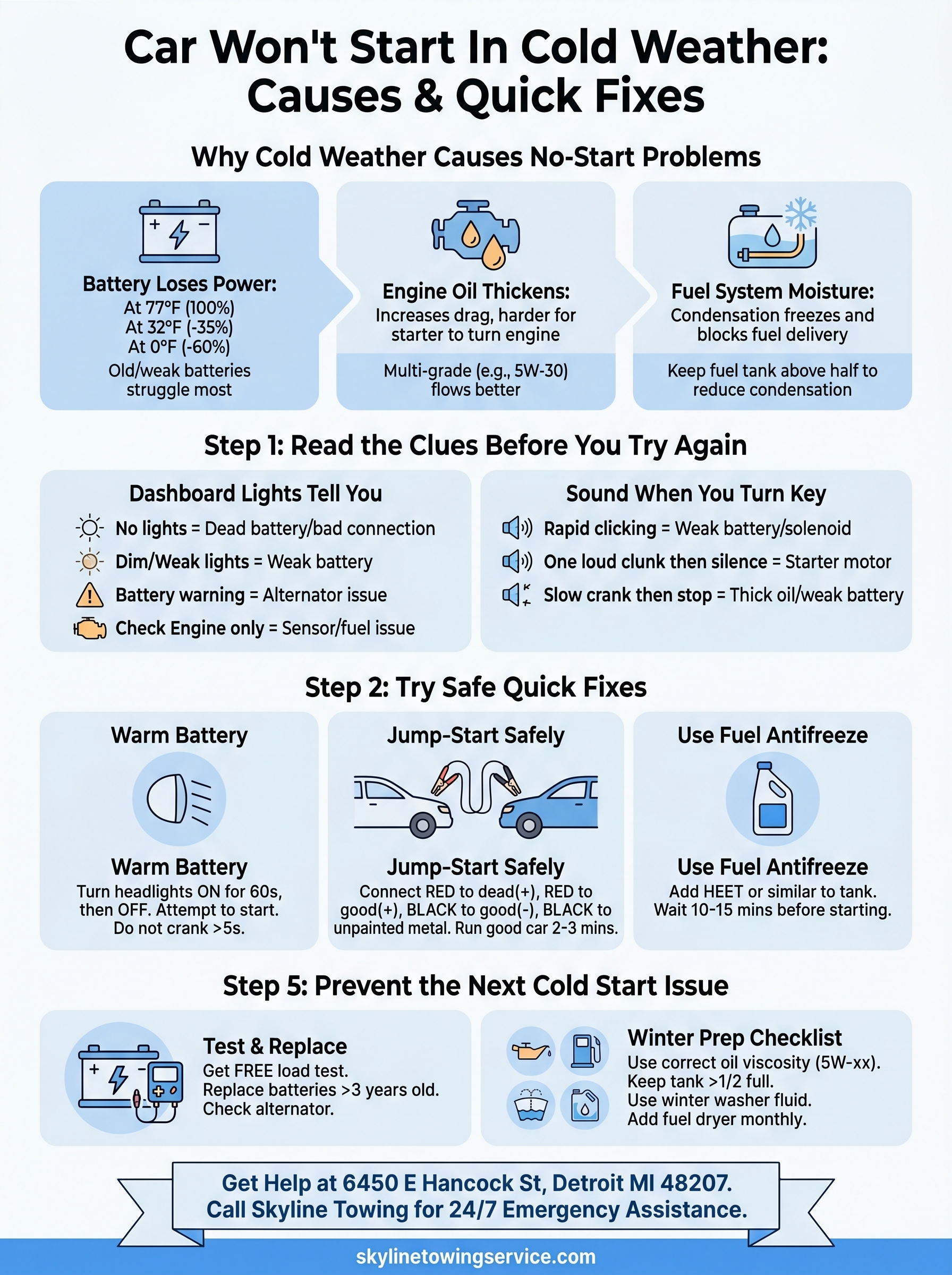
The battery is the most common culprit. A standard car battery operates most efficiently around 77°F. Once you drop to 32°F, a battery loses roughly 35% of its cranking power. At 0°F, that loss climbs to around 60%. At the same time, your engine needs more power to turn over in the cold because the oil is thicker and creates more resistance. So you have less power available right when you need the most.
If your battery is already older than three years or has been running near the end of its capacity, a cold snap is usually what finally kills it. Detroit winters in parking lots off Michigan Avenue or along Telegraph Road, left overnight in January, can push a borderline battery over the edge entirely.
A battery that tests fine in October can fail completely by January if it’s already lost significant capacity.
Engine oil thickens and increases drag
Cold temperatures cause engine oil to thicken, which means your starter motor has to work much harder to turn the engine over. This puts extra load on an already cold battery at the same time the battery has the least power to give. Most modern vehicles use multi-grade oil like 5W-30 specifically because the "5W" rating handles cold starts better, but older vehicles or those with the wrong oil viscosity for winter can still struggle below 10°F.
Running oil that is overdue for a change compounds the problem. Degraded oil loses its flow properties quicker than fresh oil, meaning it thickens at a higher temperature than clean oil of the same grade would. If you have not changed your oil heading into winter, that matters on a brutally cold Detroit morning.
Fuel system and moisture problems
Moisture inside your fuel system is a cold-weather problem that catches many drivers off guard. Water gets into your fuel tank through condensation, and in freezing temperatures that moisture can turn to ice and partially or fully block the fuel line. This issue is more common in vehicles with a lower fuel level, since there is more air space in the tank where condensation forms.
Here is a quick breakdown of the main cold-weather culprits and how each one affects your start:
| Cause | What happens | When it gets critical |
|---|---|---|
| Weak battery | Loses cranking amps | Below 20°F |
| Thick oil | Increases engine drag | Below 10°F |
| Frozen fuel line | Blocks fuel delivery | At or below 32°F |
| Bad spark plugs | Weak or no ignition spark | Any cold temp |
| Failing alternator | Battery never fully charges | Noticeable after overnight |
Ethanol-blended fuels absorb water more readily than straight gasoline, and that water can separate and freeze near the fuel filter or injectors. If your engine cranks but refuses to fire, a moisture-related fuel issue is one of the first causes worth ruling out before moving on to other possibilities.
Step 1. Read the clues before you try again
Before you crank the engine a second or third time, take 30 seconds to observe what’s happening around you. Your vehicle is giving you information right now, and reading those clues correctly saves you from making the situation worse. When a car won’t start in cold weather, the symptoms you notice in the first few seconds point directly at the likely cause, whether that’s a dead battery, a flooded engine, or something in the fuel system. Cranking repeatedly without knowing what’s wrong can drain a weak battery completely or flood the engine, so slow down before you try again.
Cranking a struggling engine more than three or four times without diagnosing the cause drains the battery faster and can push a borderline situation into a full breakdown.
What the dashboard lights tell you
Your dashboard is the first place to look before you touch the ignition again. Turn the key to the "on" position without trying to start the engine, and watch exactly what lights come up and how bright they are.
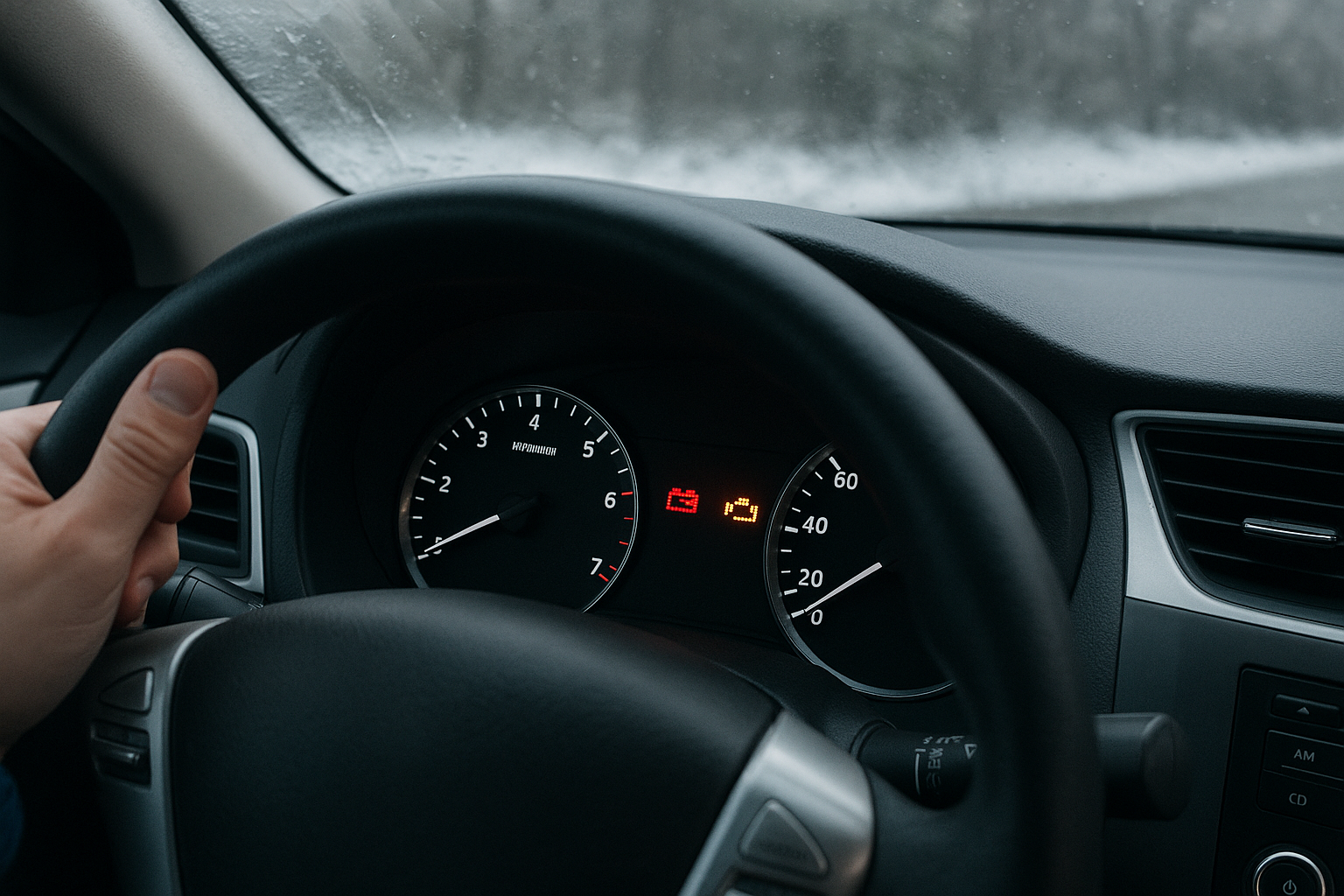
| What you see | What it likely means |
|---|---|
| No lights at all | Battery is completely dead or a connection is broken |
| Dim, weak lights | Battery has partial charge but not enough cranking amps |
| Battery warning light | Alternator may not have been charging properly |
| Check engine light only | Possible sensor or fuel delivery issue |
| All lights look normal | Starter motor, fuel system, or ignition issue is more likely |
A completely dark dashboard with zero response when you turn the key points straight at the battery or a corroded terminal. This distinction matters because a dead battery and a failed starter need completely different responses, and confusing them costs you time in a Detroit January parking lot.
What you hear when you turn the key
The sound your engine makes (or doesn’t make) is one of the most reliable clues available on a cold morning. Each sound pattern maps to a specific problem, so listen closely before assuming anything.
A rapid clicking noise with no crank almost always means a weak or dead battery. The starter solenoid is trying to engage but lacks the power to turn the engine over. One heavy clunk followed by silence typically points to the starter motor itself. If you hear the engine cranking slowly and then stopping, the battery has some charge but not enough to overcome the resistance of cold, thickened oil on a sub-zero morning.
Step 2. Try safe quick fixes on the roadside
Once you know what you’re dealing with from Step 1, you can try a few safe, proven techniques before calling for a tow. These fixes work in real conditions, whether you’re in a Southfield parking lot or your driveway off Gratiot Avenue on a morning where your car won’t start in cold weather and the temperature hasn’t climbed above 15°F. The goal here is to give the vehicle the best chance to start without making the situation worse through repeated cranking or unsafe jump attempts.
Warm the battery before you crank again
A cold battery responds better to warmth, and you can take advantage of that even without tools. Turn on your headlights for 60 seconds and then turn them off before attempting to start. This process sends a small charge through the battery’s cells and can slightly warm the internal temperature enough to improve cranking power. It sounds minimal, but on a borderline battery sitting at 18°F, it can make the difference.
Never crank the engine for more than five seconds at a time. If it doesn’t start, wait 30 seconds between attempts to let the starter motor cool and avoid draining the battery further.
After the brief warm-up, try starting the engine with all accessories off, including the heater, rear defroster, and seat warmers. Every accessory draws power away from the starter during a cold start.
Jump-start safely with a good connection
If the battery is too weak to crank, a jump-start from another vehicle is usually your fastest fix. The connection order matters, and getting it wrong can damage electronics on modern vehicles. Follow this sequence every time:
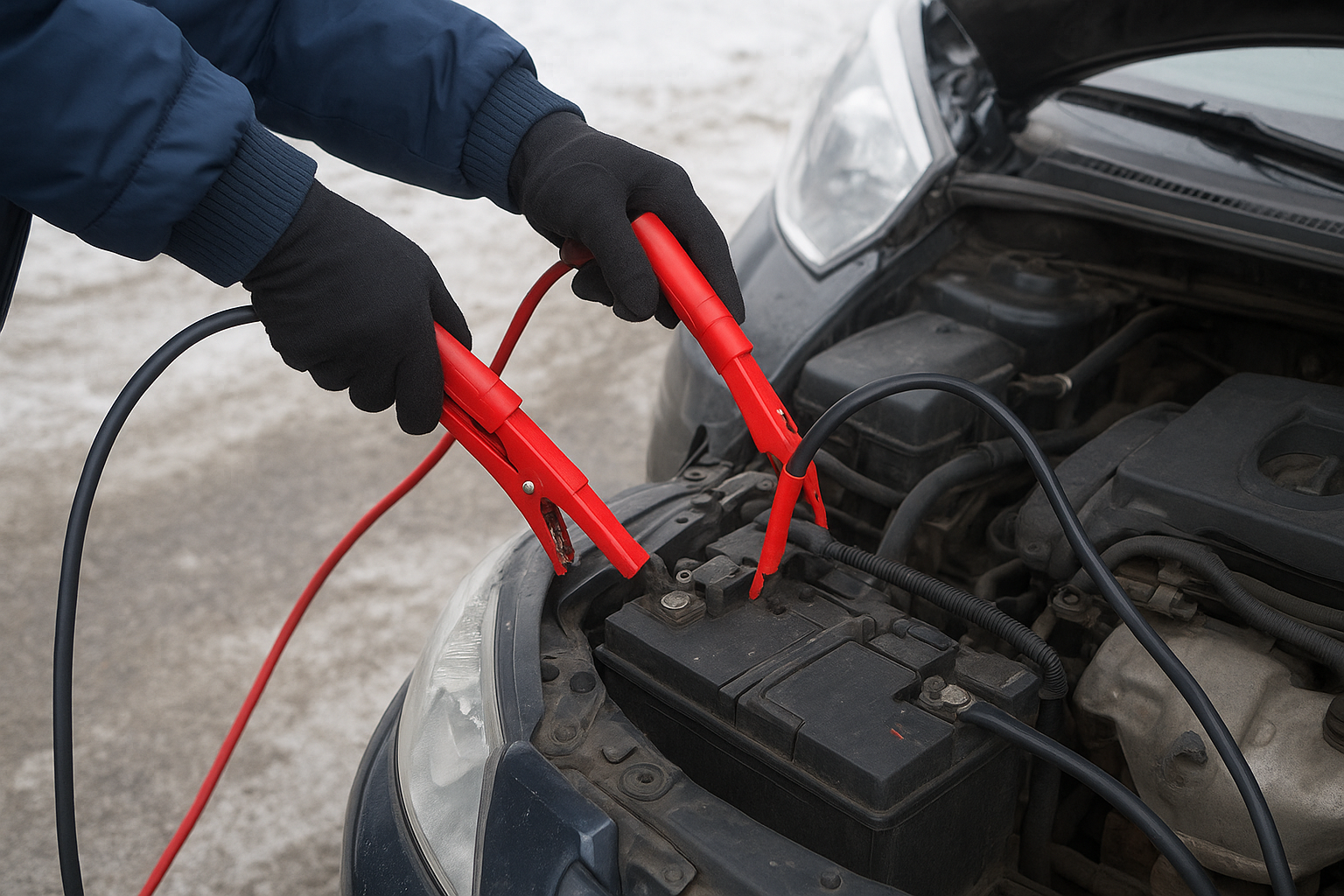
- Connect the red cable to the dead battery’s positive terminal
- Connect the other red cable to the good battery’s positive terminal
- Connect the black cable to the good battery’s negative terminal
- Connect the final black cable to an unpainted metal surface on the dead vehicle, away from the battery
- Start the good vehicle and let it run for two to three minutes before attempting to start your car
- Disconnect in reverse order once your vehicle starts
Use fuel antifreeze if the engine cranks but won’t fire
If your engine turns over fine but refuses to start, moisture in the fuel line is a real possibility, especially in Michigan winters. Products like HEET or ISO-HEET are available at most auto parts stores and gas stations along Dix Highway or Warren Avenue. Pour one full bottle into your fuel tank and give it 10 to 15 minutes to work through the system before trying to start again.
Step 3. Track down the likely cause fast
After working through the quick fixes in Step 2, your next move is to systematically rule out causes rather than keep guessing. A focused check takes less than ten minutes and saves you from replacing a part that was never the real problem. When a car won’t start in cold weather, the answer almost always comes down to one of three areas: the battery and its connections, the fuel system, or the ignition components. Work through each one in order before you make any decisions.
Check the battery terminals and connections
Corroded or loose terminals are one of the most overlooked causes of a no-start, and they are easy to spot once you pop the hood. Look at both battery terminals closely. If you see a white or bluish-green buildup caked around the posts, that corrosion is adding resistance to the circuit and preventing full power from reaching the starter motor. Even if your jump-start worked earlier, corroded terminals will pull a new or freshly charged battery down quickly if you leave them alone.
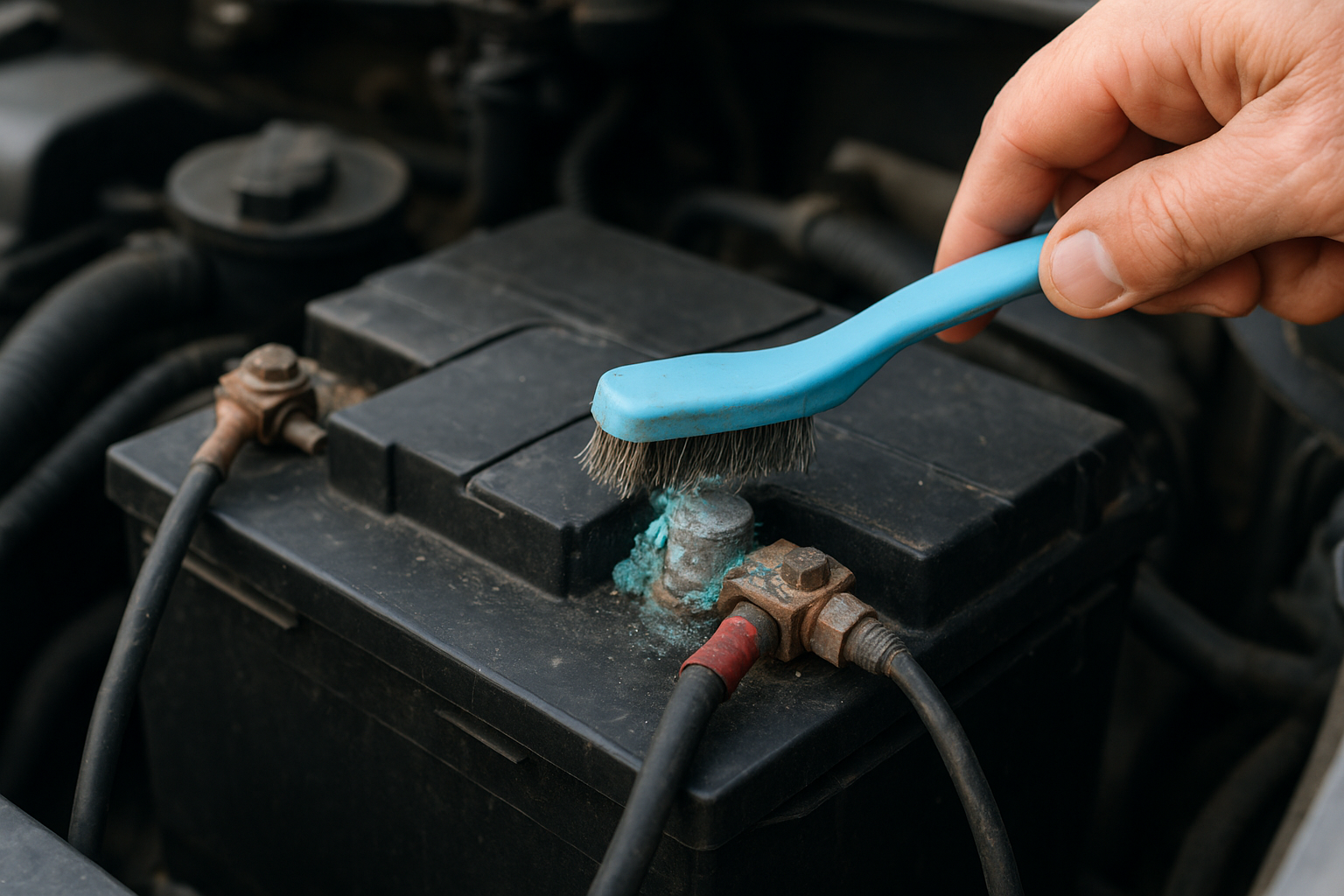
A terminal that wiggles even slightly when you push it by hand can cause an intermittent no-start that gets dramatically worse in the cold.
Use a baking soda and warm water mix to scrub the terminals if you have it available. If not, make a note of the buildup and flag it for your next shop visit. Tighten any connection that moves under light hand pressure before you try starting the vehicle again.
Test for a fuel or ignition problem
If the battery and terminals look solid, shift your attention to fuel delivery and spark. The fastest way to separate a fuel problem from an ignition problem is to listen carefully while you crank the engine. An engine that cranks at a normal speed but refuses to fire is almost always missing fuel or spark, not battery power.
Run through this quick diagnostic sequence before making any further decisions:
- Confirm you have fuel in the tank by checking the gauge directly
- Turn the key to the "on" position for five full seconds without cranking to let the fuel pump prime
- Attempt to start the engine after that pause
- If the engine still will not fire, check whether you smell raw fuel near the exhaust, which signals flooding rather than a fuel supply problem
Step 4. Decide if you should drive or call for help
Getting the engine running after a car won’t start in cold weather is only half the decision. Driving a vehicle that started with difficulty can leave you stranded on I-94 or stuck at a red light on Woodward Avenue in worse shape than when you began. Before you pull out of your driveway or parking lot, spend two minutes reading the situation honestly so you make the right call.
Signs it’s safe to drive after a cold-weather start
If your vehicle started after a jump-start or one of the quick fixes from Step 2, watch how it behaves during the first 60 to 90 seconds of idle. A healthy engine will smooth out quickly as it warms up, the battery warning light will go off, and the idle RPM will drop to a steady, consistent level without surging or stumbling.
If the battery light stays on after the engine is running, your alternator is likely not charging, and driving will drain the battery completely within a few miles.
You are generally safe to drive short distances if the engine idles smoothly, all warning lights clear within the first minute, and the heater begins producing warm air within five minutes. Keep the drive short, get to a shop or auto parts store the same day, and have the battery and alternator tested before your next overnight park.
When you should call for a tow instead
Some symptoms tell you that driving is the wrong choice, no matter how urgently you need to be somewhere. Skipping a tow in these situations can turn a manageable repair into a much larger one. Call Skyline Towing at 6450 E Hancock St, Detroit, MI 48207 if you see any of the following:
- The engine cranks but never fires despite multiple attempts and quick fixes
- You smell burning or raw fuel after cranking
- The dashboard shows multiple warning lights at the same time
- The vehicle started but stalls immediately when you shift into drive or reverse
- You hear grinding or loud knocking from under the hood after the engine turns over
Driving through any of those conditions risks engine damage, and a tow is always cheaper than a seized motor.
Step 5. Prevent the next cold morning no-start
Once you get your vehicle running again, the smartest move is to stop the problem from repeating. Most cold-weather no-start situations are predictable and preventable with a few targeted steps before the next cold snap arrives. Metro Detroit winters give you no margin for a battery that is on its last legs or fluids that are not rated for the conditions, so take action while the experience is still fresh.
Test your battery and charging system now
Battery testing is free at most auto parts stores, and it takes about five minutes. Have your battery load-tested rather than just voltage-checked, because a battery can show 12.6 volts at rest and still fail under the cranking load of a 10°F morning. If your battery is older than three or four years, replace it before winter deepens rather than waiting for another no-start to force the decision.
A battery that tests at 70% capacity or below in October will very likely fail in January when you need it most.
Ask the shop to also check your alternator output at the same time. A failing alternator means your battery never fully recharges between drives, which compounds into a no-start within a few cold nights.
Switch to the right oil and top off key fluids
Use the correct viscosity oil for cold-weather driving. Check your owner’s manual for the manufacturer’s recommendation for temperatures below 0°F. Most modern engines specify 5W-30 or 5W-20, both of which flow well in cold conditions. If you are overdue for an oil change, do it before the first deep freeze of the season.
Beyond oil, run through this quick pre-winter fluid checklist:
- Coolant mixture tested to at least -34°F with an inexpensive coolant tester
- Fuel tank kept above half to reduce condensation inside the tank
- Fuel system dryer like HEET added to a full tank once per month through winter
- Windshield washer fluid rated for -20°F or lower, not summer formula
A car won’t start in cold weather nearly as often when these basics are handled before temperatures drop. Spending thirty minutes and a small amount of money now saves you a frozen morning and a potential tow bill later.
Get Help at 6450 E Hancock St, Detroit MI 48207
When your car won’t start in cold weather and none of the fixes in this guide do the job, Skyline Towing is ready to help. We run 24/7 emergency roadside assistance across Detroit, Dearborn, Southfield, Livonia, Taylor, and every corner of Metro Detroit, so you are never far from a crew that knows these roads and these conditions firsthand.
Our team handles dead batteries, frozen fuel lines, jump-starts, and full tows to the shop of your choice, no matter how cold or how early the call comes in. Whether you are stuck in a parking lot off Telegraph Road or sitting in your driveway on a morning where the temperature never broke 5°F, we dispatch fast and arrive ready to work.
Call us or request roadside assistance in Metro Detroit directly from our site. We are based at 6450 E Hancock St, Detroit, MI 48207 and ready to roll right now.