

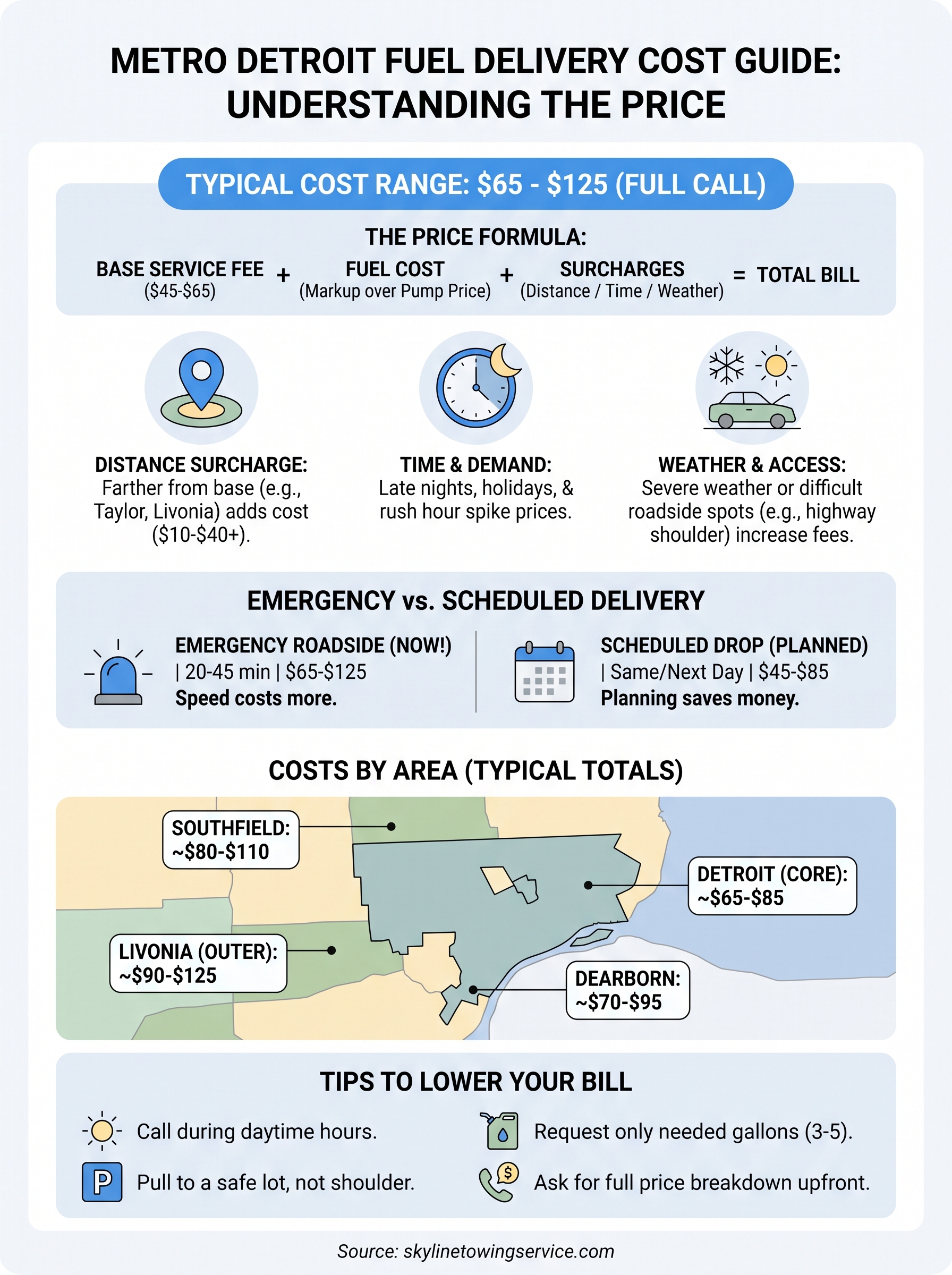
Running on empty on I-94 near the Ambassador Bridge or coasting into a dead stop on Woodward Avenue during rush hour isn’t just stressful, it’s expensive if you don’t know what you’re getting into. The fuel delivery service cost in metro Detroit usually runs between $65 and $125 for the full call, but that number swings based on time of day, your location, and how far out the truck has to travel. If you’ve never called for gas delivery before, that range can feel confusing, especially when every company quotes it differently.
Here’s the straight answer: most drivers pay a flat service call fee plus the price of the fuel itself, which is typically marked up a bit over pump price to cover the delivery. Late-night calls out to Southfield or Livonia often cost more than a weekday afternoon run near our Detroit shop.
At Skyline Towing, headquartered at 6450 E Hancock St, Detroit MI 48207, we’ve delivered fuel to stranded drivers from Dearborn Heights to Taylor in every kind of Michigan weather. This article breaks down what actually drives that price, including per-gallon rates, minimum charges, and how distance from our location affects your total bill.
Why fuel delivery cost matters for Detroit drivers
Running out of gas on I-75 near the Fisher Building isn’t just embarrassing, it’s a financial decision made under pressure. When your tank hits zero, you’re not comparison shopping. You’re calling whoever answers first, and that’s exactly why understanding fuel delivery pricing ahead of time protects your wallet. Drivers who know the going rate can spot a fair quote versus one that’s padded because dispatch knows you’re stuck and desperate.
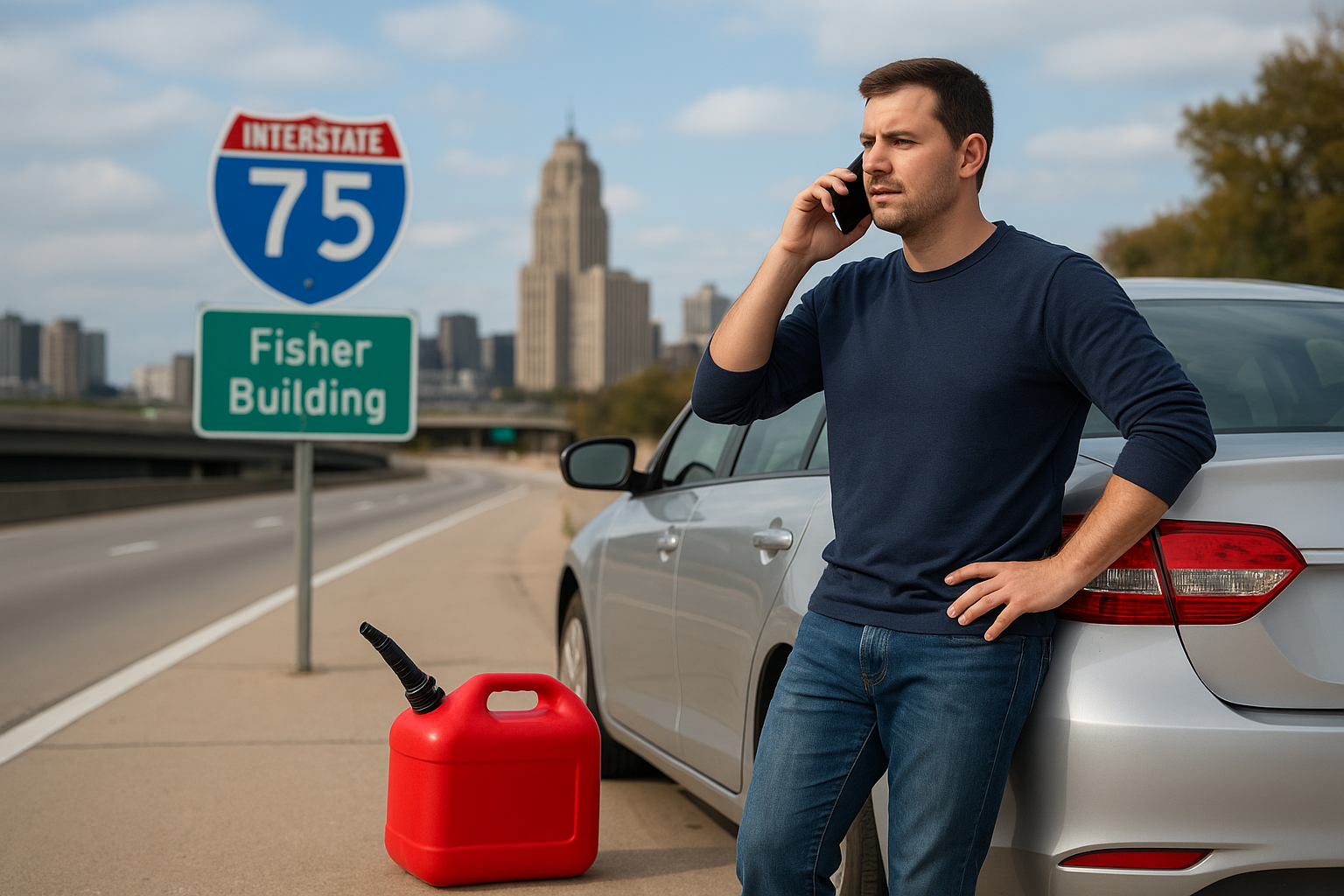
Running out of gas costs more than a tank of fuel
Skip the fuel delivery call and try to solve it yourself, and the math gets worse fast. A towing bill for hauling your car to the nearest gas station on Gratiot Avenue almost always costs more than a fuel drop, plus you lose the time waiting for a flatbed instead of a technician who shows up with a five-gallon can.
| Situation | Typical Cost Range | Time to Resolve |
|---|---|---|
| Fuel delivery service | $65-$125 | 20-45 minutes |
| Tow to nearest gas station | $95-$180+ | 45-90 minutes |
| Walking to a station and back | $0 (plus gas can) | 1-2+ hours |
Those numbers shift depending on where you’re stranded, but the pattern holds across metro Detroit: fuel delivery is almost always the cheaper, faster fix when your tank runs dry mid-drive.
A fuel delivery call almost always beats the cost and wait time of a full tow to the nearest gas station.
Metro Detroit weather raises the stakes
Winter changes everything about this equation. Stall out on I-96 during a January whiteout and you’re not just inconvenienced, you’re at risk. Sub-freezing temperatures turn a routine gas call into something closer to an emergency, and companies that run 24/7 roadside crews often adjust pricing for overnight or storm-related dispatches because the roads themselves are harder to work. Summer heat waves on the Lodge Freeway create a different kind of urgency, since sitting in a dead car with no AC for an hour isn’t safe for kids, pets, or anyone with health conditions. Either way, weather is a real cost driver, not just a backdrop, and it’s worth asking your provider directly whether storm conditions affect the quote before you agree to it.
Knowing the price keeps you from getting overcharged
Detroit has plenty of legitimate roadside companies, but it also has a few outfits that quote low over the phone and then tack on fees once the truck arrives. Asking about the full breakdown upfront, meaning the service call fee, the per-gallon rate, and any distance or after-hours surcharges, gives you leverage before the technician is standing at your window. This matters more than people expect because once someone’s on the shoulder of Telegraph Road with traffic roaring past, they’re far more likely to just pay whatever’s asked rather than argue over an extra $20.
Getting a straight number before dispatch also helps you plan for the unexpected. Nobody budgets for running dry on the Southfield Freeway during a work commute, but knowing the realistic price range means you’re not caught off guard when the bill lands. That’s the whole point of breaking this down: so the next time you’re staring at an empty fuel gauge somewhere between Dearborn and downtown, you already know roughly what to expect and can make a quick, confident call instead of a panicked one.
How to estimate your fuel delivery cost before you call
Before you dial anyone, you can rough out your own number in under a minute. Most metro Detroit fuel delivery quotes follow a simple structure: a flat dispatch fee, plus the cost of the fuel itself, plus any distance or time-of-day add-on. Knowing this formula means you’re not just hoping the quote sounds fair, you’re actually checking the math against what you already know about your situation.
Do the math with a simple formula
Here’s the rough calculation most Detroit-area providers use, including us:
Base service call fee: $45-$65
+ Fuel cost (per gallon, marked up $1-$2 over pump price)
+ Distance surcharge (if outside normal service radius)
+ After-hours or holiday surcharge (if applicable)
= Total fuel delivery cost
Say you’re stuck near the Southfield Freeway at 2 p.m. on a Tuesday and need five gallons of regular. A $50 base fee plus five gallons at roughly $1.50 over pump price adds about $7.50, landing you close to $58 before tax. Add a late-night run past midnight or a stretch out toward Taylor, and that same call can climb toward the higher end of the $65 to $125 range we mentioned earlier.
Run the formula yourself before you call, and you’ll know within a few dollars what a fair quote looks like.
Know your tank size and distance from help
Most drivers only need three to five gallons to get moving again, just enough to reach the nearest station on Michigan Avenue or Gratiot without paying for fuel you won’t use. Tank capacity matters less than how far you are from a working gas station, since that distance often determines whether the technician needs one stop or has to loop back for more fuel. If you’re way out past your provider’s normal coverage area, expect a mileage add-on baked into the quote.
Ask these questions before the truck rolls
A quick phone call can confirm your estimate before anyone leaves the shop:
- What’s the flat service call fee, and does it include the first few gallons?
- What’s the per-gallon rate compared to today’s pump price?
- Is there an extra charge for my location or the time of day?
- Does the quote change if I’m on a highway shoulder versus a parking lot?
Getting straight answers to these four questions before dispatch means the number you hear on the phone is the number you’ll actually pay when the truck pulls up.
What affects fuel delivery prices around metro Detroit
Several factors stack together to build the number you hear on the phone, and understanding each one helps you spot a fair quote versus a padded one. Location tops the list, since a fuel drop near our Detroit headquarters on E Hancock St costs less than a run out to Livonia or the far edges of Southfield, simply because the truck burns more time and fuel getting there. Every provider draws a service radius, and calls outside that radius usually carry a mileage surcharge tacked onto the base fee.
Distance from base and coverage zones
Metro Detroit is spread wide, and towing companies price around that reality. A call from Dearborn or Highland Park, both close to most Detroit-based dispatch points, typically stays near the low end of the price range. Push farther toward Taylor, Livonia, or the outer edges of Southfield, and expect a distance add-on.
| Zone | Distance from Central Detroit | Typical Surcharge |
|---|---|---|
| Core Detroit, Dearborn | 0-8 miles | None to minimal |
| Southfield, Dearborn Heights | 8-15 miles | $10-$20 |
| Taylor, Livonia, outer suburbs | 15-25+ miles | $20-$40 |
The farther the truck has to drive, the higher your quote climbs, so location alone can shift your total by $40 or more.
Time of day and demand spikes
Nighttime calls cost more almost everywhere, and metro Detroit is no exception. Dispatch crews running past midnight or during a holiday weekend often build in an after-hours surcharge, since fewer technicians are on shift and demand tends to spike during storms or major traffic backups on I-94 and the Lodge. Rush hour on the Southfield Freeway can also slow response times without necessarily raising price, but a 3 a.m. call during a January cold snap almost always does.
Fuel type and gallons requested
Diesel costs more per gallon than regular unleaded almost everywhere, and that difference carries straight through to your delivery bill. Requesting more gallons than you actually need also adds cost without adding much benefit, since most stranded drivers only need enough to reach the next station. Fewer gallons at a fair markup nearly always beats overordering fuel you won’t use before your next fill-up anyway.
Road access and vehicle location
Narrow side streets in older Detroit neighborhoods, tight parking structures downtown, or a car stuck on a highway shoulder with no safe pull-off all affect how quickly and safely a technician can reach you. Vehicles blocking traffic on a busy stretch like Gratiot Avenue sometimes require extra care or even a brief lane closure, and that added complexity can factor into the final price a company quotes.
Emergency roadside delivery vs. scheduled fuel drops
Not every empty tank calls for the same kind of response, and Detroit drivers pay differently depending on which one they need. An emergency roadside delivery gets a truck to you within the hour, often faster if you’re stuck on a busy stretch like I-96 or the Lodge Freeway during rush hour. A scheduled fuel drop, on the other hand, is something you book ahead of time, usually for fleet vehicles, construction equipment, or a car you know is running low before a long trip to Ann Arbor or beyond. The pricing gap between these two exists because urgency costs money, plain and simple.
Why emergency calls cost more
Getting a technician out to you in 20 to 30 minutes means pulling a truck off another job or keeping crews on standby around the clock. That readiness isn’t free, and it shows up in the quote. Calls placed after midnight, during a snowstorm, or right in the middle of a Woodward Avenue traffic jam almost always land closer to the top of the $65 to $125 range because dispatch has to prioritize speed over efficiency.
Paying for speed makes sense when you’re stranded, but paying for it when you didn’t need to is money left on the table.
Why scheduled drops run cheaper
Booking ahead lets a provider route your delivery alongside other stops, which cuts down on wasted mileage and lets the crew plan around traffic instead of fighting it. Fleet managers in Taylor and Livonia who schedule regular fuel drops for work trucks often lock in a lower per-gallon rate simply because the volume and predictability make the job easier to plan.
| Delivery Type | Response Time | Typical Cost |
|---|---|---|
| Emergency roadside | 20-45 minutes | $65-$125 |
| Scheduled fuel drop | Same-day or next-day | $45-$85 |
Picking the right option for your situation
Deciding between the two comes down to how much control you have over the timing. If you’re already stalled on Gratiot Avenue with traffic backing up behind you, emergency delivery is the only real option, and the higher price buys you a fast resolution. If you know your work van runs low every Friday afternoon, scheduling a recurring drop saves real money over time. Skyline Towing offers both, so whether you’re calling from the shoulder in a panic or planning ahead for a fleet of vehicles based near Dearborn Heights, the pricing structure matches the urgency of what you actually need.
Typical fuel delivery costs across the Detroit area
Numbers help more than ranges once you know your own neighborhood, so here’s what real calls tend to cost across the areas we cover most. The fuel delivery service cost shifts depending on how close you are to a dispatch point and how many gallons you actually need, but patterns hold steady enough that you can plan around them. Drivers near our Detroit headquarters on E Hancock St typically land at the lower end of the range, while those farther out pay more for the added drive time.
What drivers actually pay by area
City limits and inner suburbs like Dearborn stay closest to the base fee, while outer communities carry the distance surcharges we covered earlier. Here’s a realistic breakdown based on typical calls across our service area:
| Area | Typical Total Cost | Notes |
|---|---|---|
| Detroit (downtown, Midtown, East Side) | $65-$85 | Closest to dispatch, minimal surcharges |
| Dearborn, Dearborn Heights | $70-$95 | Slight distance add-on |
| Southfield | $80-$110 | Moderate distance, higher demand during rush hour |
| Taylor | $85-$115 | Outer service radius, mileage factored in |
| Livonia | $90-$125 | Farthest coverage zone, top of the range |
Where you’re stranded matters almost as much as when, since distance alone can swing your bill by $40 or more.
Reading a real invoice
Breaking down an actual bill removes the guesswork, so here’s what a typical Southfield call might look like on paper:
- Base service call fee: $55
- 4 gallons of regular unleaded at $1.75 over pump price: $7.00 markup plus fuel cost
- Distance surcharge (Southfield zone): $15
- Total before tax: roughly $92
Seeing the line items laid out this way makes it obvious why two calls in different zip codes can carry a $30 gap even when both drivers needed the same four gallons.
Why these numbers hold steady
Though gas prices fluctuate week to week, the service structure behind fuel delivery stays fairly consistent across metro Detroit providers. Skyline Towing keeps pricing transparent because guessing games don’t help anyone stuck on the shoulder of I-94 with traffic rushing past. Understanding these typical costs before you’re in that situation means you can recognize a fair quote the moment dispatch gives you a number, rather than wondering afterward if you paid too much.
How to keep your fuel delivery costs down
A few habits separate drivers who pay the low end of the range from those who get hit with every possible surcharge. Watching your fuel gauge before it hits empty gives you room to plan a call during business hours instead of a 2 a.m. emergency out past Southfield. Small changes in timing and location can shave real money off your next bill without cutting corners on service.
Time your call when you can
Daytime calls almost always cost less than overnight ones, since providers don’t need to pull crews off standby or pay after-hours rates. If your tank light comes on during a normal workday, pulling into a safe spot and calling right away beats limping along until midnight and paying the higher emergency rate. Weekday afternoons near our Detroit shop tend to see the fastest response and the smallest add-ons, simply because trucks are already out running routine calls in the area.
Calling during daylight hours instead of waiting until you’re stranded overnight can save you $20 or more on the same delivery.
Pull over somewhere safe and accessible
Where you stop matters almost as much as when you call. A car parked in a lot off Michigan Avenue is faster and cheaper for a technician to reach than one stuck on a narrow shoulder along I-96 with no safe pull-off. If you feel your tank running low, aim for a parking lot or side street rather than pushing until you stall in traffic, since road access sometimes factors into the final quote.
Request only the fuel you need
Ordering ten gallons when three would get you to the nearest station just adds cost for no real benefit. Most drivers only need enough to reach a gas station on Gratiot or Woodward, so asking for a smaller amount keeps the per-gallon markup from ballooning your total.
Quick checklist before you call
- Check your gauge early and call before you’re fully empty
- Pull into a lot or side street instead of a highway shoulder when possible
- Call during daytime hours if the situation allows it
- Request only the gallons you need to reach the nearest station
- Ask for the full price breakdown before the truck leaves the shop
Following even two or three of these habits consistently keeps your fuel delivery service cost closer to the low end of the range, and it turns a potentially stressful call into a quick, predictable fix.
Getting back on the road in Detroit
Running empty on the Lodge or coasting to a stop on Gratiot Avenue doesn’t have to turn into a guessing game about price. Knowing the fuel delivery service cost ahead of time, roughly $65 to $125 depending on location, time, and gallons needed, means you can make a fast decision instead of a panicked one. Distance from base, time of day, and how many gallons you actually request all shift that number, but the formula stays predictable once you understand the pieces.
Skyline Towing has run these calls across Detroit, Dearborn, Southfield, Taylor, and Livonia long enough to know what a fair quote looks like in every neighborhood we serve. Next time your gauge hits empty on I-94 or the Southfield Freeway, skip the guesswork and call Skyline Towing for fast, transparent fuel delivery. We’ll get you back on the road without the runaround.