
You hit a pothole on I-94 near the Ambassador Bridge, or roll over a chunk of debris on Woodward Avenue, and now your tire is shredded. Searching emergency tire change service near me at 11 p.m. isn’t about browsing options, you need someone who actually shows up and gets you back on the road within the hour. That’s the exact situation this guide is built for.
If you’re stuck on the shoulder of I-75 through Detroit or parked outside a closed shop in Dearborn Heights, you need two things fast: a clear plan for staying safe until help arrives, and a local mobile tire crew that answers the phone at 2 a.m. This guide walks through both, using scenarios we see constantly across Southfield, Taylor, and Livonia, from slow leaks on the Lodge Freeway to blowouts during a Michigan winter storm.
Below, you’ll find step-by-step instructions for handling a flat safely, what information to have ready when you call, and how Skyline Towing, based at 6450 E Hancock St in Detroit, handles mobile tire changes across metro Detroit day or night. No generic checklist, just what actually works on these roads.
When a tire blows out in Metro Detroit
Detroit’s roads take a toll on tires that drivers in other cities never deal with. Potholes on I-94 near Michigan Central and the deep freeze-thaw cracks along the Lodge Freeway chew through sidewalls fast, especially on vehicles running low tread through a Michigan winter. One minute you’re cruising past the Fisher Building, the next you’re fighting the wheel as a tire shreds beneath you. It happens in seconds, and where it happens determines how dangerous the next ten minutes will be.
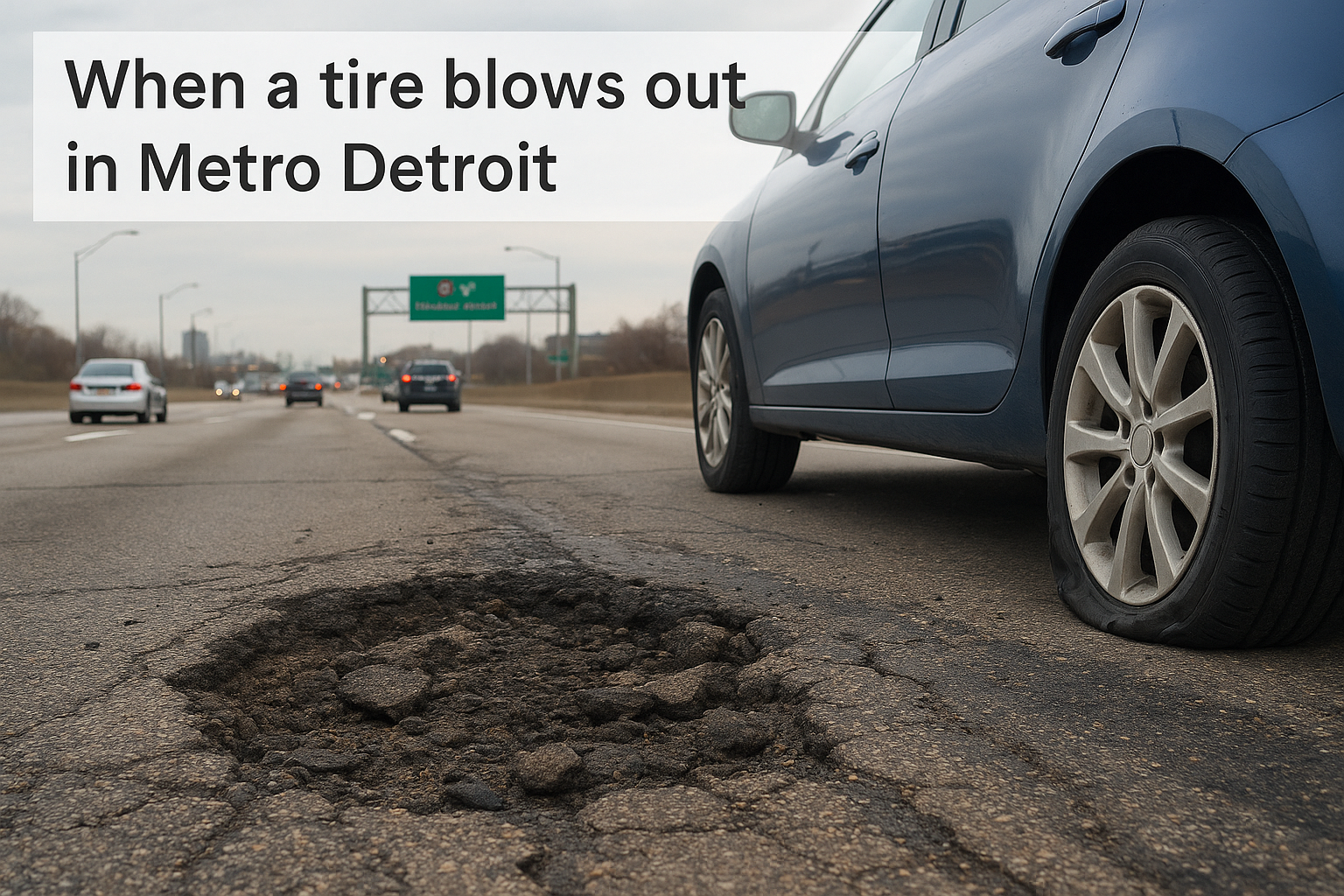
Seasonal conditions make this worse than most drivers expect. Summer construction zones on I-75 through downtown scatter loose gravel and metal debris across lanes that are already narrowed to one. Winter brings a different problem: rock salt and road brine eat away at rubber and rims, while black ice on the Southfield Freeway means a slow leak can turn into a full blowout the moment you hit a patch wrong. Taylor and Livonia drivers deal with older road surfaces full of frost heaves that snap sidewalls without warning. None of this is random bad luck. It’s just what driving in Metro Detroit does to tires over time.
A blown tire on a Detroit freeway isn’t a minor inconvenience, it’s a safety event that demands a fast, calm plan.
Where the failure happens matters as much as why it happened. A flat on a quiet side street in Dearborn is a different situation than one on the shoulder of the Lodge during rush hour, where traffic moves fast and shoulders are tight. Highway blowouts put you closest to moving traffic with the least room to work, which is exactly why so many roadside injuries happen in the first few minutes after a tire fails, not during the actual event.
That’s why speed and location both matter when you’re searching for help. Knowing what to do in the first sixty seconds, and knowing who to call that actually covers your stretch of road, changes the outcome. The next four steps walk through exactly that: how to get your vehicle out of danger, how to reach a crew that knows these roads, what details speed up dispatch, and how to stay safe while you wait. None of it is complicated, but skipping a step is how a bad tire turns into a much worse night.
Step 1. Pull over to a safe spot
The moment you feel a tire go, ease off the gas and grip the wheel firm. Don’t slam the brakes. Steady deceleration keeps the car from fishtailing, especially on the Lodge Freeway or I-75 where lanes are tight and traffic won’t slow down for you. Signal early, check your mirrors, and work your way toward the shoulder or the nearest exit ramp. If you’re near the John Lodge cut through downtown, aim for the widest shoulder you can reach rather than stopping in a narrow lane just because it’s closer.
Finding the right spot
Not every shoulder is equal. A flat spot with a guardrail or barrier between you and traffic is safer than an open shoulder with cars whipping past at 70 mph. Rest stops and gas station lots along I-94 and Telegraph Road beat a freeway shoulder every time, so keep rolling a little farther if you can do it safely on the rim.
Getting fully off the roadway before you stop is the single biggest thing you can do to stay safe.
Once you’re stopped
Turn your hazards on immediately, even before you’re fully stopped. Then run through this quick checklist:
- Set your hazard lights and keep them running the whole time
- Turn your wheels away from traffic if you’re on a slope or curve
- Set the parking brake once you’re stopped
- Stay inside the vehicle if you’re on a busy freeway shoulder
- Exit on the curb side only, never the traffic side
Detroit shoulders on I-75 and the Southfield Freeway sit close to fast-moving lanes, so don’t stand near your car unless you’re well clear of traffic. Staying buckled inside with hazards on is often safer than standing outside waiting.
Step 2. Call a local emergency tire service
Once you’re safely off the road, grab your phone and call a mobile tire service that actually covers your part of Detroit, not a national hotline that dispatches whoever’s cheapest three counties away. Skyline Towing runs crews out of 6450 E Hancock St in Detroit and covers Dearborn, Dearborn Heights, Southfield, Taylor, and Livonia around the clock, so the truck heading your way already knows the roads and the traffic patterns that slow other trucks down.
Why local matters more than fast
A dispatcher who knows that the Lodge Freeway backs up differently than I-75 through downtown can give you a realistic arrival time instead of a guess. Local knowledge means the crew knows which exits actually have room to work and which shoulders are too tight to stop on safely. That’s the difference between a 20-minute wait and an hour of standing on a narrow shoulder wondering if anyone’s coming.
Call a crew that knows your stretch of road, not just your zip code.
What to have ready before you dial
Have a few basics ready before you call, it speeds up everything that follows:
- Your current location, even a rough cross street or mile marker
- The vehicle type, make, model, and color
- Whether you’re on a highway shoulder, side street, or parking lot
- If you have a spare tire and it’s accessible
Skyline Towing answers 24/7, including holidays and overnight during winter storms when most shops are closed. That’s when tire failures spike the most, and it’s exactly when a local crew earns its reputation.
Step 3. Share your exact location and tire details
Getting your exact location across is the single biggest factor in how fast a crew reaches you. Detroit freeways don’t always have visible mile markers, so use whatever landmark you can see, an exit sign, a cross street, a billboard, even a business name. Dispatchers at Skyline Towing know these roads well enough to translate "just past the McNichols exit on the Lodge" into a real dispatch point, but they can only work with what you give them.
Pinpoint your location fast
If you’re not sure of the street name, open your phone’s maps app and read off the nearest cross streets or share your GPS coordinates directly. Here’s what to have ready:
- Nearest exit number or cross street
- Direction of travel (northbound I-75, eastbound I-94, etc.)
- Shoulder side (left or right)
- Any visible landmark, gas station, or business sign
The clearer your location, the faster the truck finds you, especially after dark.
Describe the tire problem clearly
Next, tell the dispatcher what actually happened to the tire. A slow leak from a nail is a different job than a shredded sidewall from a pothole on I-94, and the crew brings different tools depending on which one you’ve got. Mention whether the tire is fully flat or just low, whether the rim looks damaged, and whether you have a spare on board.
Finally, note your vehicle’s make and color, since that helps the driver spot you quickly among other cars pulled over on a busy shoulder. These small details, location, damage, and vehicle info, cut real minutes off your wait time on a cold Detroit night.
Step 4. Wait safely while help is on the way
Waiting on a Detroit shoulder feels like the longest part of the whole ordeal, but this is where staying disciplined matters most. Keep your seatbelt buckled if you’re parked on a freeway shoulder along I-75 or the Lodge, since a distracted driver clipping your mirror is a real risk even when you’re stopped. Crack a window instead of stepping outside, and resist the urge to check the tire yourself once you’re safely off the road. You’ve already done the hard part.
Watch for your crew
Keep your phone charged and close by. Skyline Towing’s drivers will often call or text when they’re a few minutes out, especially on a busy stretch of Telegraph Road or the Southfield Freeway where spotting one more car isn’t easy. Flash your hazards again when you see a truck slowing down nearby, and give a wave through the windshield instead of stepping out to flag them down.
Staying inside your car with the doors locked is almost always safer than standing outside waiting.
What to avoid while you wait
A few habits cause more harm than good during this stretch:
- Don’t stand behind or beside the car facing traffic
- Don’t attempt a roadside tire swap yourself on a narrow freeway shoulder
- Don’t leave your hazards off, even if the battery worries you
- Don’t wander toward a nearby exit ramp looking for help
Detroit winters make this even more important. Ice on the shoulder near the Southfield Freeway has caused more than one slip-and-fall while someone waited for a tow. Staying put, staying visible, and staying patient gets you through this last stretch safely.
Getting back on Detroit’s roads safely
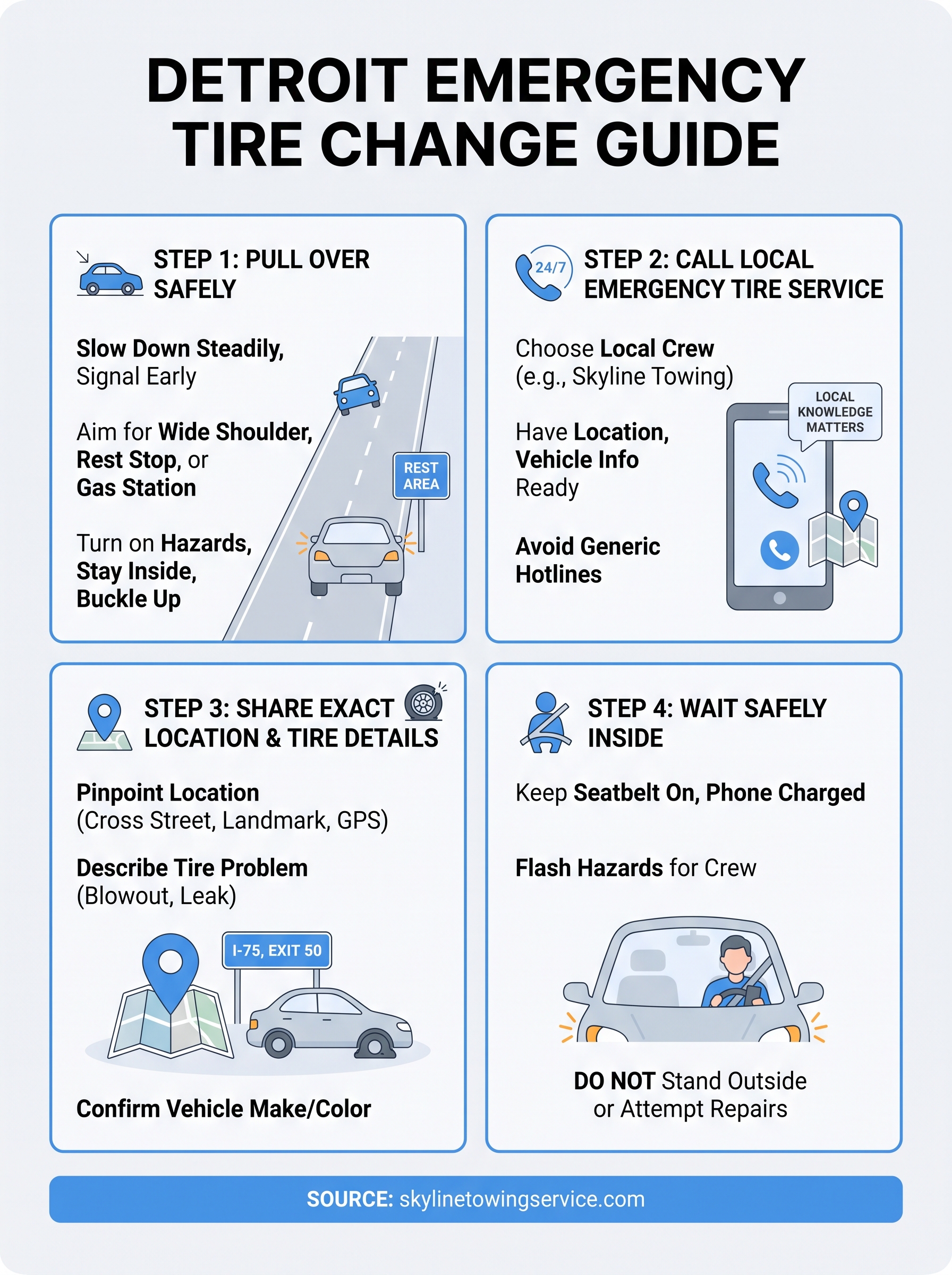
A blown tire on I-94 or a slow leak discovered outside a Dearborn gas station doesn’t have to turn into a disaster. Pull over fully, call a crew that actually knows metro Detroit’s roads, share your location and tire details clearly, and stay buckled up while you wait. Four steps, no guesswork, and you’re back on the road faster than you’d think.
Skyline Towing has handled these calls across Detroit, Dearborn, Dearborn Heights, Southfield, Taylor, and Livonia for years, day and night, through summer construction zones and winter black ice alike. Our crews run out of 6450 E Hancock St in Detroit, so when you search emergency tire change service near me, you’re getting a local team that knows which shoulders are safe and which exits actually have room to work.
Next time a tire lets go on the Lodge or I-75, skip the guessing and call Skyline Towing for fast, local roadside help.