
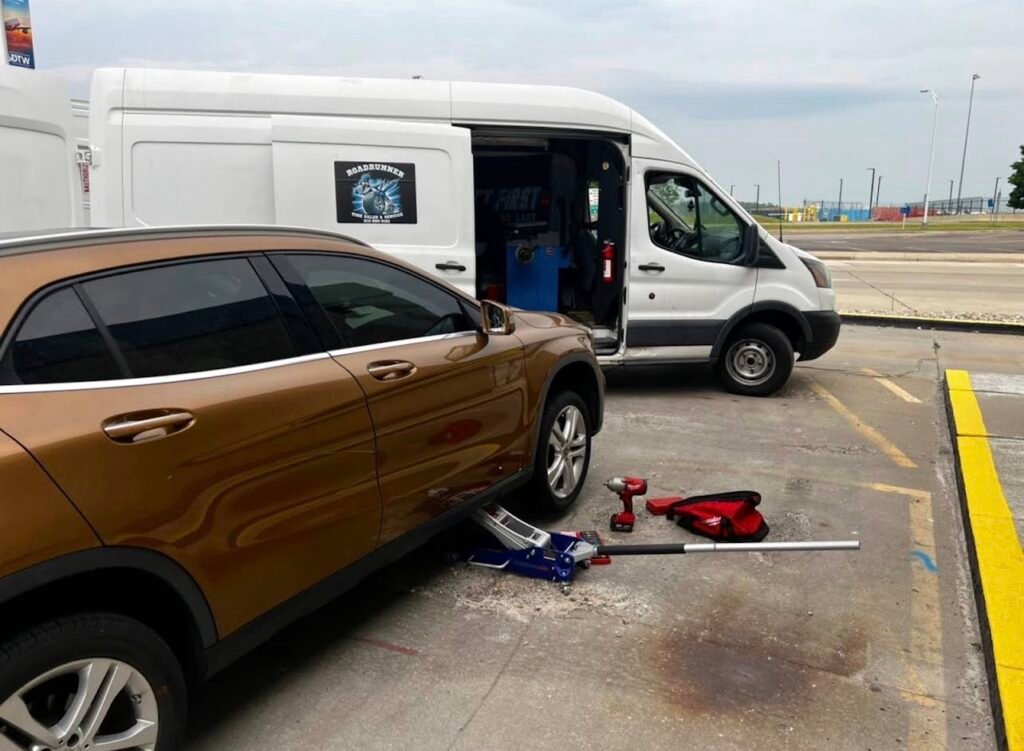
You’re driving down the Southfield Freeway or cruising along Michigan Avenue through Dearborn when you hear that unmistakable flapping sound and feel the steering pull hard to one side. Knowing what to do when tire goes flat can be the difference between a safe stop and a dangerous situation, especially on Detroit’s busy roads where potholes and road debris are part of daily driving.
The steps you take in the first 30 seconds matter most. Do you brake hard? Keep driving to the next exit? Pull onto the shoulder or into a parking lot? Every choice affects your safety, your rim, and how quickly you get back on the road. This guide walks you through exactly how to react, from the moment you feel that flat to deciding whether you can handle it yourself or need roadside help.
At Skyline Towing, headquartered at 6450 E Hancock St, Detroit, MI 48207, we respond to flat tire calls across Detroit, Dearborn Heights, Southfield, Taylor, Livonia, and the surrounding metro area, 24 hours a day, 7 days a week. We’ve helped drivers stranded on I-94, on the shoulder of Telegraph Road, and in grocery store parking lots across the city. That hands-on experience is exactly what shaped the advice below.
Before you do anything: safety and basics
The moments right after a tire blows or deflates fast are the most dangerous part of the whole situation. Sudden instinct often tells you to slam the brakes or jerk the wheel, but both reactions can spin your car into traffic on a stretch of road like I-96 or the Lodge Freeway. Understanding a few basic rules before a flat ever happens gives you a real advantage when it does.
Your first priority is always vehicle control, not diagnosing the tire.
Know the warning signs early
A blowout hits like a loud pop with an immediate jolt to the steering, while a slow leak from a nail or screw on 8 Mile Road feels more like a gradual pull to one side. Catching the difference matters because your response is different for each.
When a blowout strikes, you need to hold the wheel steady and resist braking hard. A slow deflation gives you more time to ease toward a safe exit or a parking lot. Either way, knowing what to do when tire goes flat starts with recognizing which situation you are actually in, so you do not overcorrect and create a bigger problem.
Keep an emergency kit in your car
Detroit winters and pothole season make advance preparation non-negotiable. Before you ever need roadside help, your trunk should carry the right gear so you have options no matter where you stop.

- A spare tire (full-size or compact, properly inflated)
- A lug wrench and jack that fits your specific vehicle
- Reflective road triangles or flares
- A flashlight with fresh batteries
- Work gloves for cold or wet weather
Having these items ready means you are not stuck on a dark shoulder on Van Dyke Avenue without any options. Even if you choose to call for professional help, the right gear keeps you safer while you wait.
Step 1. Get off the road without losing control
When you feel a flat tire strike, your first instinct may be to brake hard or jerk the wheel. Resist both. Grip the wheel firmly with both hands, ease off the gas slowly, and let the car decelerate on its own. Turn your hazard lights on immediately, before you start moving toward the shoulder. Braking hard at highway speed on I-94 or I-75 can send your vehicle into a spin.
The goal in the first few seconds is to keep the car going straight, not to stop it fast.
Find the safest place to stop
Knowing what to do when tire goes flat means picking the right stopping spot, not just the first one you see. On highways like the Lodge Freeway, aim for the right shoulder past an exit ramp if possible. On surface roads like Gratiot Avenue or Mound Road, a nearby parking lot or side street is far safer than stopping in a curb lane.
Here is a quick reference for choosing where to pull over in Metro Detroit:
| Situation | Best option |
|---|---|
| Highway at speed | Right shoulder, past the nearest exit ramp |
| Busy surface road | Parking lot or side street |
| Residential area | Curb away from intersections |
Step 2. Check the tire and decide your next move
Once you are safely stopped, take a breath before you open the door. Check your mirrors and make sure traffic is clear, then set out your road triangles or flares at least 20 feet behind the vehicle so other drivers can see you. Only then do you walk around to assess the damage.
Assess the damage before touching anything
Look at the tire closely. A visible nail, screw, or piece of road debris sitting in the tread tells you something very different than a sidewall that is shredded or bulging. Knowing what to do when tire goes flat depends heavily on where and how badly the tire is damaged.
A sidewall puncture or blowout means the tire cannot be safely plugged or patched. It needs replacement.
Know when to call for help versus handle it yourself
Use this quick reference to make the right call on your next move:
| Damage type | Your best option |
|---|---|
| Nail or screw in the tread | Spare tire swap or mobile repair |
| Sidewall tear or blowout | Call roadside assistance |
| Rim visibly bent or cracked | Do not drive, call for tow |
| Slow leak, minor puncture | Spare swap, then shop visit |
A damaged rim or sidewall failure puts you at risk if you try to drive even a short distance on a spare.
Step 3. Swap to a spare or call for help
If you confirmed tread damage only and your spare is in good shape, you can handle the swap yourself. Knowing what to do when tire goes flat means working through the change in the right order to avoid injury or a rolling vehicle.
Never position yourself under a vehicle that is supported only by a jack.
How to change a spare tire step by step
Follow these steps in sequence to complete a safe tire swap on the shoulder or in a parking lot:

- Loosen the lug nuts slightly while the flat tire is still on the ground
- Position the jack under your vehicle’s designated jack point (check your owner’s manual)
- Raise the vehicle until the flat clears the ground by about two inches
- Remove the lug nuts fully and pull the flat tire straight off
- Mount the spare and hand-tighten the lug nuts in a star pattern, then lower the vehicle
- Torque the lug nuts fully once the tire touches the ground
When to call Skyline Towing instead
Some situations make a DIY swap unsafe or impossible. Call Skyline Towing at 6450 E Hancock St, Detroit, MI 48207 if any of these apply:
- Your jack or lug wrench is missing from your trunk
- You have a sidewall blowout or a bent rim
- You are stopped on a high-speed road like I-75 or Woodward Avenue
Step 4. Drive smart on a spare and get it fixed
Getting the spare mounted is not the end of the process. Compact spares, often called donuts, are built for limited use only, and knowing what to do when tire goes flat means knowing how to handle the drive once you are back on the road.
Treating a spare like a regular tire is one of the most common mistakes drivers make after a roadside swap.
Know your spare’s limits
Your compact spare has strict operating limits that most drivers overlook. Keep your speed at or below 50 mph and avoid sustained highway driving on I-94 or I-75. Pushing the spare beyond its limits increases the risk of a second failure before you even reach a shop.
| Spare type | Max speed | Max distance |
|---|---|---|
| Compact (donut) | 50 mph | 50 miles |
| Full-size spare | Normal speed | Normal use |
Get the tire repaired or replaced the same day
Once you are moving, your next stop should be a tire shop, not a highway on-ramp. Detroit-area roads can stress a compromised spare more than expected. Call ahead to confirm availability so you are not waiting hours after an already tough roadside experience.
Skyline Towing, based at 6450 E Hancock St, Detroit, MI 48207, also handles mobile tire sales and installation if you need a replacement brought directly to you. Do not push the spare into a second day of driving if you can avoid it.

Wrap up and get back on the road
Knowing what to do when tire goes flat gives you a clear path forward instead of a moment of panic on a busy Metro Detroit road. You now know how to pull over safely, read the damage, decide between a DIY swap and a call for help, and drive responsibly on a spare until you reach a shop. Every step matters, and skipping one puts you or other drivers at risk.
Detroit roads are tough on tires year-round, from February potholes on Gratiot Avenue to summer debris on I-94. Keep your spare inflated, stock your emergency kit, and save a local number you can trust before you ever need it. When the situation calls for professional help, Skyline Towing Detroit is available 24/7 and dispatches from 6450 E Hancock St, Detroit, MI 48207 to handle flat tires, blowouts, and roadside emergencies across the entire metro area.

