
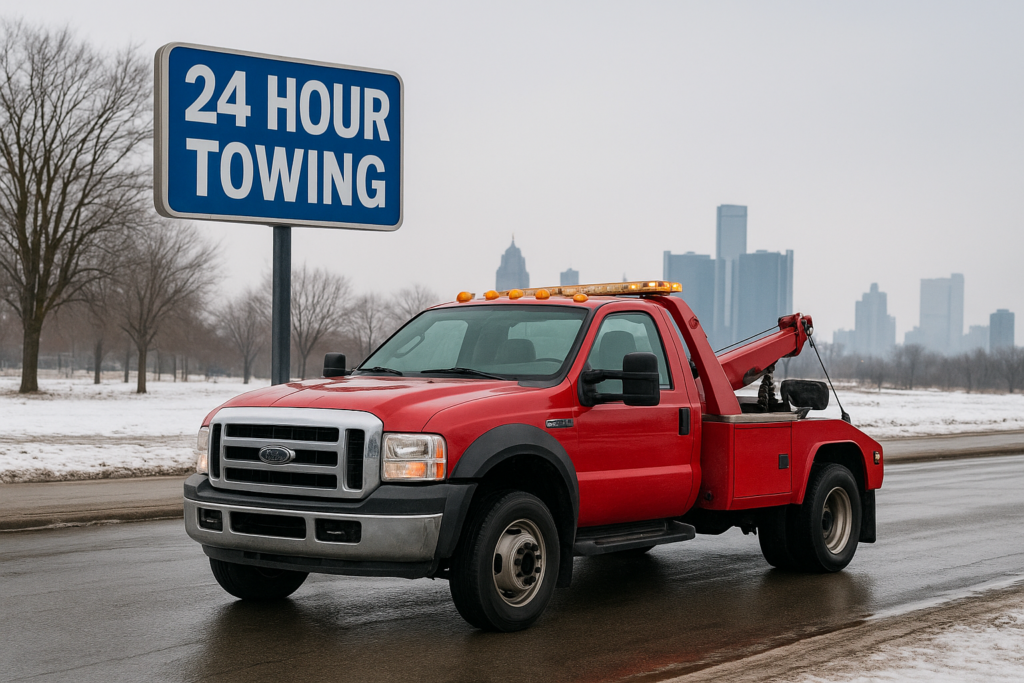
Your car doesn’t break down on a schedule. It happens at 2 a.m. on the Lodge Freeway in a January whiteout, or on a Sunday afternoon when your battery finally gives out in a Southfield parking lot. That’s exactly when you need 24-hour towing you can actually count on, not a voicemail that promises a callback during business hours.
If you’re searching for towing 24 hour service right now, here’s the direct answer: a real 24-hour towing company has live dispatchers around the clock, trucks staged across metro Detroit, and drivers who show up whether it’s rush hour on I-94 or 3 a.m. on a residential street in Dearborn Heights. That’s how Skyline Towing operates out of our Detroit headquarters at 6450 E Hancock St, and it’s the standard every driver should expect before they call anyone.
In this article, we’ll break down what genuine 24-hour towing looks like, how response times vary by time of day and weather, what services fall under round-the-clock roadside help, and how to spot the difference between a company that’s truly always on and one that just says so.
Why 24-hour towing matters for Detroit drivers
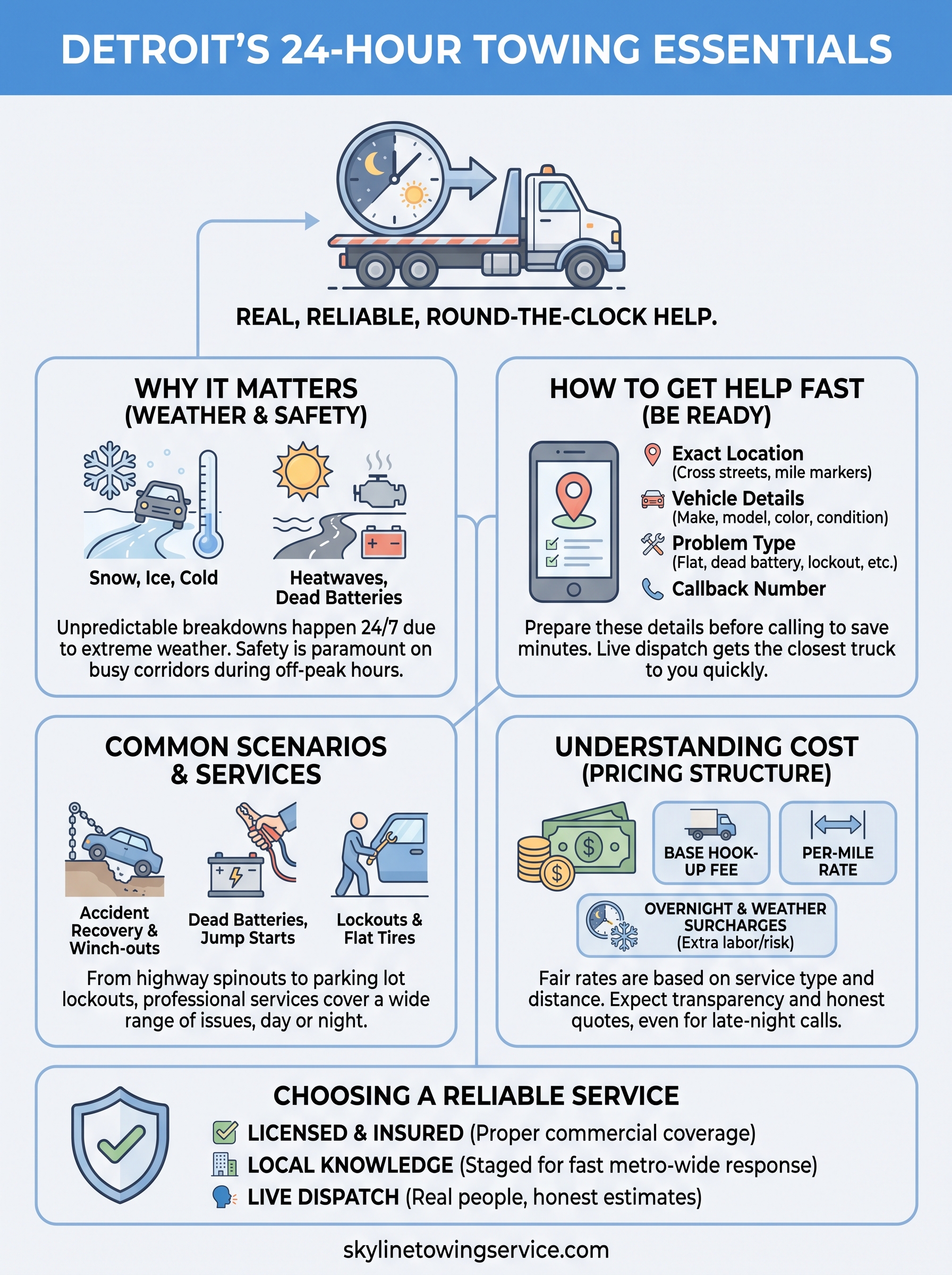
Detroit weather doesn’t care about your schedule, and that’s the biggest reason 24-hour towing isn’t a luxury here, it’s a necessity. Lake-effect snow can dump six inches on I-75 between the time you leave work and the time you hit the Ambassador Bridge exit. Summer heat waves push old batteries and worn serpentine belts past their limit on I-94 during rush hour. A company that only answers calls from 8 to 5 leaves you stranded exactly when metro Detroit’s climate is most likely to strand you: overnight, during storms, or in the dead of a February cold snap when temperatures drop below zero and rubber, plastic, and batteries all fail at once.
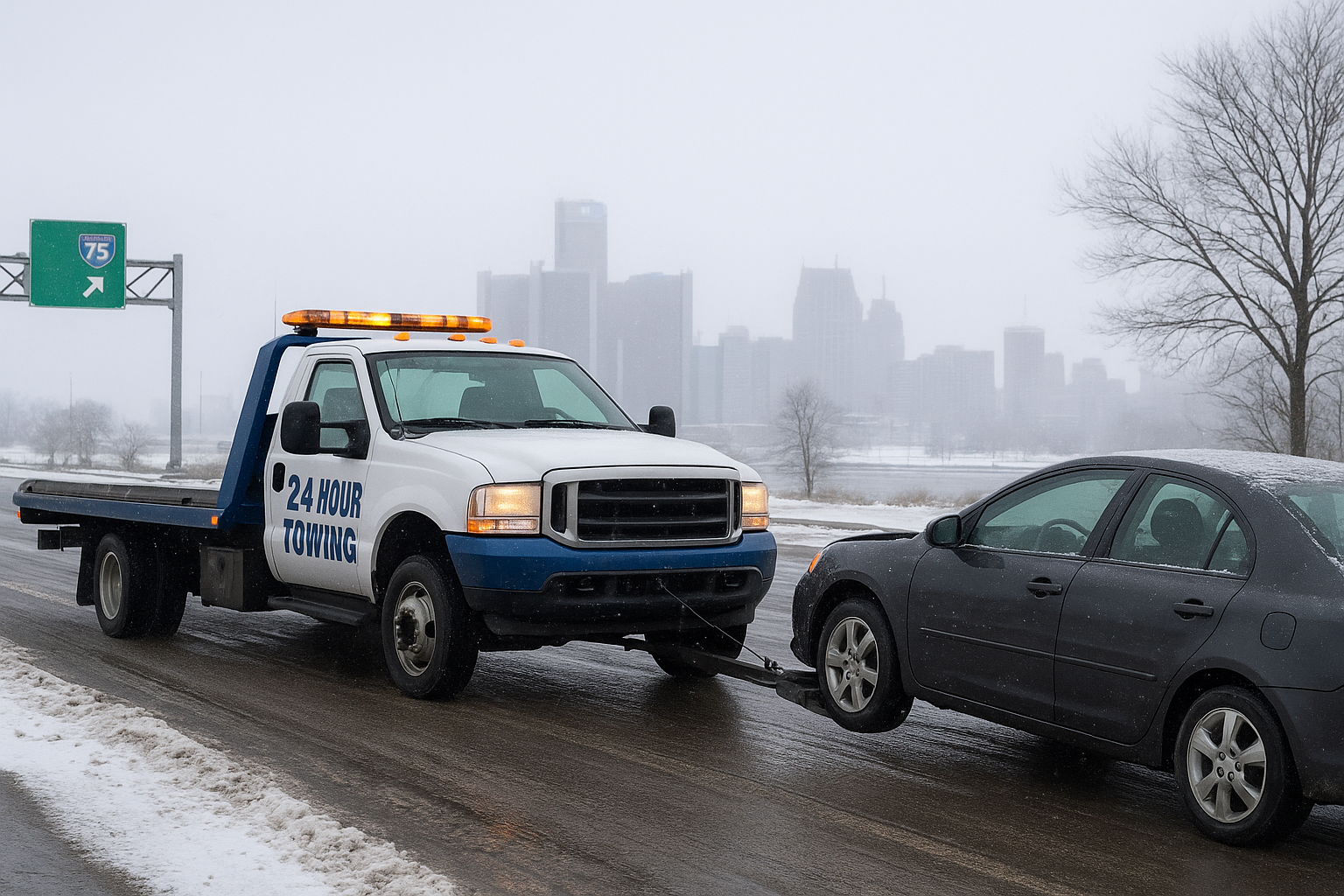
Detroit’s weather creates round-the-clock breakdowns
Subfreezing nights are brutal on vehicles parked outside in neighborhoods like Southwest Detroit, Corktown, or out in Taylor and Livonia where driveways aren’t always heated. Cold-soaked batteries lose up to 50% of their cranking power in freezing temperatures, according to the U.S. Department of Energy, which means a car that started fine at 6 p.m. can be dead by midnight. Add ice storms that turn the Lodge and Southfield Freeway into skating rinks, and you’ve got a recipe for breakdowns that happen well outside normal business hours.
| Season | Common Breakdown Trigger | Peak Risk Hours |
|---|---|---|
| Winter | Dead batteries, frozen fluids, black ice spinouts | Overnight to early morning |
| Spring | Pothole tire blowouts, flooded underpasses | Rush hour and after storms |
| Summer | Overheating engines, AC compressor failure | Midday heat, late-night road trips |
| Fall | Worn brakes from summer heat, deer collisions | Dusk and early evening |
A tow truck that only runs during business hours can’t help you when Detroit’s weather actually causes most breakdowns.
Metro Detroit’s roads and traffic patterns raise the stakes
Busy corridors like I-96, the Southfield Freeway, and Telegraph Road carry heavy traffic well past midnight, especially with shift workers commuting to and from Dearborn’s auto plants and Detroit’s hospitals. A stalled car on the shoulder during a 3 a.m. shift change isn’t just inconvenient, it’s dangerous. Michigan’s Move Over Law exists because roadside breakdowns put drivers at real risk from passing traffic, and that risk doesn’t shrink just because the sun went down. Getting a tow truck out fast during off-hours matters as much for safety as it does for convenience.
Waiting until morning isn’t a real option
Pretending your car will be fine parked on the shoulder of I-75 until sunrise ignores how metro Detroit actually works. Parking enforcement in cities like Dearborn Heights and Southfield doesn’t pause overnight, and an abandoned-looking vehicle can get ticketed or towed by the city before you even wake up. Overnight temperatures in January regularly dip into the single digits, which means a car left running for warmth can run out of gas, and a car left off can freeze solid enough to need a full service call anyway. Skyline Towing built its dispatch system around this reality, staging trucks across Detroit, Dearborn, Taylor, and Livonia so a driver on our team is never more than a reasonable distance from your breakdown, day or night. That’s the whole point of genuine 24-hour towing: it matches the actual rhythm of life and weather in this region, instead of expecting emergencies to wait for a more convenient time.
How to get help fast when you call a 24-hour tow truck
Getting a tow truck to you quickly starts before you even dial the phone. Knowing your exact location and having a few key details ready shaves real minutes off your wait, especially when you’re stuck on a dark stretch of I-96 or a side street in Southfield where cross streets aren’t always obvious. Dispatchers at a genuine 24-hour towing company are trained to move fast, but they can only move as fast as the information you give them.
What to have ready before you call
Sharing the right details up front means the closest available driver gets sent your way immediately instead of circling back for clarification. Before you call, try to gather:
- Your nearest cross streets or highway mile marker (check a road sign or your phone’s map app)
- The make, model, and color of your vehicle
- Whether you’re on the shoulder, in a lane, or off the road entirely
- The nature of the problem (flat tire, dead battery, accident, lockout)
- A callback number where you’ll actually pick up
The faster a dispatcher can picture exactly where you are, the faster a truck actually gets there.
What happens after you dial
Once you’re on the phone, a real 24-hour dispatcher gives you a straight answer, not a runaround. At Skyline Towing, that means confirming your location, giving you an honest estimated arrival time, and dispatching the truck that’s physically closest to you across our Detroit, Dearborn, Southfield, or Livonia coverage areas. You should hear a live person, not an automated menu that loops back to voicemail at 1 a.m. If a company can’t answer that call, it’s not offering true towing 24 hour service, no matter what its website claims.
Staying safe while you wait
While you wait, pull as far off the roadway as possible, turn on your hazard lights, and stay inside your vehicle with your seatbelt on if you’re stopped on a shoulder along a busy road like Telegraph or the Southfield Freeway. Standing outside your car on a freeway shoulder puts you closer to passing traffic than most people realize, and Michigan winters make that wait even riskier if you’re not dressed for the cold. Keep your phone charged if you can, since a follow-up call to confirm the driver’s progress is normal and expected, not an inconvenience to the dispatcher.
Common roadside scenarios across metro Detroit
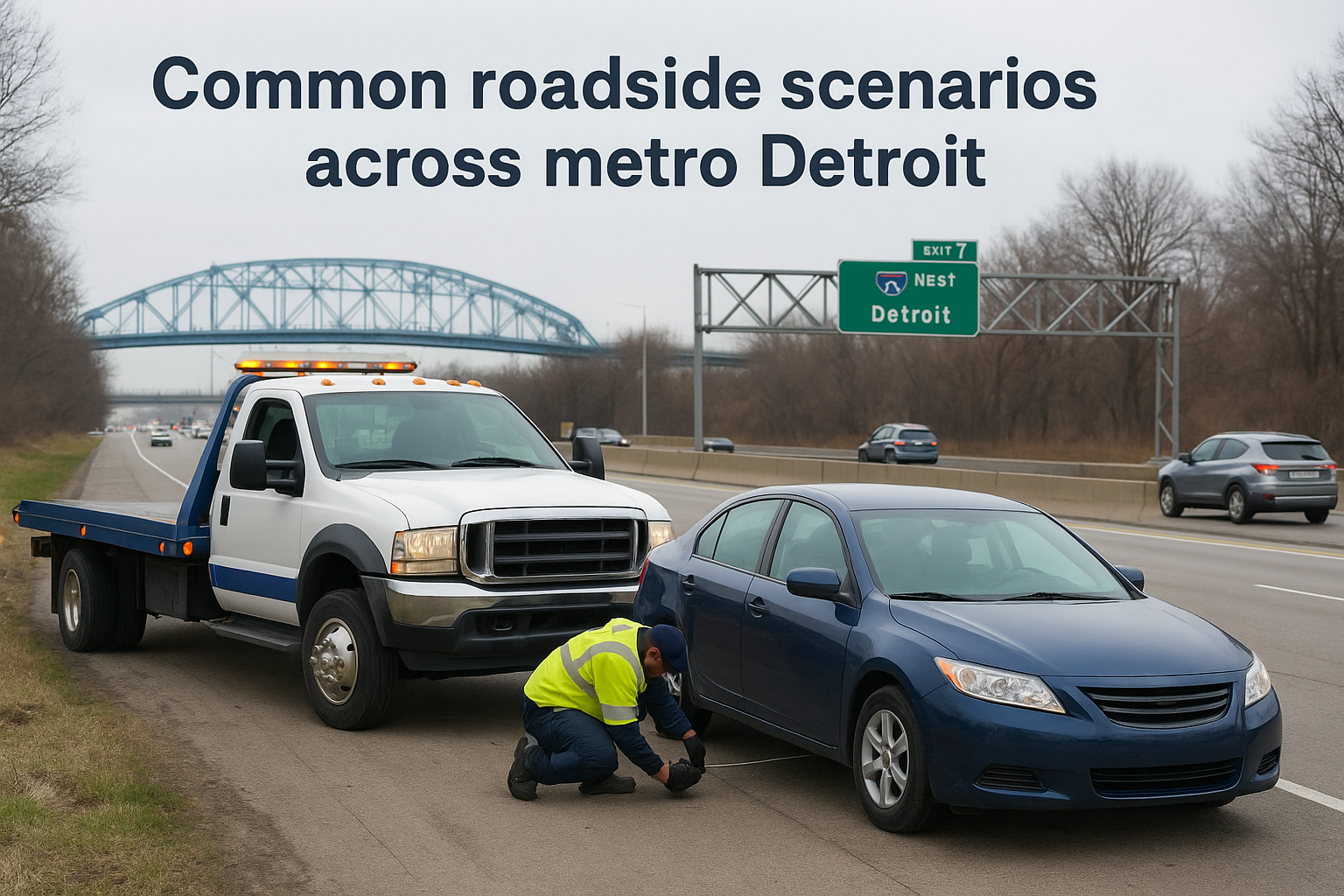
No two calls to a 24-hour towing company look exactly alike, but after years running trucks across Wayne and Oakland counties, certain patterns repeat night after night. Knowing what those scenarios look like helps you recognize when it’s time to call instead of trying to wait it out.
Highway breakdowns and accident recovery
Stalled cars on I-94 near the Ambassador Bridge, spinouts on the Lodge during ice storms, and fender-benders on the Southfield Freeway at rush hour all demand fast accident recovery and a driver who knows how to work safely close to live traffic. These calls come in at every hour, but they spike overnight and during the first snow of the season when drivers aren’t yet used to slick pavement. A truck that can winch a car out of a ditch off Telegraph Road or clear a lane on I-75 quickly isn’t just convenient, it keeps everyone else on the road safer too.
The most dangerous roadside calls happen on the busiest roads, which is exactly why fast response matters most there.
Dead batteries, lockouts, and flat tires
Cold mornings in Dearborn Heights and Livonia bring a steady stream of dead-battery calls, especially after a hard freeze drops overnight temperatures into single digits. Lockouts happen just as often, whether it’s a set of keys locked in a car outside a Southfield office building or a fumbled key fob in a Detroit parking garage at midnight. Add potholes on Grand River or Woodward that blow out a tire without warning, and you’ve got three of the most common reasons metro Detroit drivers dial for help.
| Scenario | Typical Location | Common Cause |
|---|---|---|
| Dead battery | Southfield, Livonia driveways | Overnight cold snap |
| Lockout | Detroit parking garages, Dearborn lots | Rushed exit, dropped keys |
| Flat tire | Grand River, Woodward Ave | Potholes, road debris |
| Winch out | Ditches off Telegraph, I-96 shoulders | Ice, snow, spinouts |
Private property and parking enforcement calls
Businesses in Taylor and Dearborn also rely on private property towing to keep lots clear of vehicles that overstay their welcome, and residents sometimes need a car removed from a shared driveway after a dispute. These calls aren’t emergencies in the traditional sense, but they still need a company that answers the phone at 2 a.m. just as reliably as it does at 2 p.m.
What 24-hour towing costs and how rates are set
Pricing for 24-hour towing in metro Detroit usually comes down to three factors: distance, time of day, and the type of service you need. A short hook-and-tow from a Southfield parking lot costs less than a winch-out from a snowy ditch off I-96 at 3 a.m., and that’s normal across the industry, not a sign of price gouging. Understanding the basic structure before you call helps you spot a fair quote versus one that’s padded.
Base rates and mileage
Most tow companies, including Skyline, charge a base hook-up fee plus a per-mile rate once the truck starts moving your vehicle. That base fee covers the driver’s time getting to you and the equipment needed to safely load your car, while mileage covers the distance from the pickup point to your chosen drop-off, whether that’s a repair shop in Livonia or your driveway in Dearborn Heights. Longer hauls, like transporting a car from a Taylor dealership lot to a salvage auction across town, naturally run higher than a quick tow around the corner.
Overnight and weather-related factors
Calling for towing 24 hour service in the middle of the night or during a major snowstorm sometimes carries a modest overnight or emergency surcharge, and that’s worth knowing upfront so nothing surprises you. Extra labor comes into play too, since pulling a car out of a ditch off Telegraph Road after an ice storm takes more time, more equipment, and more risk for the driver than a routine flat-tire call in daylight.
A fair towing company explains its rates before the truck leaves the lot, not after it arrives.
| Cost Factor | What It Covers | Typical Trigger |
|---|---|---|
| Base hook-up fee | Driver dispatch and vehicle loading | Any tow call |
| Per-mile rate | Distance from pickup to drop-off | Longer hauls, out-of-area tows |
| Overnight surcharge | Late-night or holiday dispatch | Calls after standard hours |
| Winch-out fee | Extra labor and equipment | Ditches, snowbanks, off-road recovery |
Getting a straight quote
Before any hook, ask for a clear price range based on your location and the service needed, and expect a real dispatcher to give you one without dodging the question. Skyline Towing quotes rates upfront over the phone, because a driver stuck on the Lodge at midnight shouldn’t have to gamble on what the final bill looks like once the truck shows up.
Choosing a reliable towing company in Detroit
Finding a trustworthy 24-hour towing company means looking past a flashy website and checking for the details that actually matter when your car breaks down at midnight. Detroit has plenty of tow operators listed online, but not all of them run live dispatch, carry proper insurance, or actually cover the neighborhood you’re stranded in. A little research before you’re stuck saves you from a frustrating call when you’re already stressed and standing on the shoulder of I-94.
Licensing, insurance, and equipment
Every legitimate tow company operating in Michigan should carry proper commercial insurance and the equipment suited to the job, whether that’s a flatbed for a newer sedan or heavy-duty gear for a work truck stuck in a Taylor construction lot. Ask directly if a company is licensed and insured before you agree to a tow, and don’t accept a vague answer. The Michigan Department of State outlines requirements for towing operators, and a company with nothing to hide will answer that question without hesitation.
A towing company that dodges questions about insurance isn’t one you want touching your car.
Local knowledge and real coverage
Genuine familiarity with metro Detroit’s roads matters more than most drivers realize until they need it. A driver who knows the difference between the Lodge and the Southfield Freeway, who understands how Telegraph Road backs up during rush hour, and who’s worked storms in Dearborn Heights and Livonia gets to you faster and handles the job with less guesswork. Skyline Towing stages trucks across Detroit, Dearborn, Southfield, Taylor, and Livonia specifically so response times stay short no matter which corner of metro Detroit you’re calling from.
Reviews, transparency, and communication
Reading recent reviews tells you a lot about how a company actually treats stranded drivers, not just what it promises on paper. Look for feedback that mentions real response times, honest pricing, and drivers who communicate clearly while you wait. Before you save a number in your phone, check for:
- A live dispatcher answering calls at odd hours, not just during the day
- Clear, upfront pricing before the truck leaves the lot
- Drivers who explain estimated arrival times honestly
- A physical presence in your area, not a call center routing to unknown subcontractors
Saving a company that checks these boxes now means one less thing to worry about the next time your car won’t start on a cold Detroit morning.
Keep our number ready for your next breakdown
Breakdowns don’t send a warning text first. One minute you’re merging onto I-94, the next you’re on the shoulder with your hazards on, wondering who actually picks up at 3 a.m. That’s the whole reason 24-hour towing exists, and it’s why saving the right number now beats searching for one while you’re stranded in the cold. Real round-the-clock service means live dispatchers, trucks staged across Detroit, Dearborn, Southfield, Taylor, and Livonia, and drivers who show up whether it’s a Tuesday afternoon or a January whiteout on the Lodge.
Skyline Towing runs out of our Detroit headquarters at 6450 E Hancock St, and we built our dispatch system around metro Detroit’s actual rhythm, not banker’s hours. Don’t wait until you’re standing on a freeway shoulder to figure out who to call. Visit Skyline Towing now and save our number, so your next breakdown is just a phone call away from being handled.