
Your car dies on I-75 near the Ambassador Bridge at 2 a.m., or you slide into a snowbank on the Lodge Freeway during a February whiteout. Either way, you need help now, not a callback during business hours. That’s exactly why 24 hour towing services exist, and why knowing what to expect before you’re stranded makes the whole experience less stressful.
A real 24 hour towing and roadside assistance provider means someone answers the phone at any hour, dispatches a truck that actually shows up, and handles whatever situation put you on the shoulder in the first place, whether that’s a dead battery, a lockout, or a full accident recovery. In Detroit, that also means dealing with potholes on Woodward, ice on the Southfield Freeway, and neighborhoods where response times matter more than a national brand name.
This article breaks down what legitimate emergency towing looks like, what services should be included, realistic response times across Detroit, Dearborn, and surrounding suburbs, and how Skyline Towing, headquartered at 6450 E Hancock St in Detroit, handles these calls every single day.
Why Detroit drivers need 24 hour towing and roadside help
Detroit doesn’t run on a 9-to-5 schedule, and neither do car problems. Third shift workers at the Stellantis Mack Assembly Plant clock out at 3 a.m. and still have to get home on streets that don’t get plowed as fast as the highways. Bar staff on Woodward in Ferndale finish closing duties well past midnight. Nurses at DMC and Henry Ford Hospital pull overnight shifts year-round. None of these people can afford to wait until morning when their car won’t start in a dark parking structure or their tire blows out on I-94 near the airport. That’s the basic reality behind 24 hour towing and roadside assistance: breakdowns don’t check the clock, and Detroit’s economy depends on people who work when most towing companies would rather be closed.
If your job doesn’t stop at midnight, your towing company shouldn’t either.
Weather makes the case even stronger. Michigan winters turn routine drives into emergencies fast. Black ice on the Southfield Freeway causes multi-car pileups before most drivers even see the sun rise. Lake-effect snow off Lake St. Clair can dump six inches on Grosse Pointe Park in a few hours while the west side stays clear. A dead battery in 10-degree weather at 4 a.m. isn’t rare here, it’s a Tuesday. Summer brings its own trouble too. July heat cooks batteries and blows radiator hoses on the Lodge during rush hour, and afternoon storms flood underpasses on Jefferson Avenue faster than most drivers expect. Detroit weather doesn’t give you a warning window, and a towing service that only operates during daylight leaves you stuck exactly when conditions are worst.
Infrastructure adds its own risks
Detroit’s roads themselves create breakdown situations that other cities don’t deal with at the same scale. Potholes on Woodward Avenue and Gratiot Avenue swallow tires whole every spring after freeze-thaw cycles tear up the asphalt. Poor lighting on stretches of I-75 through the industrial corridor makes nighttime breakdowns feel more dangerous than they need to be. Older neighborhoods in Highland Park and parts of Dearborn Heights have narrower streets where a stalled car blocks traffic fast, and waiting hours for help isn’t just inconvenient, it’s a safety hazard.
Safety concerns push the need further
Sitting on the shoulder of I-75 or the Lodge Freeway after dark is not a place anyone wants to linger. Every extra minute waiting for a truck is another minute exposed to passing traffic, especially in spots with limited shoulder width near the Fisher Freeway interchange. Fast response times cut down that exposure window significantly, and that’s the whole point of round-the-clock service instead of a callback the next morning.
Finally, there’s the trust factor that comes with living in a city like Detroit. Cars break down in odd neighborhoods at odd hours, and drivers want a company that knows the area, not a dispatcher reading off a map three states away. A local 24/7 towing and roadside assistance provider understands which exits back up, which streets flood, and which lots are safe to wait in. That local knowledge, paired with actual around-the-clock availability, is what separates a real emergency service from a company that just advertises one.
How to get fast help when you break down in Detroit
Getting stranded on I-96 near the Southfield interchange feels chaotic, but the fastest path to help is simple if you know the steps. Pull as far onto the shoulder or into a parking lot as you safely can, turn on your hazards, and stay buckled in until help arrives if you’re near active traffic. Calling a local dispatcher beats searching for a random number online, because a Detroit-based team already knows the exits, the cross streets, and which lots near Eight Mile or Gratiot are safe to wait in after dark.
The fastest tow isn’t the one you find, it’s the one you already have saved in your phone.
Saving a number before you need it changes everything. Skyline Towing answers calls around the clock from our Detroit headquarters at 6450 E Hancock St, and our dispatch team routes the nearest available driver instead of making you wait for a truck to cross town from Livonia when you’re stuck in Southfield. That local routing is a big part of what makes 24 hour towing and roadside assistance actually fast instead of just advertised as fast.
What to tell the dispatcher
Having a few details ready shaves real minutes off your wait. Before you call, try to have this on hand:
- Your exact location, including mile markers, exit numbers, or the nearest cross street
- The direction you’re traveling and which side of the road you’re on
- Your vehicle’s make, model, and color
- What happened: flat tire, dead battery, accident, lockout, or something else
- Whether you’re in a safe spot or need help getting somewhere safer first
Providing that upfront lets dispatch send the right truck the first time, whether that’s a flatbed for accident recovery or a light-duty unit for a jump start.
Requesting an ETA and sticking near your phone matters too. Detroit traffic on the Lodge or I-94 can shift a truck’s arrival time by ten or fifteen minutes, and a dispatcher who can text you updates keeps you from wondering if help is actually coming. Texting your location pin, when possible, also helps drivers find you faster in industrial stretches near Delray or the riverfront where street signs are sparse and GPS addresses get confusing fast.
What’s included in 24 hour towing and roadside assistance
Getting a truck to show up is only half the job. Real 24 hour towing services cover a full range of roadside problems, not just hooking up your car and hauling it away. When you call Skyline Towing at any hour, you’re getting a crew equipped to handle whatever actually happened, whether that’s a dead battery in a Meijer parking lot on Eight Mile or a full recovery after sliding off the Southfield Freeway.
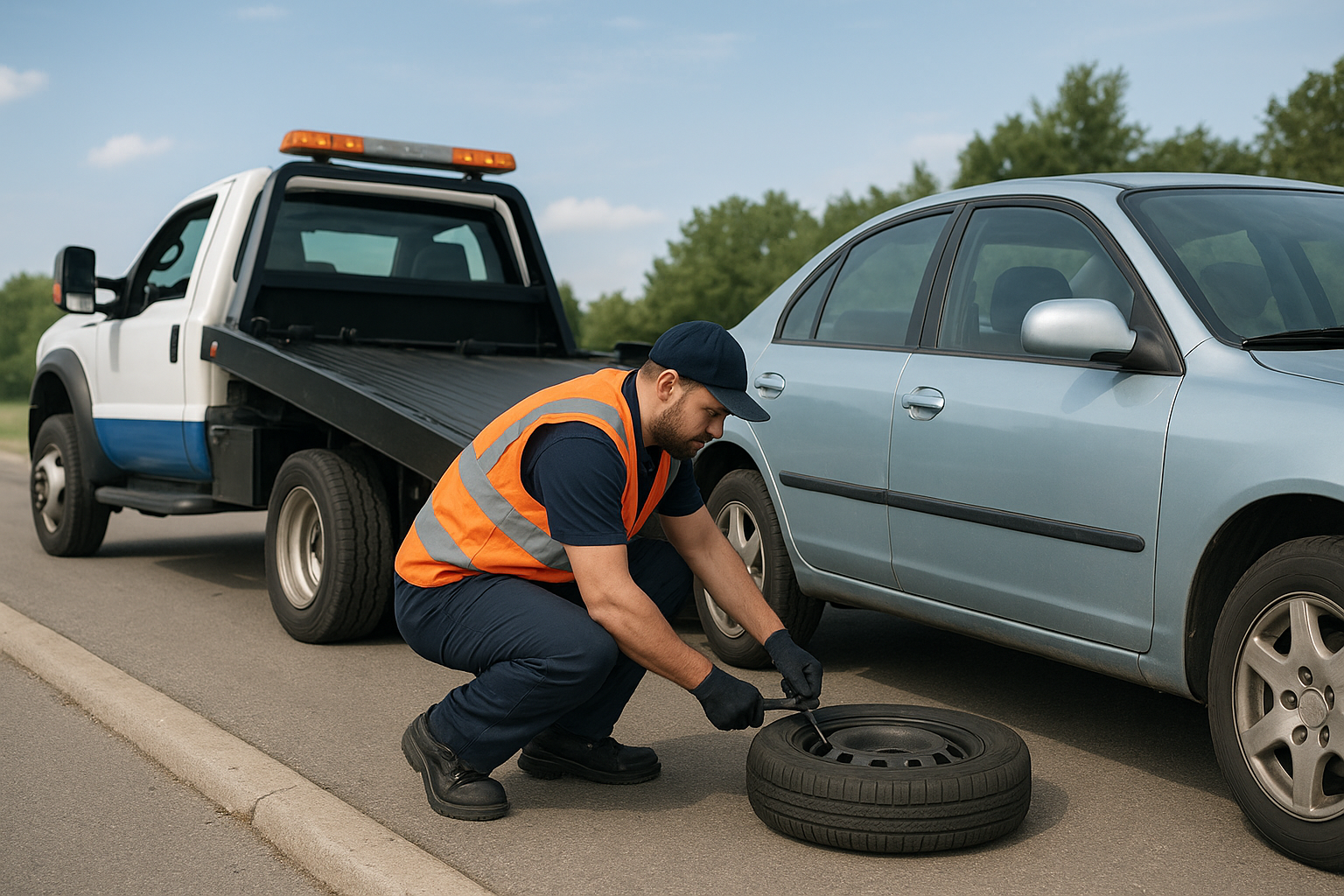
A tow truck that only tows isn’t roadside assistance, it’s half a service.
Here’s what should be on the table when you call a legitimate provider:
- Standard towing for breakdowns, dead cars, and vehicles that need to move from point A to point B
- Jump starts for batteries that die in a Ferndale driveway or a downtown parking structure
- Lockout service when keys get locked inside a car outside a bar on Woodward at 1 a.m.
- Flat tire changes on the shoulder of I-94 or in a Dearborn strip mall lot
- Mobile tire sales and installation when the spare won’t cut it and you need a real replacement on the spot
- Winch outs for cars stuck in snowbanks after a Lake St. Clair squall or mud off a gravel access road
- Accident recovery with flatbeds built to move damaged vehicles safely
- Heavy duty towing for box trucks, RVs, and larger commercial vehicles that regular flatbeds can’t handle
Beyond the basics, a full-service operation also covers private property towing for landlords and businesses dealing with unauthorized parking, plus dealer transport and salvage auction transport for vehicles moving between lots instead of off a roadside. These aren’t emergency calls, but they matter to anyone running a dealership or property in Detroit, Dearborn, or Southfield who needs a towing partner they can call for more than just breakdowns.
Parking enforcement rounds out the list, and it’s often overlooked until a business owner in Livonia or Taylor needs cars cleared from a lot after hours. A provider that only does roadside emergencies during the day but skips these services at night isn’t offering true 24/7 coverage, they’re offering a partial version of it. When you’re comparing companies, ask directly what’s covered around the clock and what gets pushed to "business hours only." That answer tells you everything about whether they’re built for real emergencies or just marketing the phrase.
What a 24 hour tow costs in metro Detroit
Money matters when you’re already having a bad night, so let’s talk real numbers instead of vague ranges. Towing costs in metro Detroit typically depend on three things: the type of service you need, the distance the truck has to travel, and whether you’re calling at 3 p.m. or 3 a.m. A short hook and tow from a Southfield parking lot to a nearby shop runs different money than a flatbed recovery after a crash on I-96 that requires winching a car out of a ditch.
Quoted prices should never come as a surprise once the truck arrives. Skyline Towing gives you a clear estimate over the phone before dispatching, based on your location and what happened, so you’re not stuck negotiating with a driver standing next to your car at midnight.
A real quote comes before the truck leaves the yard, not after it shows up.
Here’s a general breakdown of what drivers across Detroit, Dearborn, and Southfield typically pay for common calls:
| Service | Typical Cost Range |
|---|---|
| Standard tow (local, under 10 miles) | $75–$125 |
| Jump start | $50–$85 |
| Lockout service | $50–$90 |
| Flat tire change | $50–$90 |
| Winch out (snow, ditch, mud) | $100–$200+ |
| Accident recovery (flatbed) | $125–$250+ |
| Heavy duty towing | $200–$450+ |
These figures shift with mileage, time of day, and vehicle size, so a heavy duty tow for a box truck stuck on Telegraph Road will cost more than a sedan jump start in a Dearborn Heights driveway. Overnight and holiday calls sometimes carry a modest surcharge too, since running trucks and crews at 4 a.m. on a holiday costs more than daytime dispatch.
Vague pricing is where a lot of drivers get burned, especially with unfamiliar companies that quote low over the phone and pad the bill once they’ve hooked up your car. Metro Detroit drivers should ask for a total price upfront, including mileage and any after-hours fees, before agreeing to service. If you want a straight answer before you’re even stranded, check our towing services page for current rates on standard tows, lockouts, and heavy duty jobs. Knowing the range ahead of time means you’re making a calm decision instead of a panicked one when your car dies on the Chrysler Freeway at midnight.
Do you need AAA for 24/7 towing assistance
Many Detroit drivers assume a AAA membership is the only way to get reliable roadside help at 3 a.m., but that’s not the full picture. Membership-based towing works fine until you’re stuck in Redford waiting for a contracted driver who might be assigned to five other calls across the region before yours. AAA doesn’t own trucks in most cases, they dispatch through a network of independent companies, so the driver who shows up may not know Livernois from Livonia. A local towing company like Skyline Towing owns its trucks, knows the neighborhoods, and answers the phone directly instead of routing you through a national call center first.
A membership card doesn’t drive the truck, a local dispatcher does.
Cost is another factor worth weighing honestly. AAA memberships run somewhere between $60 and $130 a year depending on the tier, and that’s money spent whether you break down twice a year or never touch the service at all. Pay-per-call towing means you only pay when you actually need a truck, which makes more sense for drivers who maintain their vehicles well and rarely have trouble. Someone driving an older car on rough roads near Highland Park might still lean toward a membership, while a driver with a newer vehicle and a short commute through Southfield often comes out ahead paying as they go.
When a membership still makes sense
There are real cases where AAA membership pays off, particularly for families with multiple aging vehicles or drivers who take long road trips outside Detroit where a local towing company can’t help. If you’re driving to northern Michigan every summer, a nationwide network has value. But for day-to-day breakdowns within Detroit, Dearborn, Southfield, Taylor, and Livonia, a direct call to a local provider almost always beats waiting on a contracted dispatch.
Speed is where the comparison gets clearest. Skyline Towing dispatches from our Detroit headquarters at 6450 E Hancock St and sends the nearest available truck immediately, without routing your call through layers of membership verification first. For most metro Detroit drivers, that direct line matters more than a card in the glovebox, especially when you’re stranded and every extra minute on the shoulder counts.
Common roadside emergencies we handle across metro Detroit
Every call to Skyline Towing tells a different story, but certain emergencies show up again and again across Detroit and the suburbs. Dead batteries top the list, especially in January when overnight temperatures drop into single digits and cars parked outside apartment buildings in Southfield or Taylor won’t turn over the next morning. Flat tires from potholes on Gratiot and Woodward run a close second, since freeze-thaw cycles chew up asphalt every spring and leave craters that shred sidewalls without warning.
The most common emergency isn’t dramatic, it’s a dead battery on a cold morning, and it’s still an emergency to the person late for work.
Accidents make up a serious share of our calls too, particularly on I-94 near the airport and on the Lodge Freeway during rush hour when sudden lane changes and heavy merging traffic collide. Accident recovery in these spots requires flatbeds and drivers trained to work safely close to live traffic, not just a hook and chain. Lockouts happen just as often, whether that’s a driver locked out of a car outside a restaurant on Michigan Avenue in Dearborn or someone who dropped keys down a storm drain near the riverfront.
Winter brings its own category of trouble. Cars slide into ditches off I-96 during lake-effect snow, and drivers get stuck in snowbanks after misjudging a turn in Grosse Pointe Park or Livonia. Winch outs pull those vehicles free without further damage to the frame or undercarriage, something a driver without the right equipment risks doing every time they try to rock a car loose alone.
Summer shifts the pattern toward overheating engines and blown radiator hoses, especially on the Chrysler Freeway during July heat waves when stop-and-go traffic pushes older cars past their limit. Flooded underpasses on Jefferson Avenue after sudden storms strand cars that misjudge standing water depth. Add in occasional calls for stuck delivery vans in Highland Park alleys or a stalled RV on I-75 needing heavy duty towing, and it’s clear metro Detroit produces a wide mix of roadside emergencies. Having a 24 hour towing and roadside assistance provider that’s actually equipped for all of it, not just the easy calls, is what keeps drivers moving instead of stranded.
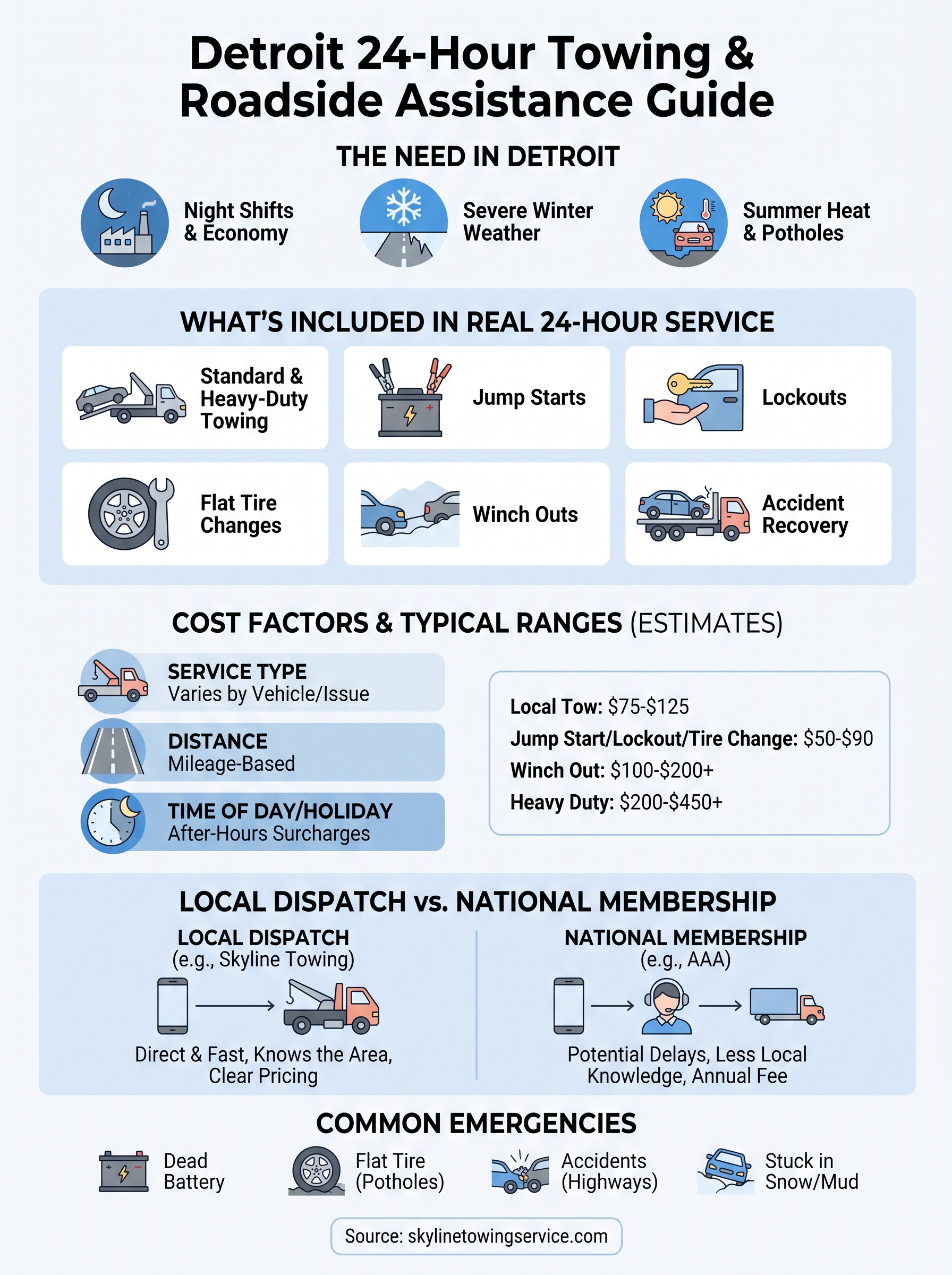
Help is always a call away in Detroit
Breakdowns don’t wait for a convenient time, and neither should your towing company. Detroit drivers deal with potholes, ice, brutal summer heat, and stretches of highway that feel a lot longer at 3 a.m. than they do at noon. Knowing what real 24 hour towing services look like, clear pricing, fast local dispatch, and a full menu of roadside help, means you’re not scrambling to figure things out while you’re stuck on the shoulder of I-75 or the Lodge.
Skyline Towing has been that call for Detroit, Dearborn, Southfield, Taylor, and Livonia drivers for years, dispatching from our headquarters at 6450 E Hancock St around the clock. Save our number before you need it, not after. When your car quits at midnight or your tire blows on Gratiot, reach out to Skyline Towing and get a truck moving your way immediately.