
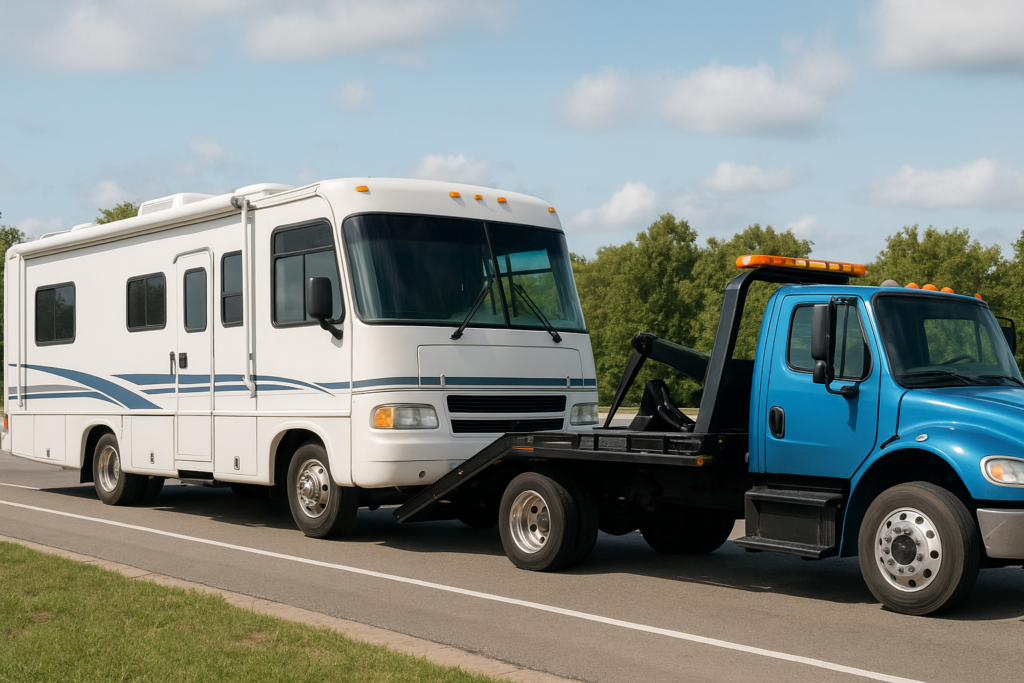
Your RV breaks down on I-94 near the Metro Airport exit, or your camper’s tire blows out on Telegraph Road right before a holiday weekend trip. Now you’re standing on the shoulder searching rv towing service near me on your phone, hoping someone local actually picks up. Most towing companies in Detroit will tell you they handle everything, but RVs and travel trailers need specialized equipment, higher weight capacities, and drivers who know how to secure a 30-foot motorhome without damaging it.
This guide gives it to you straight: what actually qualifies as RV towing, what it costs, and how to find a company nearby that can get to you fast, whether you’re stuck in Dearborn, Southfield, Livonia, or anywhere else in the metro area. We’ll cover the difference between towing a Class A motorhome versus a travel trailer, and what questions to ask before a truck shows up.
Skyline Towing operates out of 6450 E Hancock St in Detroit and runs 24/7 emergency dispatch across the region. Keep reading and you’ll know exactly what to expect before you ever need to make that call.
Why RV towing takes different equipment and expertise
A standard tow truck that pulls sedans off I-75 has no business trying to move a 32-foot Class A motorhome. RVs weigh anywhere from 5,000 pounds for a small travel trailer to over 30,000 pounds for a diesel pusher, and that weight changes everything about how a tow has to happen. Flatbed towing works for most passenger cars, but a lot of RVs simply won’t fit or balance correctly on a standard flatbed, especially anything longer than 26 feet. Get this wrong and you’re not just risking a delay, you’re risking thousands of dollars in frame damage, blown suspension, or a jackknifed trailer sitting sideways on the Southfield Freeway.
The weight problem: why your pickup truck’s tow rating doesn’t apply
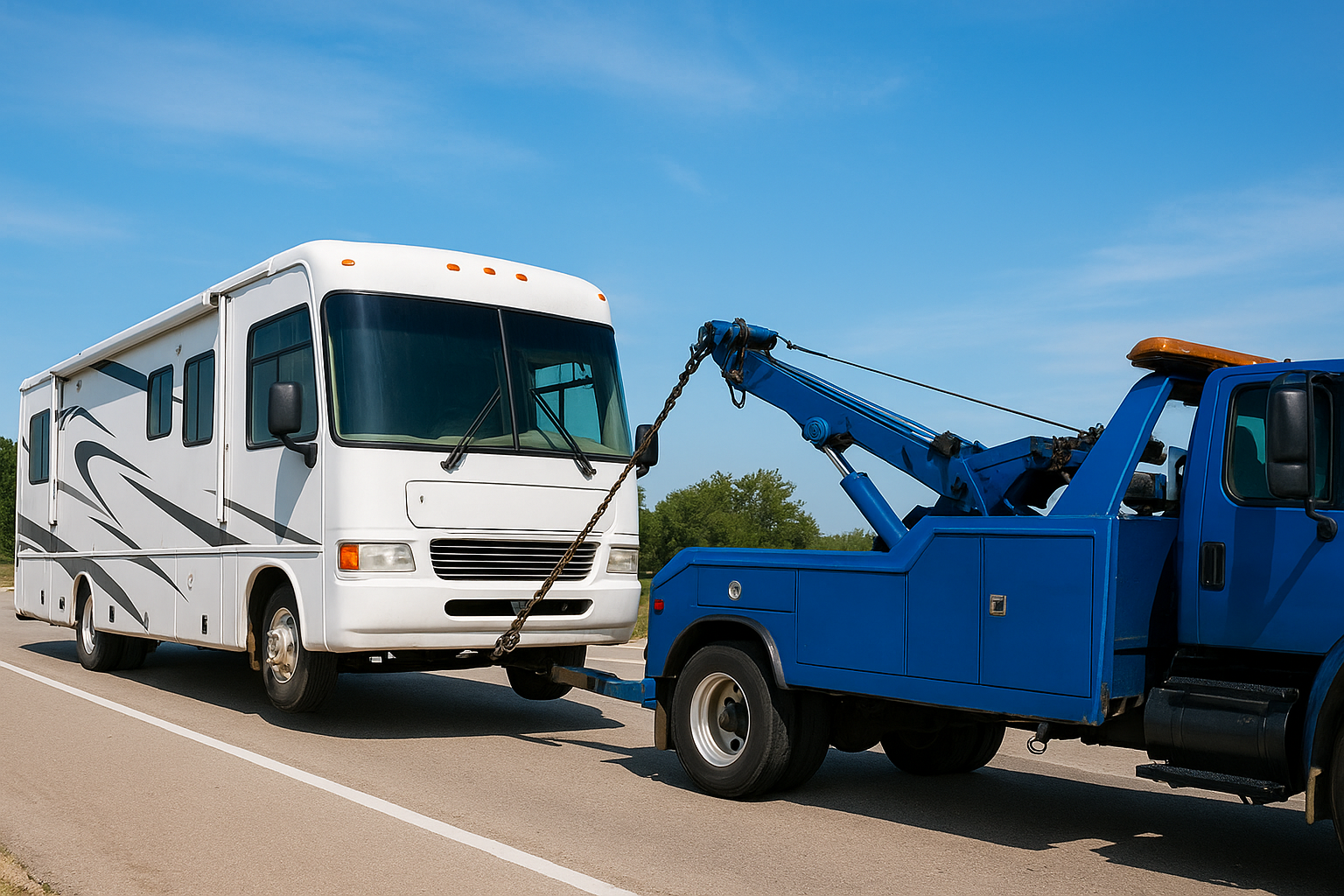
Your truck might be rated to tow your camper on a good day with good tires and a properly hitched load. That rating disappears the moment something breaks. A blown axle, a snapped hitch, or a flat on a dual-wheel setup means the RV can no longer support its own weight correctly, and pulling it with a mismatched vehicle puts everyone on the road at risk. Heavy duty towing equipment exists specifically for this gap, built with higher gross combination weight ratings, reinforced boom systems, and air brake connections that match what your RV already has onboard.
A tow truck rated for sedans will strand you twice: once on the highway, and again when it can’t finish the job.
Class A, Class C, and travel trailers each need different handling
Not every RV gets towed the same way. A Class A motorhome rides on a bus-style chassis and usually needs wheel-lift or specialized flatbed equipment rated for its length and axle spread. A Class C, built on a truck cutaway chassis, tows more like a heavy truck but still needs careful attention to the overhang above the cab. Travel trailers and fifth wheels are lighter but come with their own hitch systems that a driver has to know how to detach and secure safely, especially fifth wheels with a pin box that doesn’t match a standard ball mount.
| RV Type | Typical Weight | Towing Method | Key Challenge |
|---|---|---|---|
| Travel trailer | 5,000-10,000 lbs | Wheel-lift or flatbed | Hitch disconnection, tongue weight |
| Fifth wheel | 8,000-16,000 lbs | Specialized flatbed | Pin box compatibility, height clearance |
| Class C motorhome | 10,000-14,000 lbs | Flatbed or heavy-duty tow | Cab overhang, engine access |
| Class A motorhome | 20,000-30,000+ lbs | Heavy-duty flatbed or specialty rig | Length, air brakes, chassis type |
This is where rv towing service near me searches lead a lot of Detroit residents to the wrong company. Plenty of local outfits handle cars all day but have never secured a fifth wheel or dealt with air brakes on a diesel pusher. Ask directly what equipment they’re sending before you agree to anything.
The equipment gap most towing companies don’t have
Moving a large RV safely usually requires one or more of the following, and a company that can’t confirm this gear on the phone probably shouldn’t be your first call:
- A flatbed rated for the actual length and weight of your RV, not just its footprint
- Air brake hookups compatible with larger motorhomes and fifth wheels
- Wheel-lift equipment for situations where flatbed loading isn’t practical
- Straps and chains rated well above standard passenger vehicle towing gear
- A winch capable of pulling an RV out of soft shoulders, ditches, or gravel lots common along I-96 and M-14
Without this equipment, a tow that should take 30 minutes turns into a two-hour standoff while a driver improvises with the wrong tools, or worse, calls a second truck after damaging your RV trying to make do.
Drivers who actually know RVs
Equipment only solves half the problem. The other half is a driver who has actually secured motorhomes and trailers before and knows the difference between a load-bearing frame point and a fiberglass panel that will crack under a chain. Experienced drivers check tire pressure and axle alignment before hooking up, know how to disconnect propane and battery systems safely, and understand how wind resistance on a boxy motorhome changes handling once it’s up on a flatbed doing 60 on I-94. That kind of judgment comes from doing this work regularly, not from a general towing background. When you’re calling around metro Detroit, ask how many RVs the company tows in a typical month. The answer tells you a lot more than their advertising does.
How to get an RV towing service to you fast in Detroit
Speed matters more with RVs than with a regular breakdown. A sedan on the shoulder of Woodward Avenue is an inconvenience. A 28-foot travel trailer blocking a lane on I-75 through Downriver during rush hour is a safety hazard, and every minute you sit there increases the odds of a secondary accident. Getting a truck to you fast starts with what you tell the dispatcher, not just who you call.
Give the dispatcher details that actually speed things up
Calling and saying "my RV broke down" wastes time both people don’t have. A dispatcher who knows what’s coming can send the right truck on the first trip instead of guessing and sending a flatbed that turns out too short. Have this ready before you dial:
- Your exact location, including mile marker or nearest exit if you’re on a freeway
- RV type and length (Class A, Class C, travel trailer, fifth wheel)
- Estimated weight if you know it, or at least the GVWR from your registration
- What actually failed (blown tire, dead battery, transmission, hitch failure)
- Whether the RV is drivable at all or completely immobile
This single call usually determines whether help arrives in 30 minutes or 90.
Where breakdowns tend to happen around here
Certain stretches of road generate more RV calls than others, and it’s not random. The I-94 corridor near Metro Airport sees heavy traffic weaving that shreds tires on trailers riding low. Telegraph Road’s stop-and-go through Southfield and Redford overheats transmissions on older motorhomes. The Southfield Freeway’s tighter curves catch drivers who misjudge trailer sway. And M-14 heading toward Ann Arbor, along with I-96 further out, has long stretches with soft shoulders that swallow a wheel if you drift off during a tire blowout. Knowing these patterns helps a local company position trucks smarter instead of dispatching blind from a call center three states away.
Why a local dispatch beats a national one
National roadside programs route your call through a call center that then searches for a contractor in your area, sometimes taking 20 minutes just to find someone willing to take the job. A Detroit-based company already knows which trucks are near Dearborn Heights versus Taylor at any given moment, and dispatches directly without the middleman. That difference alone can cut your wait time in half on a busy Friday afternoon.
A local dispatcher who knows the roads beats a national call center every time an RV is stranded on the shoulder.
What to do while you wait
Once you’ve made the call, get everyone out of the RV and away from the traffic lane if you’re on a shoulder, not inside it. Turn on hazards, set out reflective triangles if you carry them, and stay visible but safe. If it’s summer and you’re near Metro Airport or anywhere along I-94, don’t run the generator for AC if there’s any fuel or exhaust concern near a disabled engine. Waiting safely matters just as much as waiting quickly, and a good emergency roadside assistance provider will walk you through this over the phone if you’re unsure.
What RV towing costs in Metro Detroit
Price is usually the first question people ask, and the honest answer is that RV towing costs more than a car tow because everything about the job is bigger. Trucks capable of hauling a 25,000-pound motorhome cost more to buy, insure, and maintain than a standard flatbed, and that gets reflected in the rate. RV towing service near me searches often turn up a low base price that doesn’t hold once the dispatcher hears the actual weight and length involved, so it helps to know what a realistic range looks like before you’re negotiating from the shoulder of I-75.
What actually drives the price up
Several factors combine to set your final bill, and none of them are arbitrary. Distance matters most obviously, since a tow from Dearborn to a dealership in Taylor costs less than one from Livonia all the way to a specialty repair shop near Ann Arbor. Weight and length come next, because a 34-foot Class A needs a bigger rig and sometimes a second truck for support than a compact travel trailer does. Time of day plays a role too, with late-night or holiday weekend calls often carrying a premium the same way emergency plumbers do. Winch-outs from mud, snow, or a ditch along M-14 add labor time on top of the base tow rate.
Typical price ranges around Metro Detroit
Here’s a rough breakdown based on what local jobs actually run, though every situation varies with distance and complexity:
| Service | Typical Cost Range |
|---|---|
| Travel trailer tow (local, under 15 miles) | $150-$300 |
| Fifth wheel tow (local, under 15 miles) | $200-$400 |
| Class C motorhome tow | $250-$500 |
| Class A motorhome tow | $400-$800+ |
| Winch-out or ditch recovery | $100-$300 add-on |
| Long-distance tow (per mile beyond base) | $5-$10/mile |
The cheapest quote over the phone rarely stays the cheapest once the truck actually shows up.
Quotes that sound too good over the phone usually leave something out, whether that’s mileage past a certain radius, a winch-out fee, or an after-hours surcharge that only gets mentioned once the truck is already hooked up.
Hidden costs worth asking about upfront
Before you agree to a job, ask specifically about these charges so nothing surprises you on the invoice:
- After-hours or holiday surcharges, especially for calls after 10 PM or on major holidays
- Mileage rates beyond the first 10 to 15 miles
- Winch-out or recovery fees separate from the base tow
- Storage fees if your RV needs to sit overnight before a shop can take it
- Whether the quote includes both the tow and a drop-off at a specific repair facility
Getting these answers before the truck arrives saves an argument later, and a company confident in its pricing will walk through all of it without hesitation.
Does insurance or a membership cover any of this?
Some RV insurance policies include roadside coverage, but the fine print often caps payouts well below what a real motorhome tow costs, especially for heavy-duty jobs. Check your policy’s specific dollar limit and mileage cap before assuming you’re fully covered, then keep a local company’s number saved anyway for the gap that’s almost always there.
Common RV breakdowns we see around Detroit
Most RV breakdowns follow predictable patterns once you’ve towed enough of them, and Metro Detroit has its own version of these patterns shaped by our roads and weather. Understanding what typically fails helps you catch warning signs early, and it explains why so many rv towing service near me calls cluster around the same few causes every season. Here’s what actually shows up on our dispatch logs most often.
Tire failures top the list
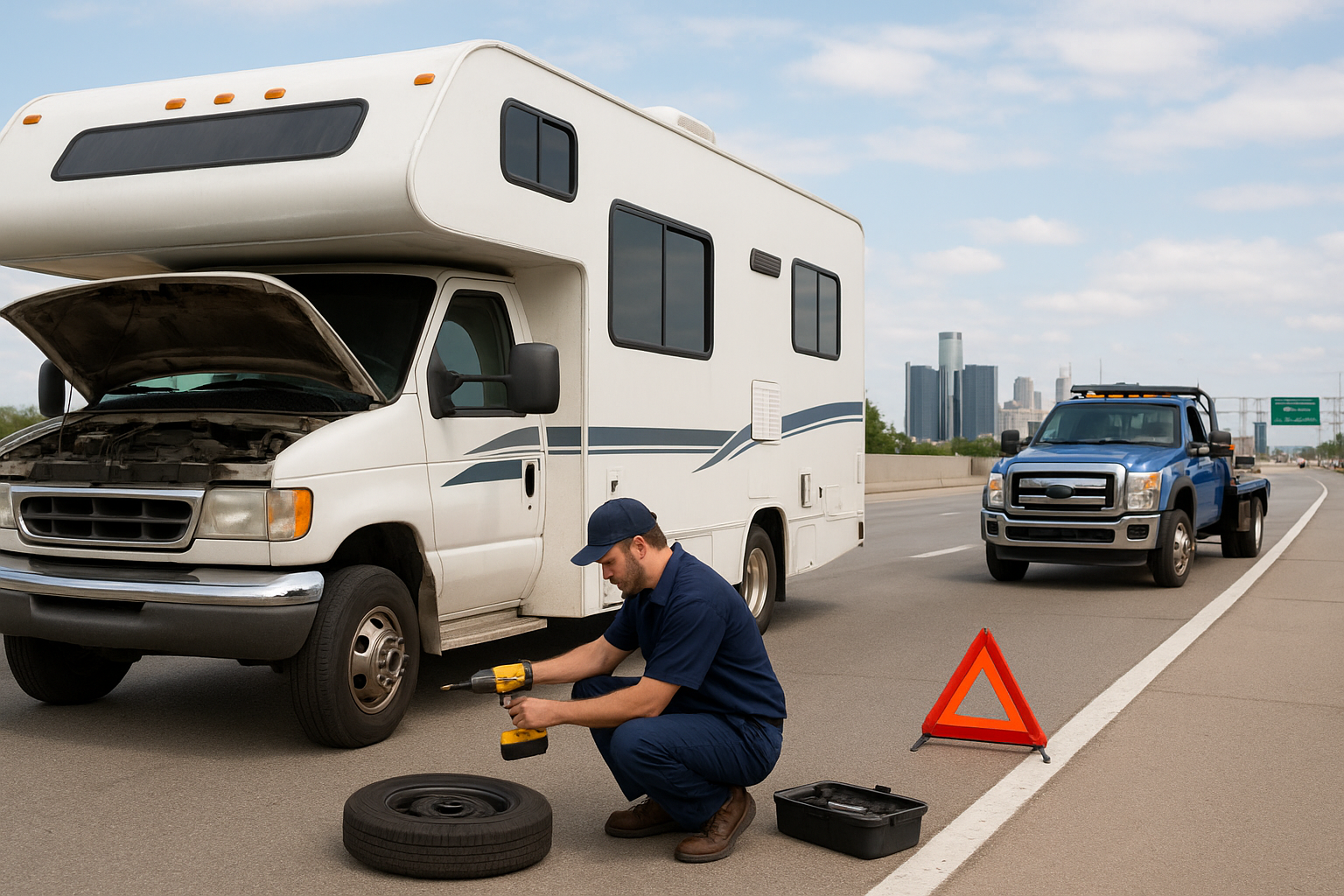
Tires cause more RV breakdowns around here than anything else, and it’s rarely a mystery why. RVs sit parked for months at a time between trips, and tire dry rot sets in from age even when the tread looks fine. Add Michigan’s temperature swings, where a tire can go from a freezing garage to 90-degree pavement on I-94 within an hour, and you get sidewall failures that a car tire would never experience the same way. A blowout on a fifth wheel at highway speed can also cause fender damage or wiring harm underneath, which turns a simple tow into a bigger repair bill.
Battery and electrical failures after storage
Batteries drain fast on RVs that sit unused, especially through a Michigan winter in an unheated driveway or storage lot. Owners head out for a spring trip, turn the key, and get nothing. Dead batteries account for a big share of our calls, particularly in April and May when everyone’s pulling their camper out for the first time since fall. Corroded terminals and parasitic drains from onboard electronics that never fully shut off make this worse, and a jump start doesn’t always fix it if the battery itself has degraded past the point of holding a charge.
Overheating in stop-and-go traffic
Older motorhomes struggle with Detroit’s traffic patterns more than newer ones do. Telegraph Road through Southfield and the backups near the Ambassador Bridge during peak hours put constant strain on cooling systems never designed for that kind of stop-and-go grind. Transmission overheating shows up often in Class C models climbing onto I-75 with a full load of passengers and gear. Once the temperature gauge climbs into the red, continuing to drive risks turning a tow call into a full transmission rebuild.
A blown tire or a dead battery is an inconvenience. Ignoring an overheating warning is how you turn a $300 tow into a $3,000 repair.
Hitch and coupling failures on trailers
Fifth wheels and travel trailers fail differently than motorized RVs, usually at the connection point rather than the engine. Hitch failures happen when a pin box wears out or a weight-distribution setup wasn’t torqued correctly before a trip, and it’s often discovered only when the trailer starts swaying on the Southfield Freeway. Winter adds its own version of this problem, with icy hitches and frozen safety chains that snap under stress on cold mornings along I-96.
Seasonal patterns matter here too. Summer brings tire and cooling failures from heat and heavy loads. Winter brings battery, hitch, and frozen line issues from cold storage and icy roads. Knowing which season you’re in tells you what to check before you ever leave the driveway.
Getting your RV back home safely
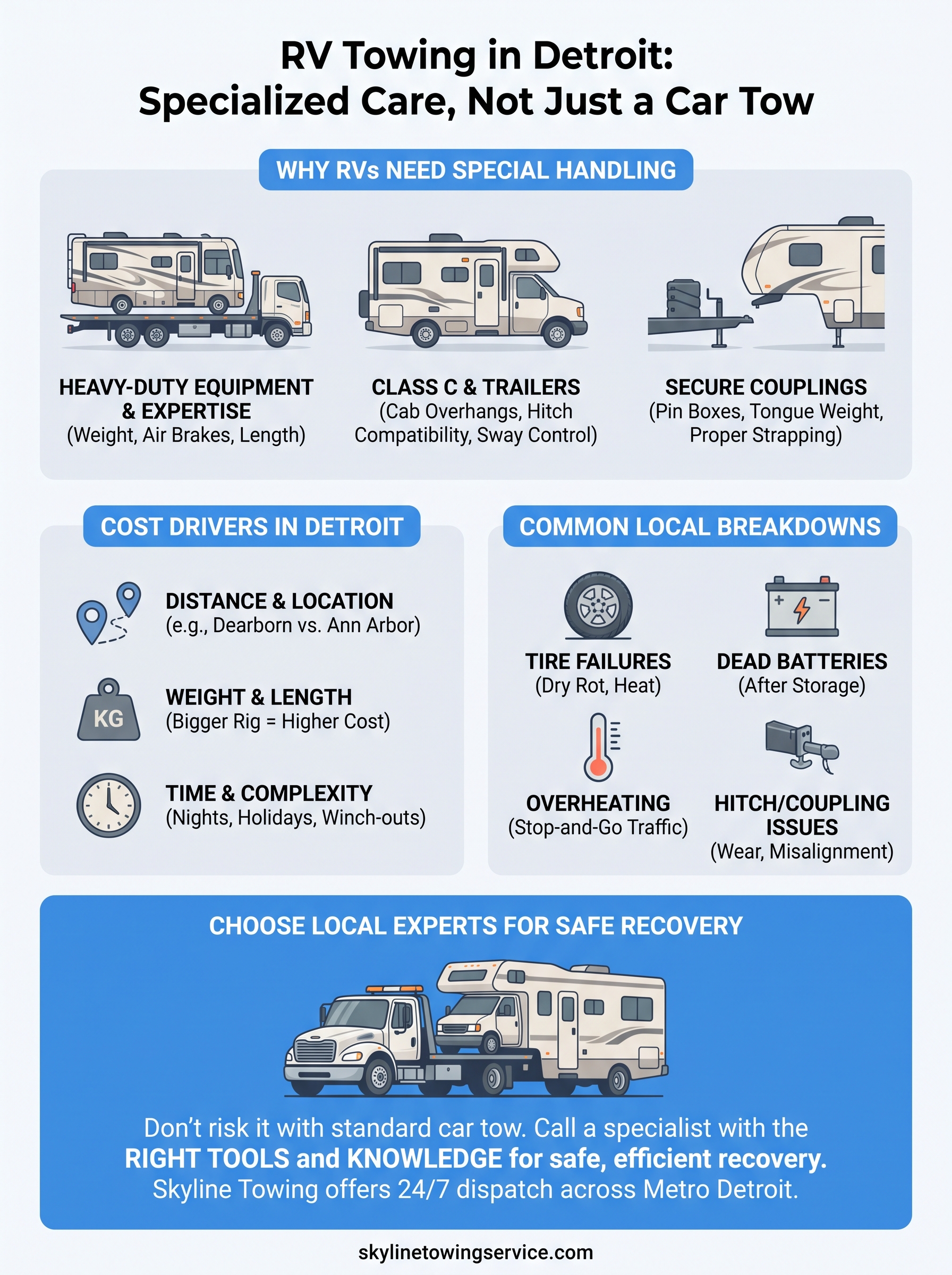
A breakdown on I-94 or a hitch failure on the Southfield Freeway feels overwhelming in the moment, but the fix is usually straightforward once the right truck shows up. RVs need specialized equipment, drivers who actually know how to secure a motorhome or trailer, and a dispatcher who understands Metro Detroit’s roads well enough to send help fast instead of guessing. Cost and wait time both come down to the same thing: calling a company that tows RVs regularly, not one that’s improvising with car-hauling gear.
Next time you type rv towing service near me from the shoulder of Telegraph Road or I-96, you’ll know what questions to ask and what to expect before the truck even arrives. Skyline Towing runs 24/7 out of 6450 E Hancock St in Detroit and covers Dearborn, Southfield, Livonia, and the surrounding metro area. Save the number now, and get in touch with Skyline Towing before your next trip, not during it.