
Your car just broke down on I-94 near Dearborn, or maybe you slid off a patch of black ice on Telegraph Road last winter and need a safe ride for your vehicle. Either way, you’re pulling out your phone and searching for a flatbed towing service near me, and you need someone who actually shows up fast. Not every tow truck is built the same, and for lowered cars, AWD vehicles, motorcycles, or anything with sentimental or financial value, a flatbed is the only smart option.
Here at Skyline Towing, we operate out of 6450 E Hancock St, Detroit, MI 48207, and we’ve handled thousands of flatbed tows across Metro Detroit, from Southfield and Livonia to Taylor and everywhere in between. We know which companies in this area do solid work because we’ve been in the trenches alongside them, responding to the same accidents on the Southfield Freeway and the same dead batteries in Greektown parking garages.
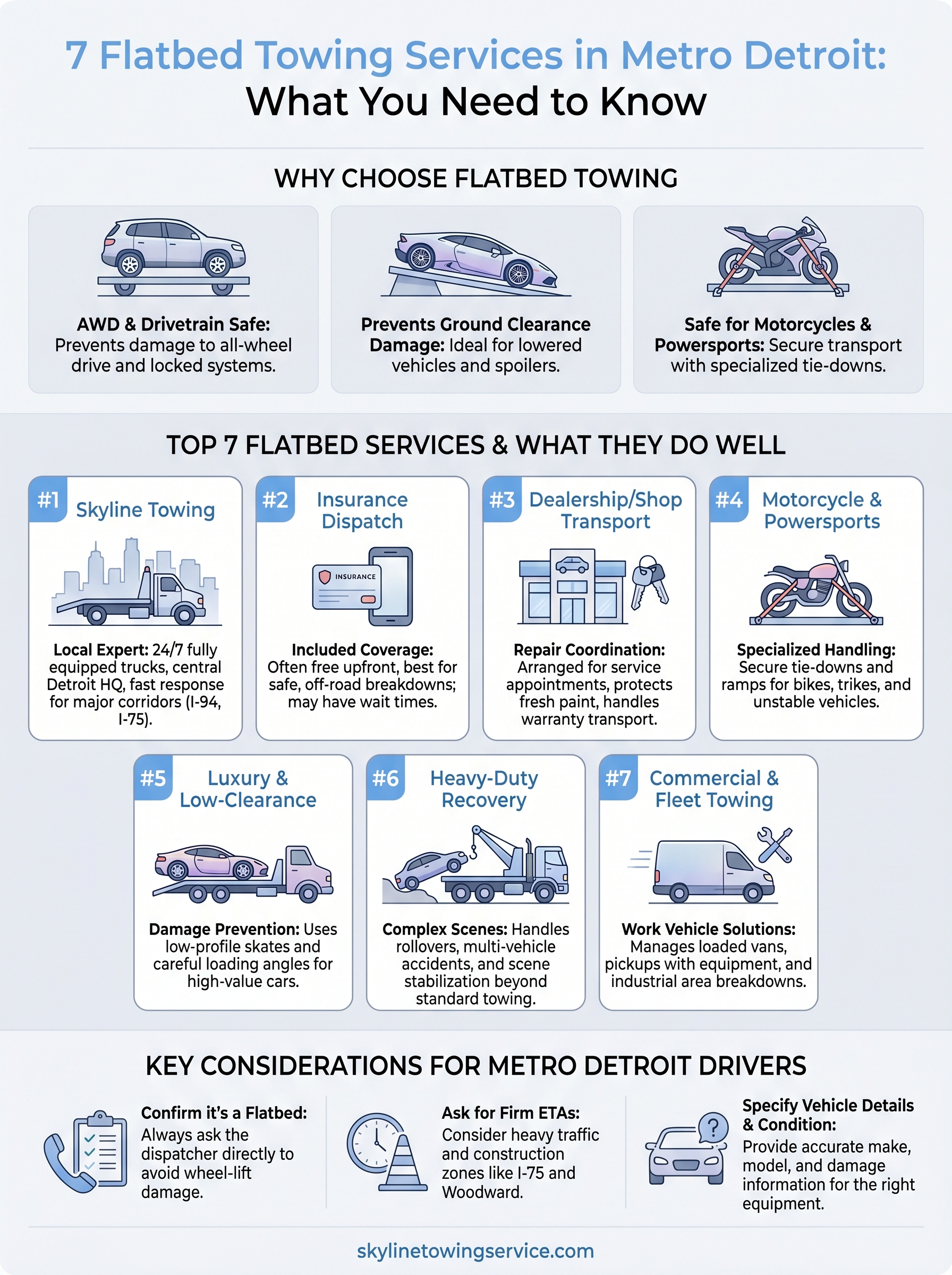
This list breaks down seven flatbed towing services worth calling if you’re a Metro Detroit driver. We’ll cover what each one does well, where they operate, and what to expect when you call. Whether you’re stranded right now or planning ahead for the next Michigan winter, this guide will help you make the right call, literally.
1. Skyline Towing flatbed service
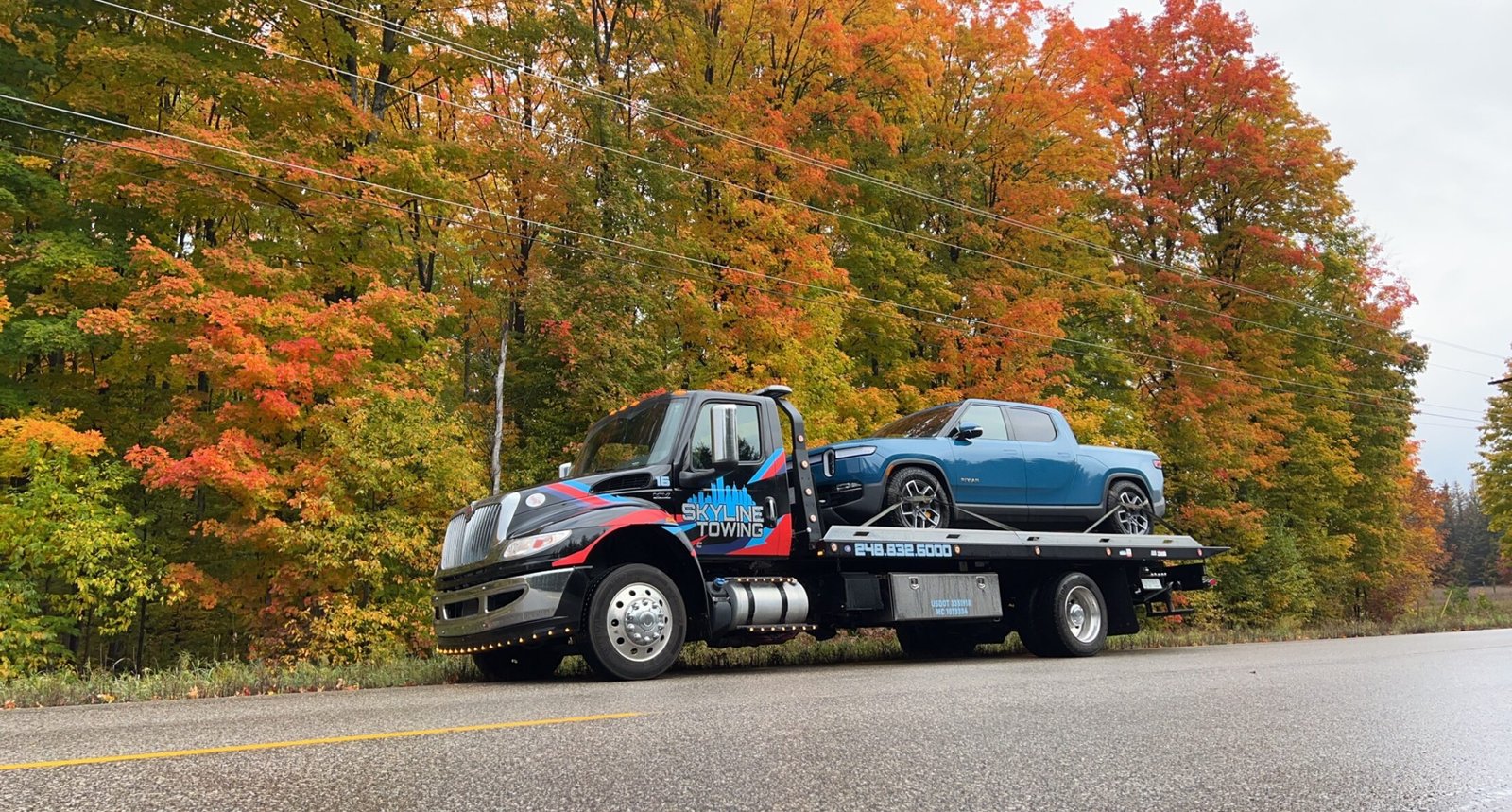
When you search for a flatbed towing service near me in Metro Detroit, Skyline Towing is the local answer. We run fully equipped flatbed trucks 24 hours a day, seven days a week, and our drivers know the roads, the traffic patterns, and the neighborhoods across the entire metro area.
Where Skyline Towing operates in Metro Detroit
Skyline Towing covers Detroit, Dearborn, Dearborn Heights, Southfield, Taylor, and Livonia, along with the broader metro Detroit area. Our drivers work the major corridors daily, including I-94, I-75, the Lodge Freeway, Woodward Avenue, and Telegraph Road. Whether you’re stuck in a Rosedale Park neighborhood or broken down near a strip mall in Taylor, we can reach you.
Dispatch and headquarters at 6450 E Hancock St, Detroit MI 48207
Our dispatch center and headquarters sits at 6450 E Hancock St, Detroit, MI 48207, putting us close to the heart of the metro area. That central location lets us cut response times significantly compared to companies operating out of distant suburbs.
Being based in Detroit means our trucks are already positioned near the corridors where breakdowns happen most, so you’re not waiting on a driver coming from 30 miles out.
When you call, you reach a real local dispatcher who can track your location and route the nearest flatbed truck directly to you.
When a Skyline flatbed makes the most sense
A flatbed is the right call whenever wheel-lift towing could damage your vehicle. AWD cars like a Subaru Outback or an Audi Q5 can’t have only two wheels on the ground without risking drivetrain damage. Lowered vehicles, cars with fresh collision damage from an accident on M-10, or anything with a locked-up brake system all need the flat surface and full-vehicle support that only a flatbed provides.
What Skyline can safely haul on a flatbed
Our flatbeds handle a wide range of vehicles, including:
- Standard passenger cars, SUVs, and pickup trucks
- Motorcycles and powersports vehicles
- Exotics and luxury vehicles requiring extra care during loading
- Light commercial vehicles and work vans
If your vehicle has a disabled drivetrain or non-rolling wheels, our drivers carry the right equipment to load it safely without adding damage on top of what already happened.
What to ask for when you call so the right truck shows up
Tell our dispatcher your vehicle’s make, model, and current condition when you call. Mention whether it runs, whether the wheels roll freely, and whether there is visible damage. If you specifically need a flatbed, say that directly so we don’t send a wheel-lift truck by mistake. Accurate information upfront means the right equipment arrives on the first trip.
Skyline flatbed pricing factors and common add-ons
Flatbed pricing depends on distance, vehicle type, and pickup complexity. A straightforward tow from Southfield to a Detroit-area shop costs less than recovering a vehicle wedged in a tight parking structure or off a ditch on I-75. Common add-ons include after-hours dispatch fees, winching, and extended transport distances. Call us directly for an honest quote before the truck rolls.
2. Flatbed towing through your auto insurance dispatch
Your auto insurance policy may already include roadside assistance coverage that dispatches tow trucks through a contracted provider network. This option can save you money upfront, but navigating the process correctly, especially in Metro Detroit, takes a little preparation on your part.
When insurance-dispatched flatbeds work well
Insurance dispatch works best when your vehicle is safely off the road and you can afford to wait. A breakdown in a Livonia parking lot or a dead engine behind a strip mall in Dearborn are solid fits. The coverage is less practical when you’re on a live freeway shoulder on I-94 or I-75 and need a truck there in under 20 minutes.
How to confirm it is a true flatbed, not wheel-lift
When your insurer confirms the dispatch, ask directly whether the arriving truck is a flatbed or a wheel-lift. Many networks send whatever is available, and that may not protect an AWD vehicle or a flatbed towing service near me situation involving a low-clearance car.
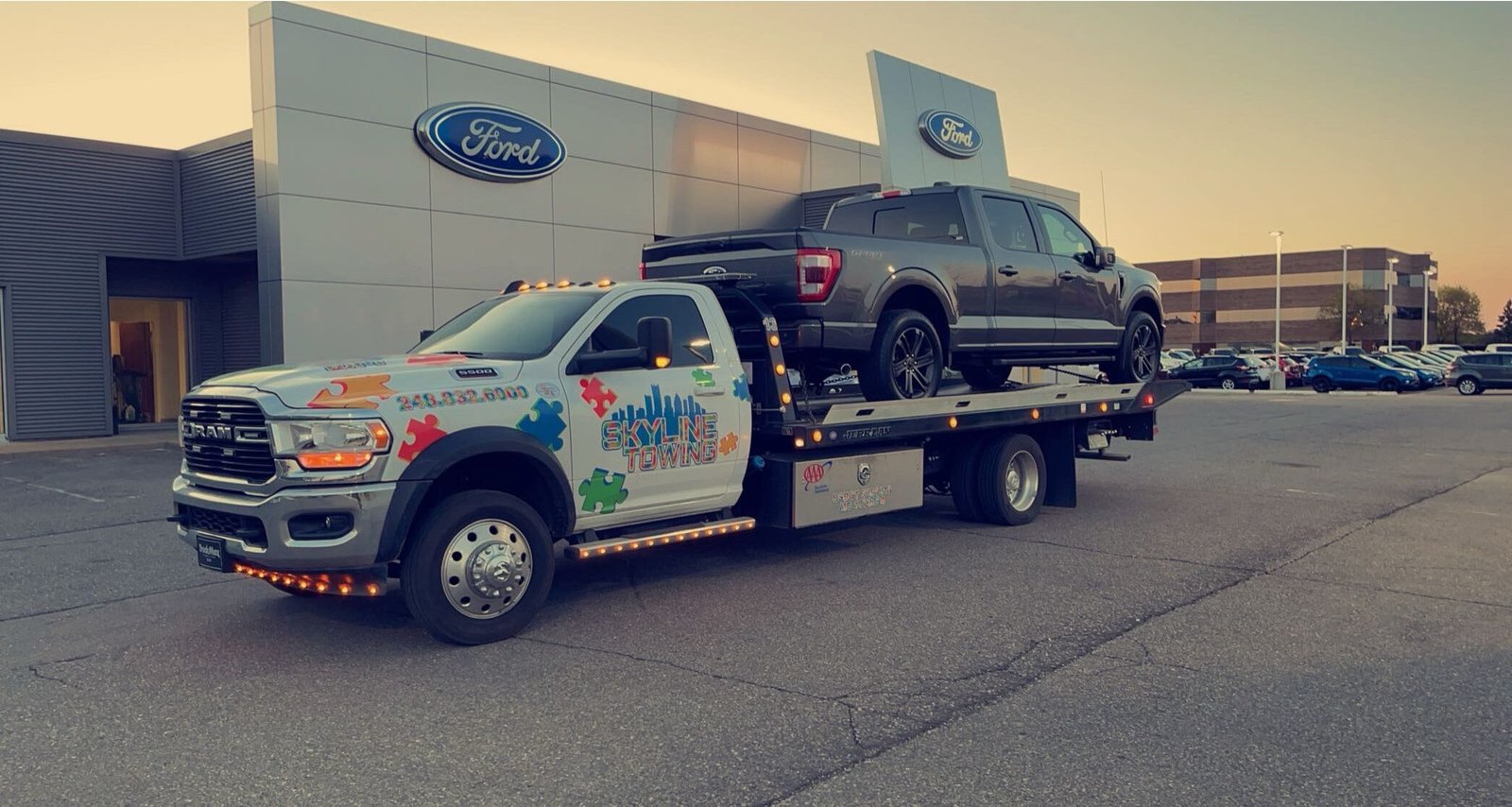
If your vehicle is all-wheel drive or has drivetrain damage, insist on a flatbed before you let the dispatcher finalize the order.
What to ask about ETAs in Detroit traffic and roadwork zones
Metro Detroit construction zones on I-75, the Lodge, and Woodward Avenue can delay contracted drivers significantly. Ask your insurer’s dispatcher for a firm ETA before you commit to waiting, and confirm whether the call center can provide real-time updates if the driver runs late.
How payments, limits, and reimbursements usually work
Most policies cover towing up to a set dollar limit or mileage cap, often between 5 and 15 miles. Any distance beyond that cap comes out of your pocket at the tow company’s standard rate. Save every receipt, because some insurers will reimburse out-of-pocket costs when you file after the fact.
Common problems and how to avoid delays
The most common breakdown in this process is miscommunication between the insurance call center and the towing company. Give your vehicle’s make, model, condition, and exact location twice, once to the insurer and once directly to the driver when they confirm arrival.
3. Dealership and collision center flatbed transport
Dealerships and collision shops often arrange their own flatbed towing service near me options when you drop a car for repairs or pick one up after a major fix. Understanding how this process works in Metro Detroit keeps your vehicle protected and your schedule on track.
Best fit situations for dealer or shop arranged flatbeds
This option works best when a dealer or body shop needs your vehicle transported between locations without putting miles on it, or when a repaired car has a fresh paint job that road debris could damage. It also fits well when financing, warranty, or insurance claims require documented vehicle transport rather than a customer-driven delivery.
How pickups work from lots, garages, and tight storage yards
Many Metro Detroit dealerships keep vehicles in cramped indoor storage bays or fenced overflow lots, which can complicate flatbed loading angles. Ask the shop contact whether the flatbed driver will have clear access to the vehicle before the truck arrives, because repositioning in a tight lot adds time and sometimes an extra fee.
What to ask about damage prevention for low-clearance cars
Before any loading begins, confirm with the driver that they plan to use loading ramps and wheel skates rather than dragging the front bumper across the deck edge. Sports cars and lower-riding sedans are especially vulnerable here.
If the shop’s contracted driver shows up without proper loading equipment for your vehicle’s clearance, it is completely reasonable to pause and call a different provider.
Timing tips for busy corridors like Woodward and Gratiot
Woodward Avenue and Gratiot Avenue see heavy traffic during rush hours and weekend events, which can push flatbed ETAs back 20 to 40 minutes. Schedule pickups for mid-morning on weekdays whenever the timeline allows to avoid the worst congestion.
Typical pricing models and when rates jump
Dealer and shop flatbed rates often run on flat trip fees rather than per-mile billing, but rates climb when after-hours pickups, tight-access loading, or long-distance transport to shops outside the immediate metro area are involved. Always get a written quote before the truck leaves the yard.
4. Motorcycle and powersports flatbed towing
Motorcycles, trikes, and powersports vehicles need specialized handling that most standard tow trucks simply cannot provide. When you need a flatbed towing service near me for your bike, the right setup matters as much as the driver’s experience.
When to choose a flatbed over a trailer or wheel-lift
A flatbed is the safest option for motorcycles any time the bike cannot roll freely or has suspension or frame damage. Wheel-lift trucks are designed for four-wheeled vehicles, and trailers introduce sway risks on Metro Detroit highways like I-94 and I-75 during heavy traffic. A flatbed keeps your bike level and stationary for the entire trip.
- Damaged or locked-up front forks: flatbed only
- Bikes with fairing or bodywork damage that cannot be strapped without adding damage
- Any powersports vehicle that cannot hold a vertical position on its own
Tie-down and loading requirements for bikes and trikes
Your driver needs at least four secure anchor points to properly restrain a motorcycle on a flatbed deck. Trikes and three-wheeled powersports vehicles require additional strap positioning to account for their wider stance. Ask the driver to show you the complete tie-down layout before the truck pulls away.
Best practices for towing in rain, wind, and early spring cold
Michigan weather creates real transport risks. Strong spring wind gusts along Telegraph Road or on the Lodge Freeway can shift an improperly secured bike mid-transit. Early spring cold also stiffens rubber tie-down straps, reducing their grip over time.
Always confirm your driver re-tightens all straps after the first mile of travel, especially in wet or windy conditions.
What to ask about ramps, soft straps, and wheel chocks
Before your driver loads the bike, ask whether the truck carries non-marring soft loop straps rather than metal hooks that scratch chrome and frame tubes. Also confirm the ramp weight rating covers your bike, since some flatbed ramps are rated for cars, not heavier touring bikes or trikes.
Pricing factors for motorcycles and specialty vehicles
Motorcycle flatbed rates in Metro Detroit run higher than standard passenger car tows because of the extra equipment, loading time, and skill required. Pricing also increases for after-hours calls, long-distance transport, or recovery situations where the bike is not upright when the driver arrives.
5. Flatbed towing for luxury and low-clearance cars
Luxury cars and low-clearance vehicles are the most common casualties of improper towing methods in Metro Detroit. Whether it’s a BMW 4 Series, a lowered Dodge Charger, or a Ferrari brought in for a weekend cruise, these vehicles need a flatbed towing service near me that treats them as a priority rather than just another pickup.
Common Metro Detroit scenarios that call for a flatbed
Metro Detroit roads create real problems for low-clearance vehicles. Potholed side streets in Detroit neighborhoods and steep parking garage ramps in Midtown can bottom out a vehicle before it even reaches the tow truck. Wheel-lift rigs will drag front spoilers and chin lips across pavement during loading, which turns a mechanical issue into a body damage claim on top of everything else.
Loading angles, dollies, and clearance issues to watch for
Your driver needs to position the flatbed at a shallow approach angle and use wheel dollies when the vehicle cannot roll freely onto the deck. Steep loading angles put the front fascia in direct contact with the ramp edge, which scratches paint and cracks aftermarket body kits.
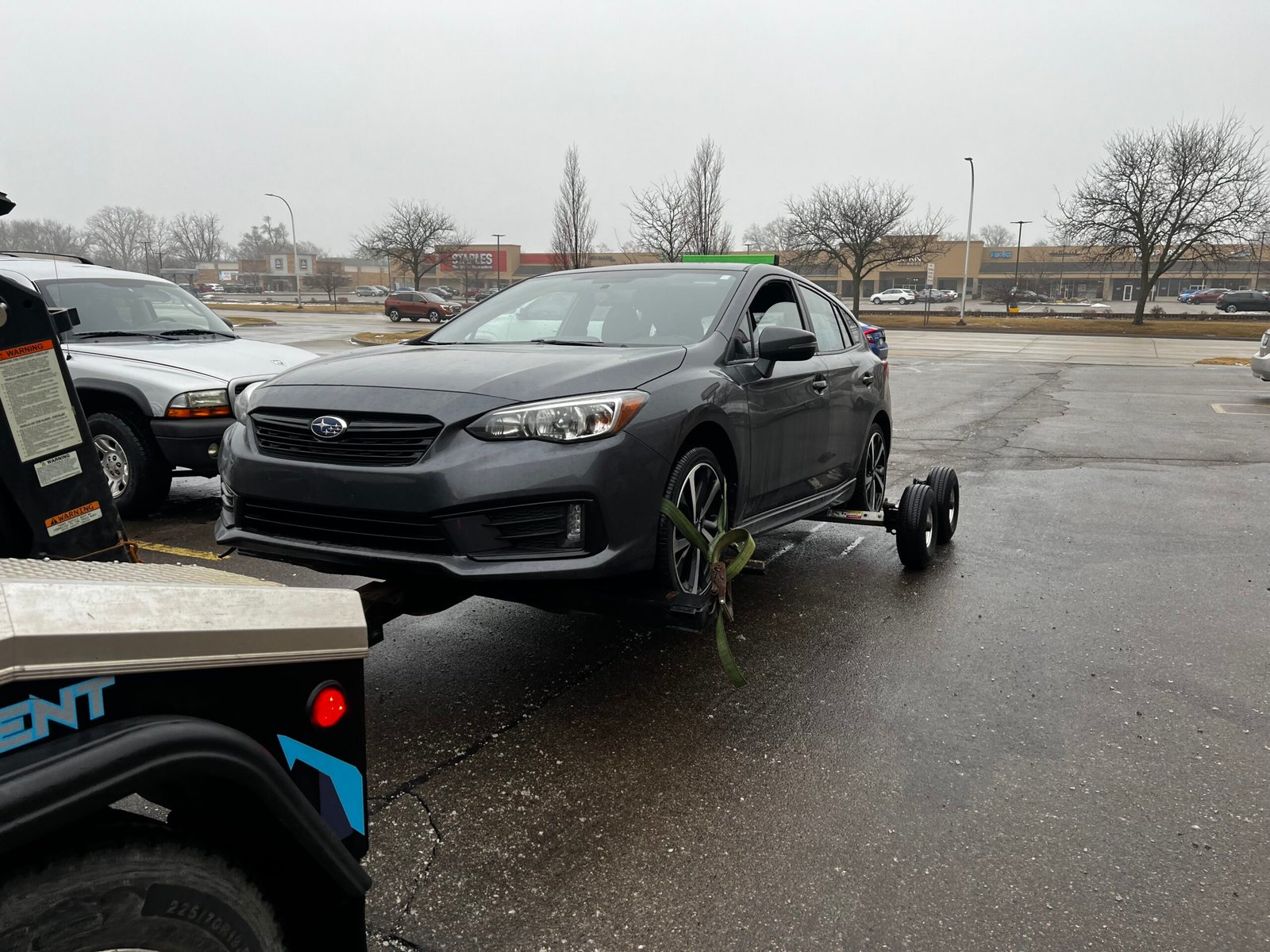
If the driver does not mention dollies before loading a car with less than four inches of ground clearance, stop the process and ask directly.
What to ask about winching, skates, and curb-safe loading
Ask your driver whether the truck carries low-profile wheel skates and a cable winch rated for your vehicle’s weight. Confirm the winch cable attaches to a proper frame or tow hook, not a bumper cover, which can pull free under load.
Drop-off planning for high-traffic areas like Downtown and Midtown
Dropping a luxury vehicle in Downtown Detroit or Midtown requires planning around parking restrictions and heavy pedestrian traffic. Coordinate the exact drop point with your shop or destination before the driver leaves your pickup location.
Pricing factors for high-value vehicles and extra care
Extended load time, specialty equipment, and careful handling all push rates higher for luxury and low-clearance vehicles. Expect to pay a premium over standard passenger car pricing, particularly for after-hours calls or drops in congested areas.
6. Heavy-duty recovery teams that also run flatbeds
Some towing situations go beyond what a standard flatbed can handle alone. Heavy-duty recovery teams bring specialized equipment, larger crews, and the training needed to stabilize serious accidents before any transport begins. When you need a flatbed towing service near me that can also manage a complex scene, a recovery-capable company is the right call.
When to call a recovery outfit for a flatbed tow
You need a recovery team rather than a standard flatbed when your vehicle is not in a stable, upright position or when the situation involves multiple vehicles. Rollovers on I-94 near the Dearborn interchange, vehicles pinned against guardrails on the Lodge, or anything that requires uprighting before it can be loaded all exceed standard flatbed scope.
If your vehicle is on its side or partially off the road surface, do not let a standard flatbed driver attempt the load without the proper recovery equipment on scene.
Multi-vehicle incidents and freeway safety on I-94, I-75, and M-10
Multi-vehicle crashes on Metro Detroit freeways create chaotic scenes where coordinating equipment, blocking traffic, and clearing the road quickly all happen at once. Recovery teams work alongside Michigan State Police and MDOT to manage lane closures and protect everyone on scene during the process.
What to ask about scene control and accident coordination
Ask the recovery operator whether their team carries traffic control equipment and barrier lighting for nighttime or low-visibility situations. Confirm they communicate directly with law enforcement on scene rather than waiting for instructions that may slow the process down.
Storage, release, and after-hours drop-off considerations
After a recovery tow, your vehicle often goes to a secured storage yard rather than directly to a shop. Ask about release hours, daily storage fees, and whether after-hours drop-off at your preferred repair facility is an option before the truck leaves the scene.
Pricing factors for recovery-style dispatches
Recovery dispatches cost more than standard tows because of the equipment, crew size, and time required. Rates factor in scene complexity, vehicle weight, and any required equipment like air bags or winch extensions used during the stabilization phase.
7. Commercial and fleet flatbed towing for work vehicles
Work vehicles break down at the worst possible times, and a standard tow truck often lacks the capacity or setup to handle a loaded cargo van or a heavy pickup with equipment on board. When your crew depends on that vehicle to finish a job, finding a reliable flatbed towing service near me moves the whole operation forward faster than waiting on an undersized rig.
Best fit for vans, pickups, and light commercial vehicles
Flatbed towing fits cargo vans, full-size pickup trucks, and light commercial vehicles best when the drivetrain is compromised or the vehicle cannot be safely wheel-lifted without damaging the undercarriage. Work trucks often carry aftermarket equipment, ladder racks, or toolboxes that shift the vehicle’s center of gravity, making flatbed loading the only safe option.
Common vehicles that fit this category well:
- Cargo and passenger vans with disabled drivetrains
- Full-size pickups with locked differentials or suspension damage
- Light commercial box trucks under flatbed weight limits
How to handle after-hours breakdowns in industrial areas
Industrial zones in Detroit, Dearborn, and Taylor tend to be poorly lit and sparsely trafficked after normal business hours, which complicates breakdown situations fast. Call a dispatcher who knows exact cross-streets and industrial park access points rather than just a general address, because GPS often fails inside large industrial complexes.
Giving your dispatcher a landmark or gate number in addition to your address cuts response time significantly in industrial zones.
What to ask about GVWR, load weight, and cargo on board
Before the truck arrives, tell the dispatcher your vehicle’s GVWR and whether it carries tools, equipment, or cargo on board. A flatbed rated for a standard pickup may not safely transport a van loaded with construction materials without exceeding the deck’s weight rating, which creates both a safety risk and a liability problem.
Routing and drop-off tips for Dearborn, Southfield, and Livonia
Dearborn’s industrial corridors and Southfield’s commercial districts see heavy truck traffic during morning and late afternoon hours. Schedule drop-offs at fleet yards or repair shops for mid-morning on weekdays to avoid congestion delays that push your vehicle’s downtime even further.
Pricing structures for fleet calls and repeat service
Fleet operators who call regularly can often negotiate account-based pricing or priority dispatch agreements with local towing companies. Ask about flat-rate contracts or monthly billing options if your business runs multiple vehicles across Metro Detroit on a consistent basis.
Next Steps
You now have a clear picture of every major flatbed towing service near me option available to Metro Detroit drivers. From insurance dispatch to motorcycle specialists and fleet operators, the right call depends on your vehicle type, your location, and how fast you need help on the ground.
Skyline Towing runs 24/7 flatbed service across Detroit, Dearborn, Southfield, Livonia, Taylor, and the surrounding metro area, dispatching from our headquarters at 6450 E Hancock St, Detroit, MI 48207. Our drivers know these roads, these neighborhoods, and exactly what it takes to load your vehicle safely without adding damage to an already stressful situation.
Save our number before you need it, because scrambling to find a reliable tow company from the shoulder of I-94 is not the moment you want to be doing research. When you’re ready to book or just want a quick quote, contact Skyline Towing and we’ll get the right truck headed your way.